 Is Now Vyapar TaxOne | Same Trust, New Name!
 AI Weapon for Financial Soldiers


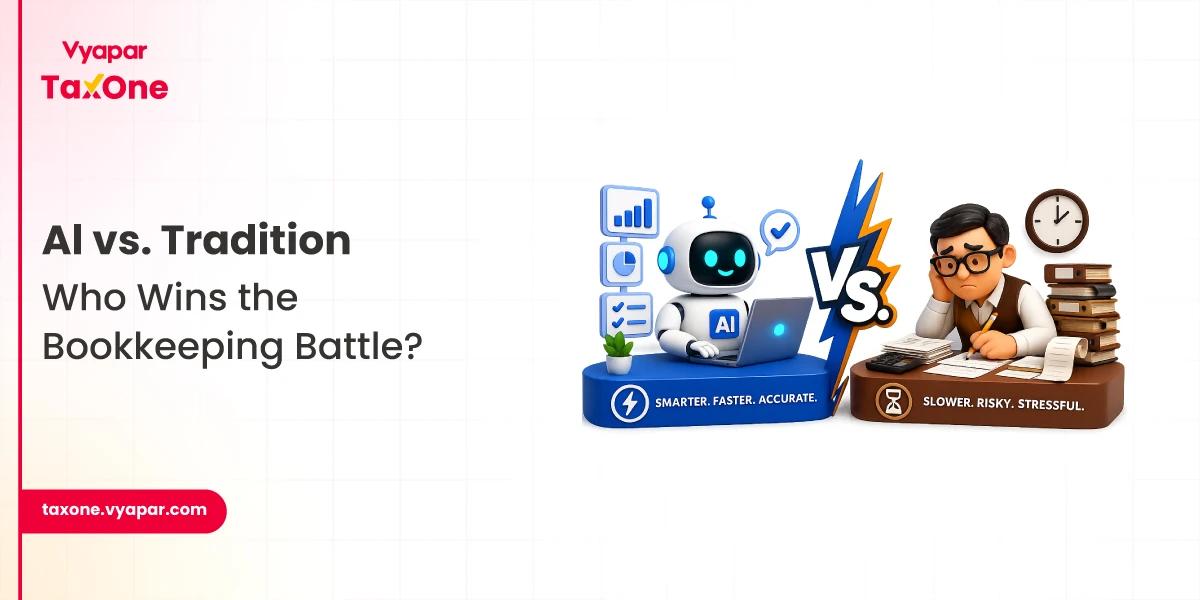
Bookkeeping is no longer limited to manual data entry and spreadsheets. Today, businesses can use AI-powered tools to automate repetitive work such as invoice capture, transaction categorisation, bank reconciliation, and routine reporting.
That has led to an important question: AI vs Traditional Bookkeeping, which one is better?
The honest answer is that it is not a simple either-or decision. AI can improve speed, consistency, and efficiency, but traditional bookkeeping still plays a critical role in review, interpretation, exception handling, and financial decision support. For most businesses, the smartest approach is not replacement. It is a collaboration.
In this guide, we will break down the biggest myths, explain the real differences, and help you decide when AI, traditional bookkeeping, or a hybrid model makes the most sense.
Traditional bookkeeping relies heavily on human input. A bookkeeper records transactions, reviews documents, reconciles accounts, corrects errors, and helps maintain accurate financial records.
This method offers context, judgment, and flexibility, especially when records are incomplete or business situations are unusual.
AI-powered bookkeeping uses automation and pattern recognition to handle recurring accounts tasks faster. It can read invoices, match transactions, suggest ledger categories, detect anomalies, and generate reports in far less time than manual processes.
The key difference is this:
So when comparing AI vs. traditional bookkeeping, the real question is not which system is smarter overall. The better question is which parts of bookkeeping should be automated and which parts still require human expertise.
AI is especially useful for high-volume, rule-based bookkeeping tasks. These usually include:
For businesses that handle a large number of transactions every month, this can save significant time and reduce processing delays.
Even the best automation has limits. Traditional bookkeeping remains important when businesses need:
Software can process numbers. A skilled bookkeeper understands what those numbers actually mean.
Reality: AI is more likely to replace repetitive tasks than entire bookkeeping roles.
Bookkeepers do much more than enter data. They review inconsistencies, resolve missing information, understand business context, and support better financial decisions. Businesses still need human oversight to verify outputs and manage exceptions.
A better way to think about AI is this: it helps bookkeepers do higher-value work instead of spending hours on repetitive admin.
Reality: AI is only as reliable as the data, rules, and review process behind it.
If invoices are uploaded incorrectly, bank feeds are incomplete, vendors are mapped the wrong way, or business rules are poorly configured, the output can still be wrong. Automation can reduce manual errors, but it does not eliminate the need for review.
Accuracy improves most when AI and human validation work together.
Reality: Traditional bookkeeping can feel slower, but it often performs better in complex or messy situations.
When records are incomplete, tax treatment is unclear, or historical books need cleanup, human expertise is usually more effective than fully automated processing. Traditional bookkeeping may take longer in such cases, but the added review can prevent bigger problems later.
Reality: Small and mid-sized businesses can benefit too.
AI tools are no longer limited to large enterprises. Many smaller businesses use automation to reduce repetitive work, improve visibility, and free up time for growth. The value usually depends less on company size and more on transaction volume, process maturity, and the need for faster reporting.
Reality: The strongest setup is often a hybrid one.
In many real-world cases, AI handles data-heavy processes while bookkeepers review outputs, resolve exceptions, and guide decisions. This model combines speed with accountability.
AI and traditional bookkeeping aren’t competing forces; they’re complimentary.
Here’s how they can work together:
Many businesses already use AI to support, not replace, their bookkeepers.
This collaborative approach ensures the best of both worlds—speed and precision from AI, combined with human judgment and expertise.
Before switching to AI-based workflows, ask the following:
1. How clean is your data?
Poor input leads to poor output. If your records are inconsistent, automation may amplify problems instead of solving them.
2. Who reviews the output?
AI should not operate without accountability. A review workflow is essential for catching misclassifications, duplicates, and exceptions.
3. Can the system handle your business model?
A tool that works well for a simple retail business may not fit a company with layered billing, project accounting, or compliance-heavy operations.
4. Does it integrate with your current systems?
The best bookkeeping setup should connect smoothly with your accounting software, reports, and document workflows.
5. Is there a clear audit trail?
You should be able to understand what was automated, what was edited, and who approved the final output.
The future of bookkeeping is not a battle between machines and professionals. It is a workflow where each does what it does best.
AI reduces manual effort. Bookkeepers provide review, interpretation, and control. Together, they create a faster and more reliable process.
That is why the most practical conclusion in the AI vs Traditional Bookkeeping debate is this: AI improves bookkeeping, but human expertise keeps it accurate, useful, and trustworthy.
No. It can transform how bookkeeping is done, but it cannot fully replace human judgment, financial context, and professional accountability.
If your goal is speed alone, AI may look like the winner. If your goal is accuracy, clarity, and better decision-making, a hybrid approach is usually stronger.
When evaluating AI vs. traditional bookkeeping, the best choice is rarely total automation or total manual work. The best choice is the balance that fits your transaction volume, complexity, and need for oversight.
AI is better for repetitive, high-volume tasks. Traditional bookkeeping is better for judgment, review, and complex financial situations. Most businesses benefit from using both.
AI can automate parts of bookkeeping, but it cannot fully replace the human review, interpretation, and decision support that businesses still need.
It can be, as long as the business uses the right tool, has clean records, and includes human review in the workflow.
The biggest benefits are speed, reduced manual work, faster reconciliation, and improved efficiency in routine processes.
Its main limitations include weak handling of edge cases, dependence on clean data, and lack of human judgment in complex financial decisions.


Get started today and simplify your accounting process!