 Is Now Vyapar TaxOne | Same Trust, New Name!
 AI Weapon for Financial Soldiers


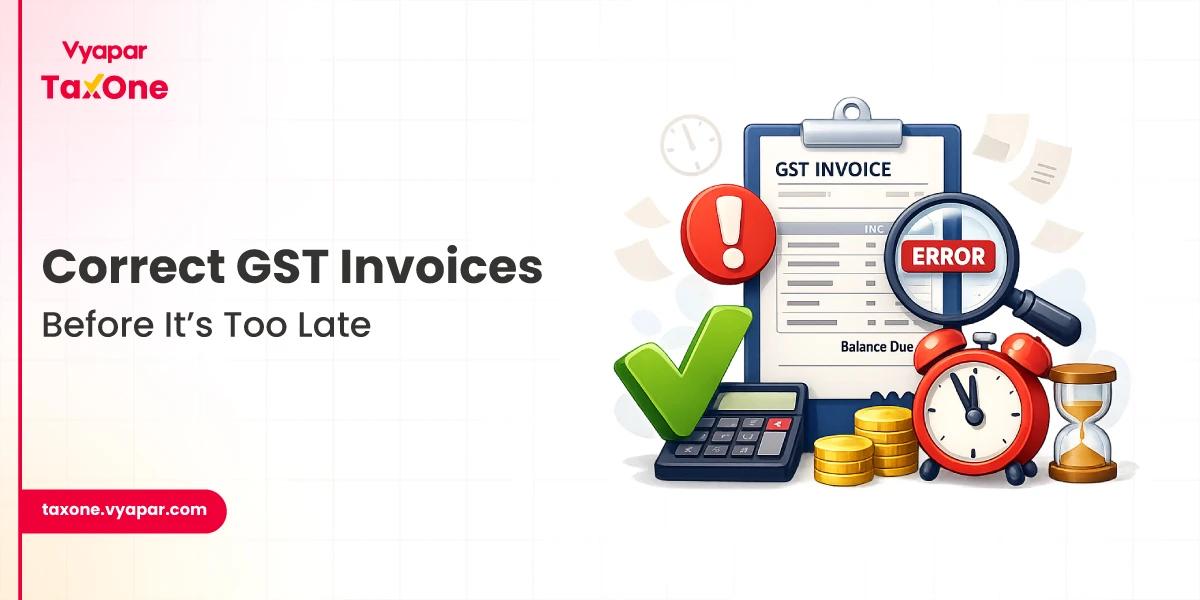
Invoice errors in GST returns are common, especially when businesses handle high invoice volumes, multiple branches, or data from different systems. A wrong GSTIN, missing invoice, incorrect taxable value, or wrong tax amount can affect outward supply reporting and create unnecessary pressure before GSTR-3B filing.
That is where GSTR-1A becomes useful. It allows businesses to correct invoice-level mistakes for the same tax period after filing GSTR-1 and before filing GSTR-3B. For tax professionals, this creates a short but valuable correction window.
This blog explains the step-by-step process to file GSTR-1A, the common compliance challenges around invoice corrections, and how Vyapar TaxOne's GST can support better GSTR-1 filing, reconciliation, and review.
GSTR-1A is an optional return facility that helps taxpayers:
In simple terms, if a business discovers an invoice error after filing GSTR-1, GSTR-1A offers a way to fix it within the same reporting cycle.
For tax professionals, this is important because outward supply errors can lead to:
GSTR-1A helps reduce those risks, but only if used carefully and within the available window.
Businesses should consider GSTR-1A when errors are identified after GSTR-1 filing but before GSTR-3B filing.
Common situations
This includes errors in:
Sometimes, a B2B or B2C invoice is left out while preparing GSTR-1. GSTR-1A helps add such missing records.
A mismatch may appear only after comparing:
Many tax teams detect errors during final liability review. GSTR-1A becomes useful in such cases, provided GSTR-3B has not yet been filed.
Before using GSTR-1A, it is important to understand the compliance boundaries.
| Point | What to Remember |
|---|---|
| Purpose | Correct or add outward supply details for the same tax period |
| Timing | Available after GSTR-1 filing and before GSTR-3B filing |
| Nature | Optional facility |
| Frequency | Can be filed only once for a tax period |
| Use case | Invoice corrections, omissions, and supply-level amendments |
Practical takeaway
Because GSTR-1A can be filed only once, professionals should avoid using it in a rushed or partial manner. The better approach is first to complete a proper review, then file all required corrections together.
Start by checking the filed GSTR-1 against the business records. The review should not be limited to totals. It should focus on invoice-level accuracy.
Check the following:
This first review is critical because GSTR-1A should not be used casually. It is a one-time correction opportunity for that period.
After reviewing GSTR-1, compare it with:
This step helps identify whether the issue is:
Why this matters
Many businesses do not find mistakes while preparing GSTR-1. They find them only when books and return data are matched side by side.
Not every error can be pushed through GSTR-1A. Before proceeding, confirm that:
If the issue relates to a different period, the treatment may be different.
Once the error is identified, assess its effect on output tax liability.
Review whether the correction changes:
This step helps tax professionals understand the impact before the corrected data flows into GSTR-3B.
After GSTR-1 has been filed, access GSTR-1A for the relevant period on the GST portal.
At this stage, the taxpayer can begin making corrections to the outward supply data already furnished.
Now enter the required corrections.
This may include:
Accuracy is extremely important here. Recheck every field before moving ahead.
Before filing GSTR-1A, perform a final review.
A strong review checklist includes:
A short review at this stage can prevent a much bigger issue later.
This is the final and most time-sensitive step. Once GSTR-3B for the same period is filed, the GSTR-1A correction window closes.
Best practice
Do not rush to file GSTR-3B if material outward supply mismatches are still unresolved.
Even though the process sounds simple, the real difficulty usually comes from the data environment.
1. Fragmented data sources
Businesses often work with:
When data is spread across multiple systems, invoice mistakes become harder to detect early.
2. Last-minute compliance pressure
Many teams finalise GSTR-1 close to the due date. Reconciliation then happens late, leaving very little time for correction before GSTR-3B.
3. Manual review overload
Tax teams managing multiple GST registrations often review invoices manually. This increases the chance of missing:
4. Growing need for invoice accuracy
As GST compliance becomes more system-driven, businesses cannot rely on correction at a later stage. Clean reporting in the first attempt is becoming more important.
Vyapar TaxOne's GST automation feature can help tax professionals strengthen their GSTR-1 filing process by improving pre-filing review and reconciliation.
Instead of treating invoice correction as only a portal task, professionals can use a reconciliation-led workflow to detect issues earlier.
Reconciliation support
Vyapar TaxOne helps businesses compare GST-related data across records and identify mismatches before they become filing problems.
Validation before filing
A major advantage of using a GST reconciliation tool is validation. It helps reduce manual oversight and improves the quality of the data used for return preparation.
Data handling from common business systems
Since businesses often work through Tally, Excel, and Vyapar, a centralised review process becomes useful for reducing mismatches.
Better control for tax professionals
For CA firms and in-house tax teams handling multiple clients or registrations, a structured reconciliation platform can improve consistency and speed.
A good GST tool should not only help after an error is found. It should help reduce the chance of that error occurring in the first place.
Where Vyapar TaxOne adds value
Example
Suppose a business uploads outward supply data from Tally and compares it with GST reporting records. If a few B2B invoices are missing or one GSTIN is wrongly mapped, these issues can be detected before filing the return. That reduces the need to depend on GSTR-1A later.
GSTR-1A is useful, but it should remain a correction tool, not a regular compliance strategy.
Recommended practices
Professional view
The most efficient tax teams are not the ones that correct the fastest. They are the ones that detect issues early and reduce the need for correction.
Avoid these errors while handling GSTR-1A
Each of these mistakes can weaken return accuracy and increase compliance effort later.
GSTR-1A is used to correct or add outward supply details after filing GSTR-1 and before filing GSTR-3B for the same tax period.
No. GSTR-1A can be filed only once for a particular tax period.
Invoice corrections should be made after GSTR-1 is filed but before GSTR-3B is filed for the same period.
Yes. Businesses can add omitted invoices of the same tax period through GSTR-1A, subject to portal rules.
Vyapar TaxOne helps by improving GST reconciliation, validating data before filing, and reducing manual errors in GSTR-1 preparation.


Get started today and simplify your accounting process!