 Is Now Vyapar TaxOne | Same Trust, New Name!
 AI Weapon for Financial Soldiers


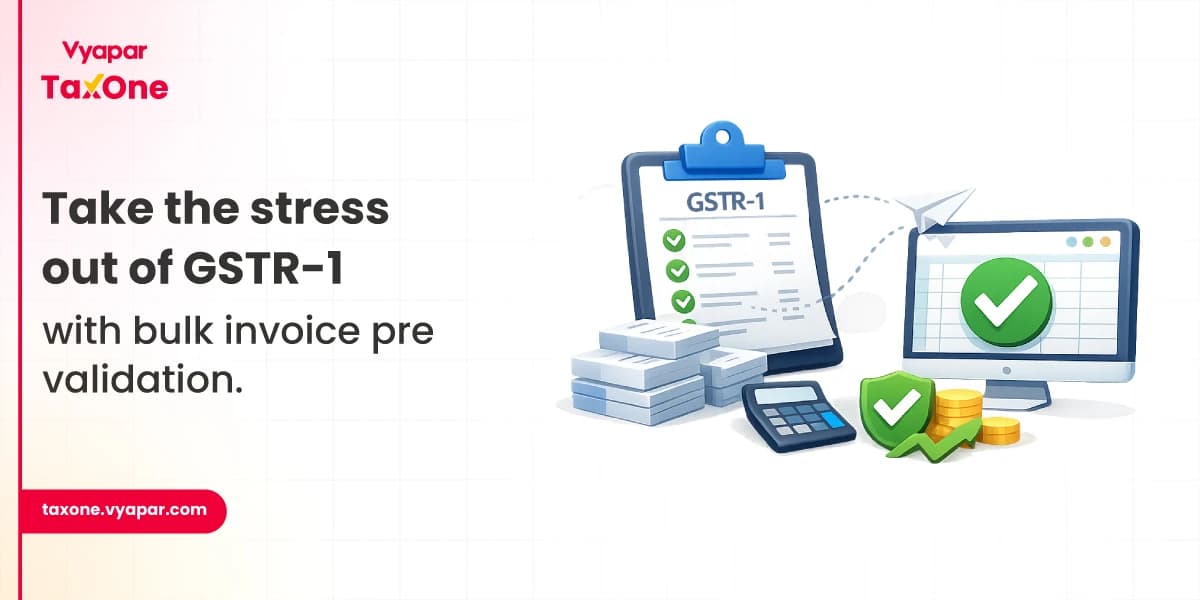
GSTR-1 pre-validation has become a critical control for tax professionals handling monthly and quarterly GST compliance in India.
In 2026, the cost of filing errors is higher because outward supply data now has a more direct impact on downstream return accuracy, amendment workload, recipient follow-up, and overall compliance timelines.
For firms managing large volume filing, a disciplined bulk invoice validation process is no longer optional. It is the foundation for error prevention in filing and a reliable portal submission check before return filing.
A strong GSTR-1 pre-validation workflow should help tax teams do four things before filing:
This matters more in 2026 because the GST Portal controls around HSN reporting, e-invoice timelines, and GSTR-3B linkage have become tighter and more structured.
GSTR-1 remains deadline-sensitive
GSTR-1 filing still follows strict monthly or quarterly timelines, so errors found after upload can quickly lead to filing delays. For tax teams, that makes early GSTR-1 pre-validation essential, especially in large volume filing environments.
GSTR-1A is only a limited correction window
GSTR-1A can be used only until GSTR-3B for the same tax period is filed. It helps with same-period corrections, but it should support compliance rather than replace a strong filing error-prevention process.
HSN checks are now more structured
From the May 2025 return period, Phase 3 HSN reporting changes made Table 12 more validation-driven, with clearer B2B and B2C reporting and tighter system checks. That means bulk invoice validation now needs a focused HSN review before upload.
E-invoice timing affects return readiness
From 1 April 2025, taxpayers with an AATO of ₹10 crore or more must report e-invoices within 30 days of the invoice date. A missed timeline can create problems later during the portal submission check stage.
GSTR-3B linkage increases the cost of errors
From the January 2026 tax period onward, the portal auto-populates the tax liability breakup in GSTR-3B using document dates from GSTR-1, GSTR-1A, and IFF for earlier-period supplies reported later. This makes accurate invoice dates and clean reporting more important than before.
In real-world compliance work, the biggest GSTR-1 issues usually come from process gaps rather than legal interpretation. The most common pain points include:
These are exactly the kinds of issues that make large volume filing difficult without a formal GSTR-1 pre-validation checklist.
Below is a practical framework that tax teams can use before uploading or filing.
| Validation Area | What to Check | Why It Matters |
|---|---|---|
| Source data readiness | Confirm all invoice sources are received and frozen for the period | Prevents omissions, duplicate imports, and version confusion |
| Document numbering | Check duplicate numbers, missing sequences, prefix variations, and case inconsistency | Reduces upload issues and supports e-invoice control discipline |
| Party master review | Validate GSTIN, registration status, place of supply, and transaction type | Prevents incorrect B2B/B2C/SEZ/export reporting |
| Tax computation | Recompute taxable value, tax amount, rate logic, and invoice totals | Catches invoice-level errors before portal upload |
| Table mapping | Confirm each supply is routed to the correct GSTR-1 table | Avoids misreporting that may not always be blocked by the portal |
| HSN review | Match HSN, UQC, and value summary with detailed outward supplies | Supports Table 12 accuracy and reduces reconciliation friction |
| Amendments review | Separate prior-period corrections from same-period reporting | Keeps GSTR-1 and GSTR-1A usage clean and controlled |
| Final portal submission check | Review summary tables before filing | Helps ensure downstream GSTR-3B impact is understood |
The table above reflects a practical workflow aligned with current portal validations, HSN reporting requirements, and return sequencing considerations.
Set a clear cut-off for inward data collection from clients, branches, and internal teams. For bulk invoice validation, changing source files during review is one of the fastest ways to create duplicate records and missed invoices. A frozen data pack gives the filing team a stable base for validation.
Before reviewing tax logic, review invoice-series logic. Check for:
This step is especially important because GSTN's e-invoice advisory imposes strict timing requirements for eligible taxpayers, and invoice control failures often surface late when teams are under deadline pressure.
A return can be technically complete and still be commercially wrong. Review whether the recipient is correctly tagged as registered or unregistered, whether the transaction belongs in B2B, B2CL, B2CS, export, or SEZ reporting, and whether the place of supply supports the tax treatment applied.
This is one of the most important steps in error prevention, because incorrect classification often persists until reconciliation or recipient follow-up.
A proper GSTR-1 pre-validation process should recompute taxable value, tax amount, invoice total, and CGST-SGST versus IGST logic. This helps catch hidden differences that may not be obvious in a summary-level review. In large-volume filing, even a small recurring tax-mapping error can quickly distort return totals.
Do not treat HSN review as a separate cleanup item. GSTN's current framework validates HSN-related values against other GSTR-1 tables, so the HSN summary must be checked together with detailed invoice reporting. This is now a high-value portal submission check for 2026 because summary errors may not always be blocked immediately, but they still signal weak return quality.
Current-period misses and prior-period corrections should not be mixed. Use GSTR-1A only for same-period additions or amendments after GSTR-1 is filed and before GSTR-3B is filed. A clean amendment policy improves review quality and helps preserve audit clarity.
Before the return is filed, review the summary table by table. Confirm that:
This final review matters even more now because GSTR-3B auto-population increasingly reflects what is reported in GSTR-1 and related forms.
With the use of Vyapar TaxOne's GST reconciliation feature, tax teams can receive outward supply data from multiple systems.
The platform supports GST automation, imports from Tally and TaxOne Chat, mismatch detection, and reconciliation-oriented workflows. That makes it useful at the consolidation stage of bulk invoice validation.
30+ smart checks directly link to GSTR-1 pre-validation. For firms that want a more repeatable review process, this kind of validation layer can help detect mismatches before upload rather than after portal rejection or recipient dispute.
Vyapar TaxOne also provides real-time invoice management and TaxOne Chat for reminders and bill collection. In practice, this is relevant because many GSTR-1 delays begin with document collection bottlenecks rather than portal issues. Better intake workflows help prevent filing errors well before the return reaches the final review stage.
In 2026, GSTR-1 pre-validation should be treated as a control function rather than a clerical review. For Indian tax professionals, the practical answer is clear: validate early, review systematically, and complete a serious portal submission check before filing. That is the most reliable path to bulk invoice validation, error-free filing, and smoother GST compliance at scale.
GSTR-1 pre-validation is the process of checking invoice data, GSTINs, tax values, table mapping, and HSN details before filing to reduce errors.
Bulk invoice validation helps tax teams catch mismatches early, improve accuracy, and manage large volume filing more efficiently.
No. GSTR-1A is only a limited correction window for the same tax period before GSTR-3B is filed. It should not replace proper pre-validation.
It should cover invoice totals, GSTIN accuracy, tax calculation, table mapping, HSN summary alignment, and amendment review.
Vyapar TaxOne can support data consolidation, smart validations, reconciliation, and document collection, making the filing process faster and more controlled.


Get started today and simplify your accounting process!