 Is Now Vyapar TaxOne | Same Trust, New Name!
 AI Weapon for Financial Soldiers


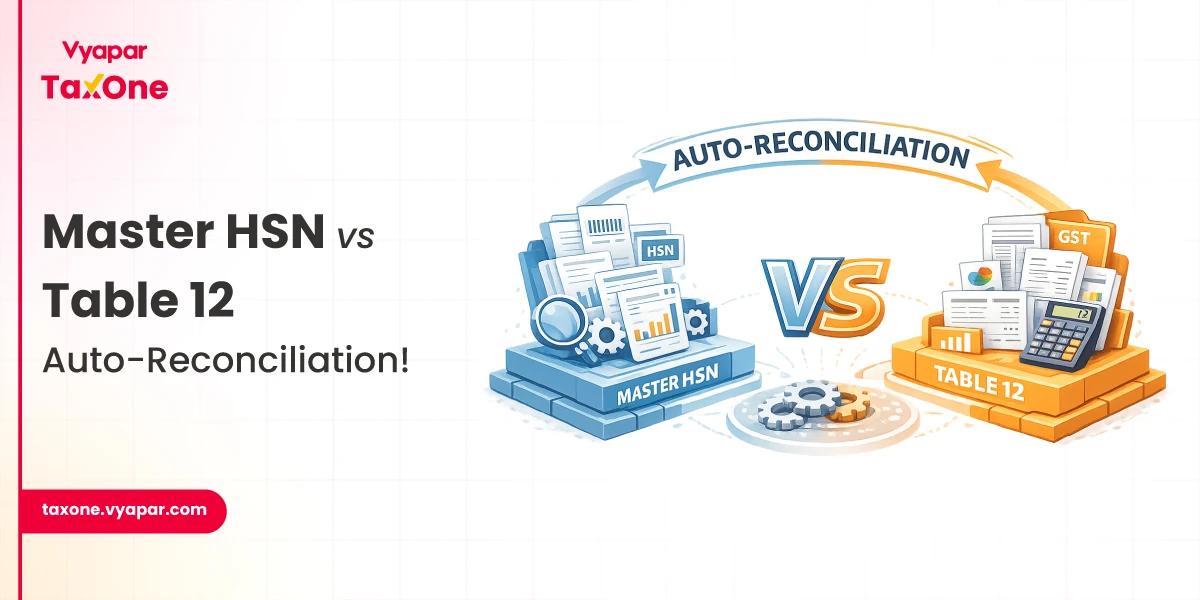
HSN summary reconciliation is vital for GST compliance in India, ensuring that HSN-wise outward supplies in GSTR-1 align with the corresponding liabilities in GSTR-3B to prevent discrepancies.
Table 12 mismatches frequently cause invoice furnishing facility (IFF) rejections, underscoring the need for robust HSN code validation and automated HSN matching among tax professionals.
This guide explores these elements and offers actionable advice tailored to 2026 GST updates and industry pain points.
HSN summary reconciliation involves verifying and matching aggregate outward supply data classified by Harmonized System of Nomenclature (HSN) codes between GSTR-1 reports and accounting records.
This process gained prominence with GSTN's phased enhancements, which ensured that tax liabilities reported in GSTR-3B matched invoice-level details.
Tax professionals must understand that incomplete HSN summary reconciliation can trigger automated GSTN alerts, delaying filings and inviting penalties under Section 122 of the CGST Act.
Accurate HSN code validation prevents under-reporting, a common trigger for IFF rejection prevention failures. In 2026, with GST 2.0 introducing refined slabs, professionals face heightened scrutiny during GSTR-9 audits, making proactive reconciliation non-negotiable.
Table 12 in GSTR-1 represents the modern evolution of HSN reporting, bifurcated for precision.
Here's a detailed comparison:
| Aspect | HSN Summary (Traditional/Pre-2025) | Table 12 (Phase-III, 2025 Onward) |
|---|---|---|
| Structure | Single aggregate view of outward supplies | Mandatory B2B tab + Optional B2C tab |
| Data Population | Manual HSN entry allowed | Dropdown-only from validated list; e-invoice auto-population |
| Turnover Thresholds | 4-digit (AATO less or equal to ₹5Cr); 6-digit (greater than ₹5Cr) | B2B mandatory at all levels; B2C optional less or equal to ₹5Cr |
| Validation Checks | Basic total matching | Real-time HSN auto-matching with Tables 4-6; variance alerts |
| Reconciliation Impact | Manual cross-checks with GSTR-3B | Auto-flags Table 12 mismatches for IFF rejection prevention |
| Risks | Long-term variances | Immediate submission blocks, notices |
This table highlights how Table 12 addresses legacy shortcomings, enforcing stricter HSN code validation to streamline HSN summary reconciliation workflows.
GSTN's system pulls HSN-wise summaries directly from the e-invoice repository into Table 12, performing instant cross-verification against granular invoice data in Tables 4 (B2B), 5 (B2C), and 6 (Credits).
Any detected Table 12 mismatch, such as rate-wise variances exceeding 1%, blocks the GSTR-1 submission until it is rectified.
Step-by-Step Process:
In 2026, enhanced algorithms incorporating machine learning for predictive mismatch detection will further integrate with GSTR-2B for ITC claims.
Expect tighter enforcement as GST slabs are revised (e.g., new 6% and 12% brackets for essentials). HSN summary reconciliation now mandates quarterly reviews for AATO >₹10Cr firms, aligning with Bi-monthly GSTR-3B cycles to curb revenue leakages estimated at ₹15,000 crore annually.
Tax professionals encounter multifaceted hurdles in maintaining seamless HSN auto-matching:
These issues compound during peak seasons (July-October), where high-volume filers report 40% longer filing cycles due to IFF rejections. GSTR-1 HSN validation errors and Table 12 auto-population failures dominate GST support forums, reflecting widespread frustration.
Additionally, inter-state supplies complicate HSN summary reconciliation, as IGST rate variances trigger false positives in auto-matching.
Implement a structured monthly audit to fortify HSN code validation:
Pro Tip: Set up conditional formatting in spreadsheets to auto-highlight Table 12 mismatches, saving 2-3 hours per client.
Tailor approaches by Annual Aggregate Turnover (AATO):
For inevitable errors:
Adopt a holistic framework for sustained compliance:
Quarterly reviews should include:
This multi-layered approach minimizes litigation risks and enhances advisory value for tax professionals.
Vyapar TaxOne transforms HSN summary reconciliation into a seamless experience for Indian tax professionals.
Its advanced GST reconciliation feature instantly detects Table 12 mismatches via AI-powered HSN auto-matching, conducts comprehensive HSN code validation across GSTR-1, GSTR-3B, and e-invoices, and prevents IFF rejections with automated correction workflows.
Key benefits include one-click B2B/B2C tab population, real-time variance alerts with a set threshold, ideal for 2026's stringent requirements.
Designed for high-volume users, it reduces manual effort by 80%, integrates with Tally/Excel, and provides mobile access for on-the-go audits. Tax professionals using Vyapar TaxOne report 95% faster filings and zero penalty notices.
Adopt Vyapar TaxOne today to master HSN summary reconciliation, eliminate Table 12 mismatches, and elevate your practice amid evolving GST landscapes.
Sign up for a free trial and experience compliance redefined.
HSN Summary offers a traditional consolidated view, while Table 12 (post-2025) splits into mandatory B2B and optional B2C tabs, with dropdown-only HSN entries and automated matching validations.
GSTN auto-populates Table 12 from e-invoices, cross-checking totals against Tables 4-6; mismatches block filing until resolved, ensuring alignment with GSTR-3B liabilities.
Issues stem from B2C omissions, dropdown errors, and e-invoice delays; prevent via monthly Excel audits, 6-digit HSN enforcement for high AATO, and GST software integration.
No, B2C remains optional for AATO ≤₹5Cr, but B2B is mandatory; skipping it risks aggregate mismatches during GSTR-9 audits.
It automates HSN code validation, detects Table 12 mismatches instantly, and enables one-click corrections to ensure seamless 2026 compliance and prevent IFF rejections.

Get started today and simplify your accounting process!