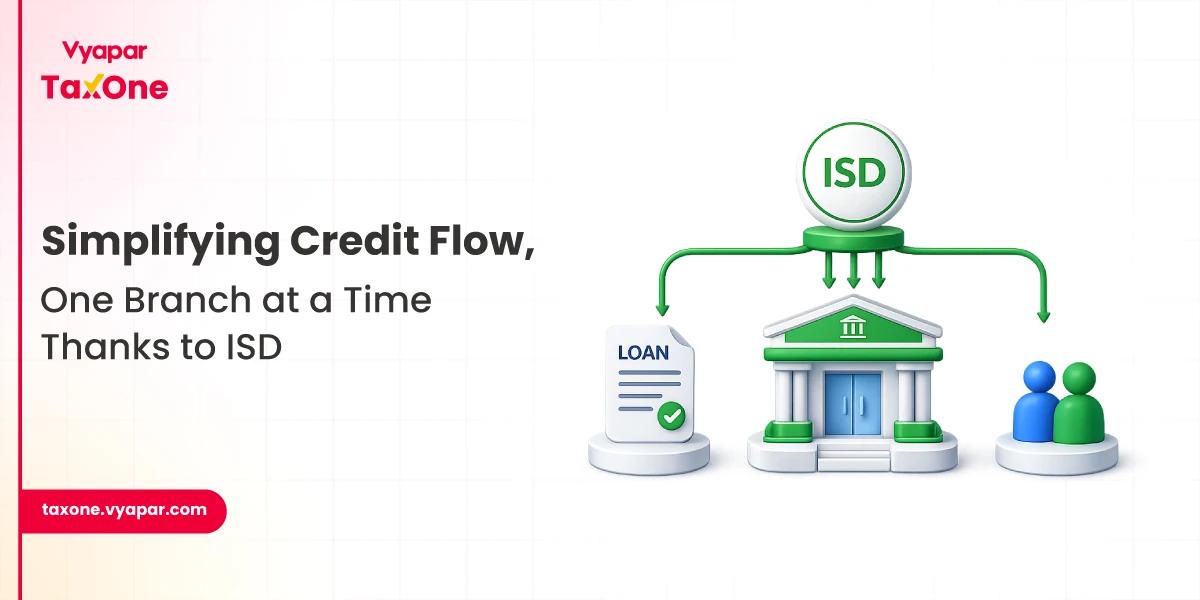
ISD in GST refers to an Input Service Distributor, a GST-registered office that receives input service invoices on behalf of its branches or units and distributes eligible Input Tax Credit (ITC) to them.
In simple terms, the ISD meaning in GST is a system that helps businesses with multiple GSTINs under the same PAN transfer ITC for common services such as audit, legal, consultancy, software, advertising, HR, and IT services.
This mechanism is useful for businesses operating from multiple states or locations. For example, if a head office receives a software invoice used by different branches, the ITC should be distributed to the relevant GSTINs through ISD.
From 1 April 2025, ISD compliance has become more important, as amended GST provisions require offices receiving common input service invoices for distinct persons under the same PAN to register and distribute ITC through the ISD route.
ISD Meaning in GST
An Input Service Distributor (ISD) is a registered GST office that:
- Receives invoices for input services centrally.
- Distributes ITC proportionally to other branches under the same PAN.
- Files GSTR‑6 monthly to document the credit distribution.
Example: A head office receives an invoice for IT services worth ₹1,00,000 used by branches in Mumbai, Delhi, and Bangalore. The ISD allocates the ITC to each branch based on turnover or usage ratio, ensuring correct credit utilization and compliance.
Using ISD in GST correctly is critical to avoid ITC denial during GST audits.
Latest Update: ISD in GST Became Mandatory from 1 April 2025
One of the most important updates related to ISD in GST is the change effective from 1 April 2025. Before this update, many businesses used various approaches, including cross-charging, to transfer credits or costs between branches.
However, after the amendment, where an office receives invoices for input services for or on behalf of distinct persons under the same PAN, ISD registration and ITC distribution through the ISD mechanism become necessary.
This means businesses with multiple GSTINs should review all common service invoices received at the head office or any central office. If those services benefit more than one branch, the ITC should be distributed through ISD rather than retained at a single GSTIN.
Examples of services that may require ISD treatment include:
- Audit fees
- Legal and professional fees
- Software subscriptions
- Cloud hosting services
- Digital marketing and advertising services
- HR and recruitment services
- IT support services
- Consultancy services
- Telecom and communication services
This update is important because incorrect ITC distribution can lead to GST mismatches, audit disputes, credit reversals, interest charges, or notices from the department.
Who Needs ISD Registration Under GST?
A business should register as an Input Service Distributor under GST when one office receives invoices for input services that are used by other branches or units registered under the same PAN.
ISD registration is generally required when:
- The business has more than one GSTIN under the same PAN
- A head office, corporate office, regional office, or administrative office receives common input service invoices.
- Multiple branches, factories, depots, offices, or business units use the services.
- The ITC needs to be distributed to the units that actually used or benefited from the service.
- The invoice relates to input services and not goods or capital goods.
When ISD May Not Be Required
ISD may not be required if the invoice relates only to one GSTIN and the service is used exclusively by that GSTIN. In such a case, the ITC should generally be claimed by the GSTIN to which the service is attributable.
How Does the ISD Mechanism Work?
The ISD mechanism under GST allows the central or head office to distribute the input tax credits (ITC) on services to different branches based on a prescribed formula.
Here’s how the process works in detail:
- Centralized Receipt of Services: The central office or headquarters receives input services, such as consultancy, HR, or IT services, and pays GST.
- ISD Registration: The central office must be registered as an ISD with the GST authorities to use the ISD mechanism. This allows the business to distribute the credit to the branches or units receiving the services.
- Distribution of ITC: Once the services are received and the central office claims ITC, it is distributed to the branches. The distribution is done in a manner that aligns with the turnover of each branch, ensuring fairness.
- GSTR-6 Filing: The ISD must file GSTR-6 every month to report the distribution of ITC. This remarkable return helps the tax authorities monitor the distribution process.
How to Distribute ITC Under the ISD Mechanism?
Under the ISD mechanism, the ITC is distributed based on a prescribed formula. The distribution of input credits is proportional to each branch or unit’s turnover. The GST law clearly defines how and when ITC can be distributed.
Key Points for Distribution:
- Turnover-based Distribution: The most common method is to distribute the credit in proportion to the turnover of each branch. For example, if Branch A generates 60% of the total turnover of the business, it will receive 60% of the ITC from the central office.
- Eligible ITC: Only input service credits related to services can be distributed. Goods and other non-service-related credits cannot be claimed under the ISD mechanism.
- Fair and Proportional Distribution: The ISD can only distribute ITC to the branches registered under GST, and the distribution must align with each branch’s business activities and turnover.
Types of Services Eligible for Credit Distribution
Certain services are eligible for credit under the ISD mechanism. These typically include input services used across the business. Let’s explore which types of services can benefit from the ISD mechanism:
Eligible Services:
- Consulting and Advisory Services: Services related to legal, tax, financial, and business consultancy.
- IT Services: Software, cloud services, and technical support services.
- HR Services: Recruitment, payroll management, and other HR-related services.
- Marketing and Advertising Services: Services related to digital marketing, print advertising, and brand consulting.
- Telecommunication and Communication Services: Phone bills, internet services, etc.
Non-Eligible Services:
- Goods: The ISD mechanism is specifically for services, not goods. Therefore, input tax credits on goods cannot be distributed under ISD.
- Non-business Services: If a service is not used for business purposes, such as personal services, it cannot be distributed under ISD.
ISD Registration and GSTR-6 Filing Requirements
A business that qualifies as an Input Service Distributor must obtain a separate ISD registration under GST. This registration is different from the regular GST registration used for outward supplies.
ISD Registration Requirements
To register as an ISD, the business should:
- Identify the office receiving common input service invoices.
- Check whether those services benefit other GSTINs under the same PAN.
- Apply for ISD registration on the GST portal.
- Maintain invoice-wise records of services received and credit distributed.
- Issue ISD invoices or ISD credit notes wherever applicable.
GSTR-6 Filing for ISD
Every registered ISD must file GSTR-6, a monthly return used to report input service credit received and distributed to recipient units. Rule 65 of the CGST Rules provides that an ISD must furnish Form GSTR-6 electronically with details of tax invoices on which credit has been received and documents issued under Section 20.
GSTR-6 generally includes:
- Input service invoices received.
- Eligible and ineligible ITC
- ITC distributed to each recipient GSTIN.
- ISD invoices issued.
- ISD credit notes issued.
- Amendments to earlier period details.
The due date for GSTR-6 is generally the 13th of the following month, unless extended. It is a monthly return for Input Service Distributors.
Challenges Faced by Businesses with ISD
While the ISD mechanism offers a streamlined process for credit allocation, it is not without its challenges:
- Complexity in Distribution: Determining the exact percentage of ITC to be distributed across various branches can be tricky, especially in businesses with multiple products or services.
- Reconciliation Issues: Ensuring ITC is accurately reconciled between the central office and the branches can be cumbersome without robust accounting systems.
- Compliance Risks: Any failure to comply with filing deadlines or distribution rules can lead to penalties and loss of credits.
Benefits of the ISD Mechanism
The ISD mechanism under GST offers several key benefits to businesses:
- Efficient Credit Utilization: Businesses can optimize the use of GST credits by ensuring the appropriate allocation across their branches or units.
- Improved Compliance: ISD registration simplifies the process of credit distribution, making it easier for businesses to comply with GST regulations.
- Cost Savings: By ensuring that input tax credits are accurately distributed, companies can minimize GST liabilities and reduce operational costs.
Key Takeaways
- ISD in GST means Input Service Distributor.
- The ISD meaning in GST is a mechanism for distributing ITC on input services to different GSTINs under the same PAN.
- ISD is mainly relevant for businesses with multiple branches, offices, factories, or units.
- From 1 April 2025, ISD compliance became more important due to amended GST provisions.
- ISD applies to input services, not goods or capital goods.
- ITC must be distributed based on attribution or turnover ratio as prescribed under Rule 39.
- Registered ISDs must file GSTR-6 monthly.
- Businesses should maintain invoice-level records, ISD invoices, credit notes, turnover working, and reconciliation documents.
FAQs
Q1. What is ISD in GST?
ISD in GST means Input Service Distributor, an office that receives input service invoices and distributes related Input Tax Credit to branches or GSTINs under the same PAN.
Q2. What is ISD meaning in GST?
ISD stands for Input Service Distributor, a mechanism for distributing ITC on common input services to units that use those services.
Q3. Is ISD registration mandatory under GST?
Yes, if an office receives input service invoices for distinct persons under the same PAN, it must register as ISD and distribute ITC as per GST law, effective from 1 April 2025.
Q4. Can ISD distribute ITC on goods?
No, ISD distributes ITC only on input services, not on goods or capital goods.
Q5. Why is ISD important for multi-branch businesses?
ISD helps distribute ITC properly, avoid credit buildup, reduce reconciliation issues, and improve GST compliance and audit readiness.
Also Read:
- A Complete Guide to GSTR 1: Filing Dates, Late Fees, and Penalties
- Free GST Software in India: Features, Limitations, and Best Options
Chartered Accountant & Finance ProfessionalChartered Accountant & Finance Professional
Designation: CA
 Is Now Vyapar TaxOne | Same Trust, New Name!