 Is Now Vyapar TaxOne | Same Trust, New Name!
 AI Weapon for Financial Soldiers


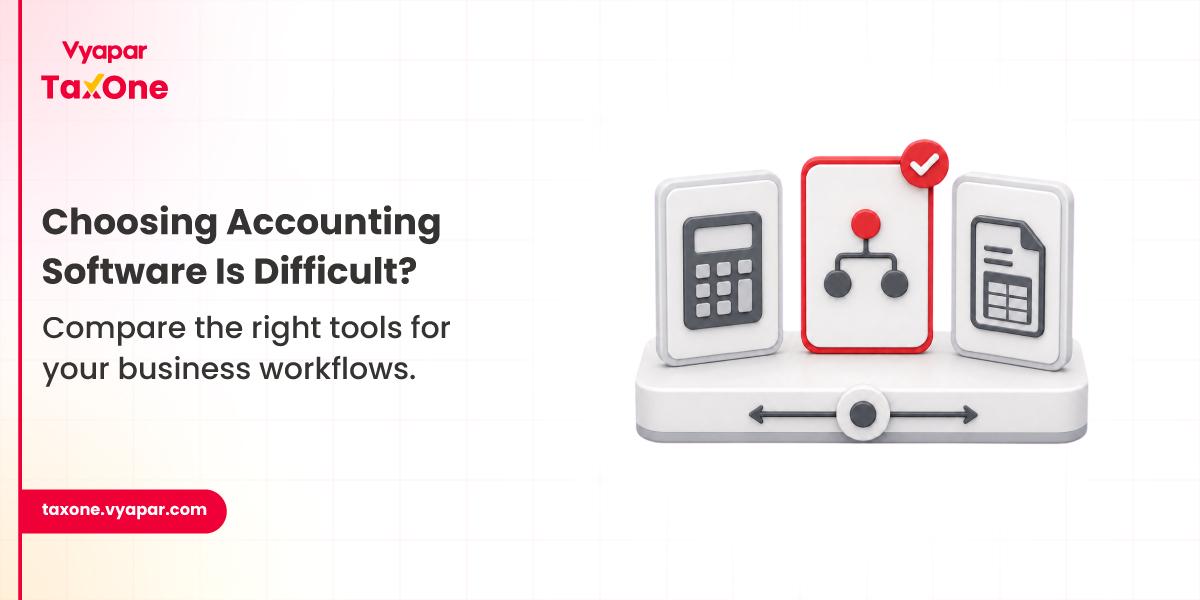
Choosing accounting software isn't just about comparing features anymore.
For many businesses, the bigger challenge is finding software that fits the way their finance team actually works. A solution that works well for a small retailer may not be practical for a manufacturing business handling multiple warehouses. Likewise, software that's ideal for invoicing may fall short when your business starts managing GST compliance across several locations or requires more detailed financial reporting.
We've seen businesses switch accounting software not because the previous one was "bad," but because it could no longer support their day-to-day operations. As transaction volumes increase, manual workarounds, disconnected systems, and reporting limitations become much more noticeable.
That's why selecting accounting software should start with understanding your operational requirements rather than simply choosing the most popular option.
If you're still deciding which capabilities matter most, it's also worth reviewing the accounting software features based on your business size before comparing different solutions.
In this guide, we'll compare some of the most widely used accounting software in India, discuss where each one fits best, and help you evaluate which solution aligns with your current needs and future growth.
Instead of comparing software based on the number of features, focus on how well it supports your day-to-day business operations. Here are the key factors to consider:
Choose software that helps you manage GST invoicing, tax reporting, and compliance requirements efficiently, reducing the need for manual work.
Your finance team should be able to perform routine tasks like invoicing, expense tracking, and financial reporting without a steep learning curve.
Look for software that provides essential reports such as cash flow, profit and loss, receivables, payables, GST summaries, and inventory reports to support informed business decisions.
As your business grows, the software should be able to support additional users, higher transaction volumes, multiple branches, and expanding operational requirements.
If you use inventory management, payroll, banking, CRM, or ERP systems, choose software that integrates smoothly to minimise duplicate data entry and improve efficiency.
One of the biggest mistakes businesses make is selecting software based solely on popularity or recommendations.
We've often seen businesses discover limitations only after implementation, when changing systems becomes much more difficult.
Some common challenges include:
A retail business may prioritise invoicing speed and inventory tracking.
A manufacturing company may require BOM management and detailed stock movement.
A CA firm may value import capabilities, reconciliation support, and compatibility with clients using different accounting systems.
Choosing one solution for every business scenario rarely delivers the best outcome.
Budget certainly matters, especially for small businesses.
However, selecting software purely because it has the lowest subscription cost can lead to additional manual work, third-party tools, or expensive migrations later as the business grows.
Looking at the overall operational value often provides a clearer picture than comparing pricing alone.
Many of these issues eventually show up as day-to-day operational challenges. Understanding the common accounting problems businesses face as they grow can help you evaluate whether your current software will continue supporting your operations.
Once years of accounting data have been accumulated, switching systems becomes a significant project.
Data migration, staff training, process changes, and reporting continuity all need careful planning.
That's why many businesses spend extra time evaluating software before making a long-term decision.
Every accounting software has its strengths. The right choice depends less on which software is "best" and more on which one matches your business operations.
Here's a closer look at some of the widely used accounting solutions in India.
Best suited for: Small and medium businesses, manufacturers, distributors, and businesses that need detailed accounting and inventory management.
TallyPrime has been one of the most widely used accounting solutions in India for years. Many businesses and CA firms are already familiar with its workflows, making it easier to collaborate during audits and compliance activities.
It offers features like:
As businesses grow, many continue using TallyPrime because of its flexibility and widespread acceptance across industries.
Best suited for: Businesses and accounting teams managing high volumes of accounting data, multiple clients, or repetitive accounting workflows.
While many accounting applications focus on recording transactions, accounting teams often spend additional time preparing, validating, and transferring data between different systems.
This becomes more noticeable when handling:
We've seen many CA firms and finance teams gradually move towards more structured workflow solutions as manual data preparation starts consuming a significant part of the accounting cycle.
This is the kind of operational challenge that structured systems like Vyapar TaxOne are designed to support, particularly where reducing repetitive accounting work becomes an important objective.
Best suited for: Small businesses, retailers, wholesalers, and local service providers.
Vyapar is popular among businesses looking for an easy-to-use accounting and billing application.
Some commonly used features include:
For businesses that don't require enterprise-level complexity, Vyapar offers a practical balance between usability and functionality.
Best suited for: Service businesses, startups, and companies looking for cloud-based accounting.
Zoho Books is designed for businesses that prefer working entirely online.
Apart from accounting, it integrates with other Zoho applications, making it useful for businesses already using the Zoho ecosystem.
Common capabilities include:
Its cloud-first approach makes collaboration easier for distributed teams.
Best suited for: Trading businesses, wholesalers, distributors, and SMEs.
BUSY focuses on practical accounting requirements commonly found in Indian businesses.
Its strengths include:
Businesses looking for straightforward accounting without unnecessary complexity often consider BUSY a practical option.
| Software | Best For | Key Strength |
|---|---|---|
| TallyPrime | SMEs, manufacturers, distributors | Comprehensive accounting and inventory management |
| Vyapar TaxOne | CA firms and high-volume accounting teams | Structured workflows for repetitive accounting operations |
| Vyapar | Small businesses and retailers | Simple billing, accounting, and offline access |
| Zoho Books | Startups and service businesses | Cloud accounting with strong integrations |
| BUSY | Traders and wholesalers | Practical GST billing and inventory management |
Every business has different accounting needs, so choosing software based only on popularity or pricing isn't always the right approach. Before making a decision, evaluate whether the software supports your day-to-day operations today and can continue meeting your requirements as your business grows.
Use this checklist during your evaluation:
| Checklist | Why It Matters |
|---|---|
| Supports your current accounting workflows | Helps your team work efficiently without changing established processes unnecessarily. |
| Handles GST compliance requirements | Simplifies invoicing, tax reporting, and other GST-related activities. |
| Generates the reports your business needs | Gives quick access to financial insights without extensive manual work. |
| Integrates with your existing systems | Reduces duplicate data entry across inventory, banking, payroll, and other business applications. |
| Can support future business growth | Accommodates additional users, branches, and higher transaction volumes as your business expands. |
| Offers reliable customer support | Ensures timely assistance during implementation and day-to-day operations. |
| Fits your overall budget | Helps balance software costs with the value it delivers to your business. |
As businesses grow, accounting extends well beyond recording transactions. Finance teams often need to consolidate data from multiple sources, validate records before import, handle increasing transaction volumes, and coordinate with different stakeholders during month-end closing or compliance cycles.
We've seen many businesses and CA firms gradually move towards more structured workflows as these operational demands increase. The challenge isn't always the accounting software itself; it's managing the growing volume of manual processes that develop around it.
That's where structured systems like Vyapar TaxOne naturally fit into the workflow. Rather than replacing your accounting software, they help streamline repetitive accounting processes that begin affecting accuracy and turnaround time as operations become more complex.
Ultimately, there isn't a single accounting software that's the right fit for every business. The best choice depends on your industry, transaction volume, reporting requirements, compliance responsibilities, and future growth plans.
Whether you're evaluating TallyPrime, Zoho Books, BUSY, Vyapar, or considering structured workflow solutions alongside your existing accounting setup, focus on how well the software supports your day-to-day accounting operations, not just today, but as your business evolves. Choosing a solution that aligns with your operational needs can reduce manual effort, improve consistency, and help your finance team work more efficiently over time.
Many businesses start evaluating new software when manual work increases, reporting becomes slower, or existing systems struggle to support growing transaction volumes or additional business locations.
Not necessarily,
Cost is important, but it's equally important to consider whether the software can continue supporting your business as operations expand. A lower upfront cost may lead to additional manual work or another software migration later.
It depends on your business requirements.
Cloud solutions offer advantages such as remote access and easier collaboration, while some businesses may still prefer desktop-based systems based on their internal processes, infrastructure, or compliance preferences.
Most modern accounting software includes GST-related capabilities such as tax calculation, invoicing, and reporting.
However, compliance also depends on maintaining accurate accounting records and following consistent internal processes.
Instead of comparing feature lists alone, it's better to evaluate how well the software supports your everyday accounting activities, reporting needs, future growth, and integration requirements.


Get started today and simplify your accounting process!