 Is Now Vyapar TaxOne | Same Trust, New Name!
 AI Weapon for Financial Soldiers


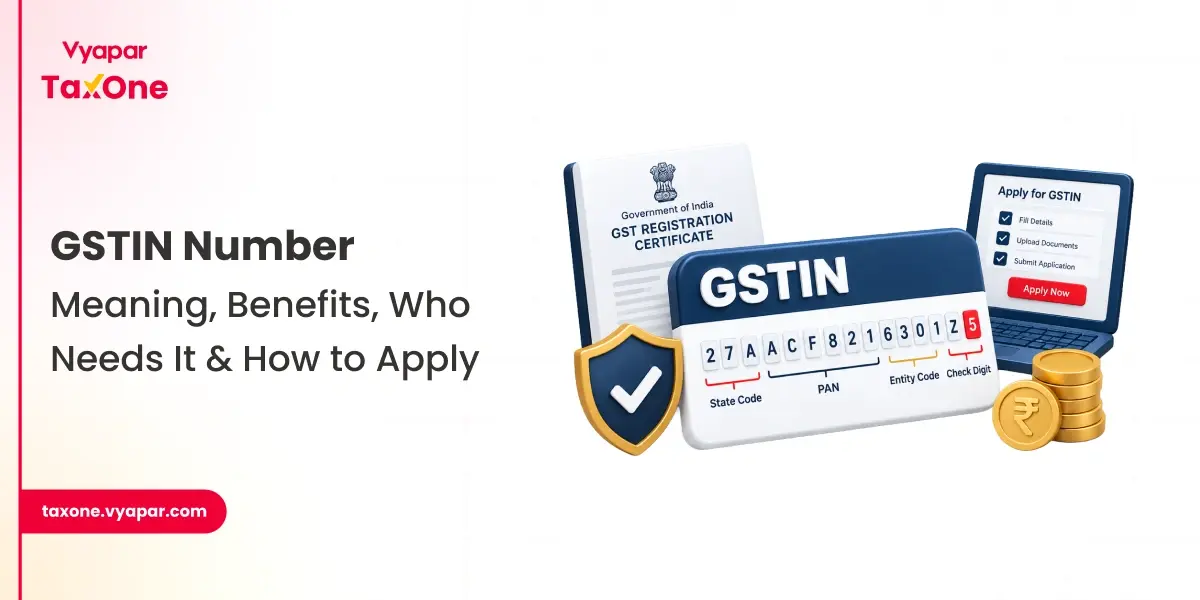
GST, or Goods and Services Tax, is an indirect tax system used in India for the supply of goods and services. It replaced multiple older indirect taxes and created one common tax structure across the country. For business owners, GST mainly affects invoicing, tax collection, return filing, Input Tax Credit, and compliance records. A business that is registered under GST receives a unique GSTIN number, which must be used on GST invoices, returns, and other tax documents.
GSTIN stands for Goods and Services Tax Identification Number. It is a unique 15-digit number issued to a business after successful GST registration. Many business owners search for it as:
In simple terms, GSTIN is the official GST number of a registered business in India. Example GSTIN format: 27AAAPA1234A1Z5
| GSTIN Part | Meaning |
|---|---|
| First 2 digits | State code |
| Next 10 characters | PAN of the business or proprietor |
| 13th character | Entity number under the same PAN in that state |
| 14th character | Usually “Z” |
| 15th character | Check digit |
GST registration is state-wise, so a business operating in multiple states may have different GSTINs for different states. Under Section 25 of the CGST Act, separate registrations are treated as distinct persons for GST purposes. (Section 25, GST Act)
Yes. In common business language, GST number and GSTIN number usually mean the same thing.
| Term | Meaning |
|---|---|
| GSTIN | Official 15-digit Goods and Services Tax Identification Number |
| GST Number | Common term used by business owners for GSTIN |
| GST Registration Number | Another common way to refer to GSTIN |
| ARN | Application Reference Number generated after submitting GST registration application |
The key difference is that ARN is temporary, while GSTIN is issued only after the GST registration application is approved.
A business needs a GSTIN number when it crosses the applicable GST registration turnover limit or falls under a mandatory registration category.
| Business Type / Situation | When GST Registration Is Needed |
|---|---|
| Supplier of goods | When aggregate turnover exceeds ₹40 lakh in a financial year, subject to applicable conditions |
| Supplier of services | When aggregate turnover exceeds ₹20 lakh in a financial year |
| Special category states | Lower limits may apply, such as ₹20 lakh for goods and ₹10 lakh for services |
| Interstate suppliers, e-commerce sellers, reverse charge cases, casual taxable persons, non-resident taxable persons, ISD, TDS/TCS cases | GST registration may be required regardless of turnover |
Note: GST turnover is calculated on aggregate turnover, not just one shop, branch, or location. The CGST Act mentions the standard ₹20 lakh threshold, ₹10 lakh for special category states, and also allows an enhanced ₹40 lakh threshold for persons engaged exclusively in the supply of goods, subject to notified conditions. (GST Acts) Section 24 also lists categories that may need GST registration regardless of turnover. (cbic-gst.gov.in FAQs )
Some businesses may need GST registration even if their turnover is below the normal threshold. These can include:
Section 24 of the CGST Act covers categories of persons required to register regardless of turnover. (Explore Section 24 of CGST)
Getting a GSTIN number helps businesses operate more professionally and stay compliant under GST.
| Benefit | How it Helps Businesses |
|---|---|
| Legal GST Compliance | Allows eligible businesses to collect and pay GST legally |
| GST Invoice Creation | GSTIN can be printed on tax invoices and business documents |
| Input Tax Credit | Registered businesses can claim eligible GST paid on purchases |
| Better Business Trust | Vendors, customers, and B2B clients can verify business details |
| E-commerce Selling | Helps businesses sell through online marketplaces where GSTIN is required |
| Interstate Business | Makes it easier to sell goods or services across states where registration applies |
| Business Loan Support | GST records may help lenders understand business activity |
| Vendor Verification | Buyers can verify supplier GSTIN before claiming ITC |
Before applying for GST registration, keep the required documents ready.
| Document | Why It Is Needed |
|---|---|
| PAN card | To identify the business, proprietor, firm, or company |
| Aadhaar card | For identity verification and Aadhaar authentication |
| Business address proof | To verify the principal place of business |
| Bank account details | To link business banking information |
| Photograph | Required for proprietor, partners, directors, or authorised signatory |
| Business registration proof | Required for companies, LLPs, partnerships, or other entities |
| Authorisation letter or board resolution | Needed when an authorised signatory applies on behalf of the business |
| Digital Signature Certificate | Required in specific cases such as companies and LLPs |
The exact document requirement can vary based on business type, constitution, and registration category. Businesses should verify the latest requirements on the official GST portal before applying. (Checklist of Documents Required For GST Registration)
To apply for a GSTIN number, visit the official GST portal and go to Services → Registration → New Registration. The GST registration application has two parts: Part A and Part B.
| Step | What to Do |
|---|---|
| 1. Start new registration | Select New Registration, choose Taxpayer, and enter your State/UT and district. |
| 2. Fill Part A | Add legal business name as per PAN, PAN, email ID, mobile number, and captcha. |
| 3. Verify OTP | Enter the OTPs received on your mobile number and email ID. |
| 4. Get TRN | After OTP verification, the portal generates a Temporary Reference Number (TRN). |
| 5. Fill Part B | Log in using TRN and complete details like business information, promoters/partners, authorised signatory, place of business, goods/services, Aadhaar authentication, and verification. |
| 6. Submit application | Submit using the applicable method such as DSC, E-Signature, or EVC. |
| 7. Track ARN | After submission, you receive an Application Reference Number (ARN) to track your GST registration status. |
Note: The GST portal says the TRN-based draft application should be submitted within 15 days, otherwise the TRN and saved details may be deleted.
Section 25 of the CGST Act says a person liable for GST registration must apply in every state or union territory where they are liable within the prescribed timeline. (Explore Section 25)
Explore the official GST Registration User Guide and learn how to apply online.
GST verification helps businesses check whether a GST number is valid, active, and linked to the correct business.
The official GST tutorial states that the Search Taxpayer feature lets users view taxpayer details by entering GSTIN/UIN, and no login is required for these public details.
Explore the GST portal guide for GST taxpayer search and GST verification.
If your business is already registered under GST, you can find your GSTIN in these places:
| Place | Details |
|---|---|
| GST Registration Certificate | GSTIN is available on Form GST REG-06 |
| GST Portal Dashboard | Log in to the GST portal to view registered GST details |
| GST Invoices | GSTIN is printed on tax invoices issued by registered businesses |
| Search by PAN | GST portal can show GSTINs linked with a PAN |
| GST Returns | GSTIN appears on filed GST returns and related documents |
If a business is liable for GST registration but continues without registration, it may face compliance issues and penalties. Possible risks include:
| Mistake | Why It Matters |
|---|---|
| Using the wrong GSTIN on invoices | Can create invoice mismatch and ITC issues |
| Not checking supplier GSTIN | May create risk while claiming Input Tax Credit |
| Not updating business details | Address, signatory, or constitution changes should be updated on the GST portal |
| Assuming GSTIN is optional after crossing threshold | Registration may become mandatory once rules apply |
| Not filing returns after GST registration | Registered taxpayers have return filing obligations |
| Confusing ARN with GSTIN | ARN is only an application tracking number, not the final GST number |
| Using one GSTIN for multiple states | GST registration is state-wise where applicable |
For CAs, tax consultants, accounting firms, and finance teams, managing GSTIN details, GST documents, client data, invoices, and compliance records manually can take significant time. When multiple clients are involved, tracking GST registration status, documents, returns, notices, and accounting entries becomes even more difficult.
Vyapar TaxOne is an AI accounting automation software that helps tax professionals reduce manual data entry, process financial documents faster, centralize client records, and improve accounting accuracy. It supports automation-led workflows for GST, accounting, banking, and document processing, so CAs and finance teams can spend more time on review, compliance, advisory, and client service.
GSTIN number is a 15-digit Goods and Services Tax Identification Number issued to a business after GST registration. It is also commonly called GST number or GST registration number.
Yes. GSTIN is the official term, while GST number is the common term used by business owners, vendors, and customers.
Businesses may need GST registration if they cross the applicable turnover limit or fall under mandatory registration categories such as certain interstate supplies, e-commerce supplies, reverse charge, or other GST rules.
You can apply for GST number online through the official GST portal by filling Form GST REG-01, verifying details, uploading documents, and submitting the application.
GST registration on the official GST portal does not require a government registration fee. Professional fees may apply if you take help from a CA, consultant, or service provider.
You can verify a GST number on the GST portal using the Search Taxpayer option. Enter the GSTIN to check business name, state, status, and registration details. GST Tutorial
ARN is the Application Reference Number generated after submitting the GST registration application. GSTIN is the final 15-digit number issued after registration approval.
Yes. A business operating in multiple states may have separate GSTINs for different states. Multiple registrations are treated separately under GST law. GST Acts
No. Input Tax Credit is available only to registered taxpayers who meet GST conditions. Without GSTIN, a business cannot file GST returns or claim ITC.
You can find your GSTIN on your GST registration certificate, GST portal dashboard, GST invoices, GST returns, or by using the GST portal’s Search Taxpayer feature.


Get started today and simplify your accounting process!