 Is Now Vyapar TaxOne | Same Trust, New Name!
 AI Weapon for Financial Soldiers


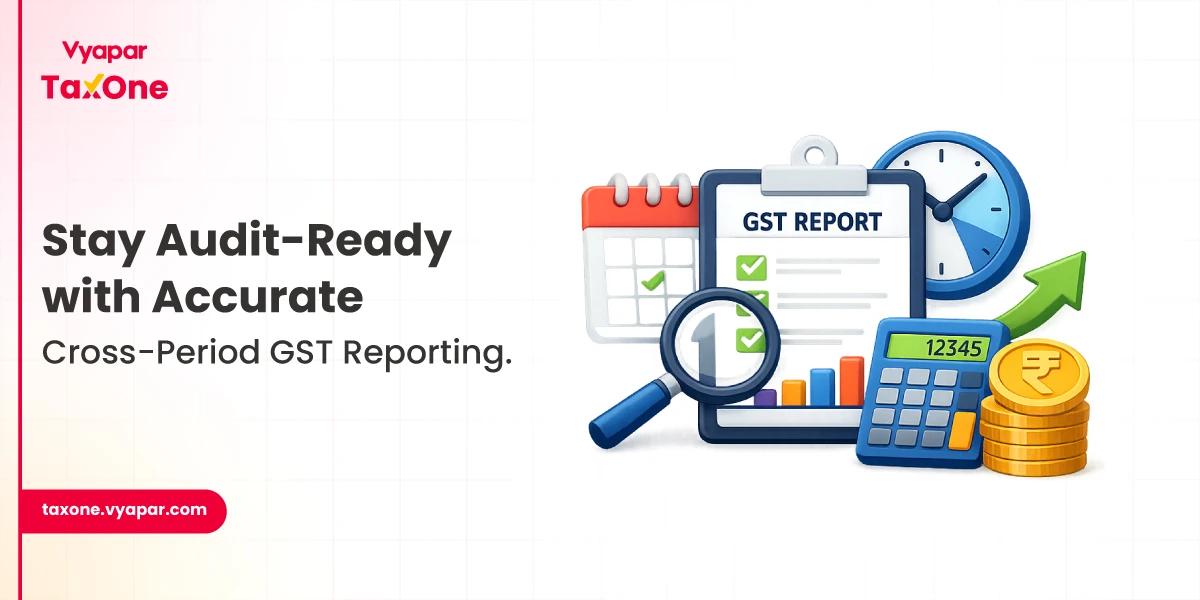
In India's complex Goods and Services Tax (GST) framework, managing credit notes across financial periods has become one of the most frequently debated compliance areas.
As ERP systems mature and GSTN validations tighten in 2026, challenges related to cross-period credit notes, where an adjustment belongs to a different reporting month or financial year, require renewed attention from tax professionals.
Incorrect or delayed reporting can distort tax liabilities, lead to ITC mismatches, and even trigger audit scrutiny.
This blog offers a practical filing strategy for cross-period credit notes under GST, focusing on compliance precision, automation, and documentation in line with the 2026 reporting environment.
Under Section 34 of the Central Goods and Services Tax Act, 2017, a credit note allows a supplier to reduce taxable value and tax liability when:
A cross-period credit note refers to a credit note issued for an invoice from an earlier tax period, for instance, one issued in May 2026 for an invoice raised in December 2025.
Cross-period credit notes often arise in the following contexts:
These real-world cases underscore the relevance of timely amendment filing and proper documentation to support offset of tax liabilities.
Despite improved guidance over the years, tax teams still face persistent hurdles with cross-period adjustments, especially due to tighter GSTN system validations.
| Challenge | Impact on Compliance |
|---|---|
| GSTR-1 and 3B month mismatch | Creates reconciliation differences and negative liabilities |
| Late credit note reporting | May disallow tax liability reduction beyond statutory limit |
| ITC reflection delays in GSTR-2B | Recipient unable to reverse credit timely, leading to notices |
| Multi-period contract amendments | Complex mapping of invoice reference vs reporting period |
| GST portal validation errors | Portal rejects very old period references, especially cross-financial-year adjustments |
| Improper accounting linkage | Results in data inconsistency during annual return reconciliation |
These pain points make it essential to integrate data accuracy, timing validation, and audit traceability into business compliance systems.
A structured approach ensures compliance, consistency, and minimizes tax liability disputes:
1. Issuance of Credit Note
2. Reporting in GSTR-1
3. Adjustment in GSTR-3B
4. Reconciliation and Documentation
5. ERP Tagging
Scenario:
Company ABC issues a sales invoice in December 2025. A discount is approved, and a credit note is created in April 2026.
Compliance Flow:
Audit officers emphasize accuracy and comprehensive documentation for late or cross-financial-year amendments. Maintain the following checklist:
A robust documentation process not only supports transparency but also reduces risks during departmental verifications.
Recent CBIC circulars and judicial rulings have reiterated strict timelines and documentation priorities.
Key Clarifications
Practical Implication:
Tax professionals should maintain real-time monitoring dashboards for period allocation and ITC sync status to identify any missing cross-period entries before deadlines.
Preventive measures can significantly reduce compliance risks linked to late credit note reporting and inaccurate adjustments.
These practices enhance transparency and help maintain good standing during any departmental scrutiny.
The era of manual spreadsheets is fading. Businesses managing high transaction volumes require smart automation platforms that enable seamless, error-free reconciliation across periods.
Our solution, Vyapar TaxOne, is an intelligent GST compliance platform built for Indian enterprises and tax professionals.
For professionals handling multi-period GST adjustments, this feature streamlines compliance and mitigates the manual burden of cross-period credit note management.
As India enters 2026 with increasingly data-driven GST compliance, cross-period credit notes require deliberate strategy, technology adoption, and disciplined reporting.
Late reporting or mismatched period allocation not only affects tax liability reconciliation but also invites departmental queries.
By combining clear procedural steps, robust documentation, and tech-enabled automation tools such as Vyapar TaxOne, tax professionals can confidently navigate the evolving GST landscape, ensuring accuracy, consistency, and audit readiness throughout the financial year.
A cross-period credit note is a credit note issued for an invoice from a previous tax period, often due to post-sale discounts, cancellations, or rate revisions.
Yes, but only up to the due date of the September return following the financial year or before filing the annual return (GSTR-9), whichever is earlier.
Declare them in GSTR-1 (Table 9B) and adjust the tax liability in the same month's GSTR-3B. Ensure both supplier and recipient data match for ITC accuracy.
Late reporting may disallow a reduction in output tax liability, cause ITC mismatches, and invite audit scrutiny.
Vyapar TaxOne automates invoice-note matching, cross-period tracking, and GST reconciliation, helping prevent filing errors.


Get started today and simplify your accounting process!