 Is Now Vyapar TaxOne | Same Trust, New Name!
 AI Weapon for Financial Soldiers


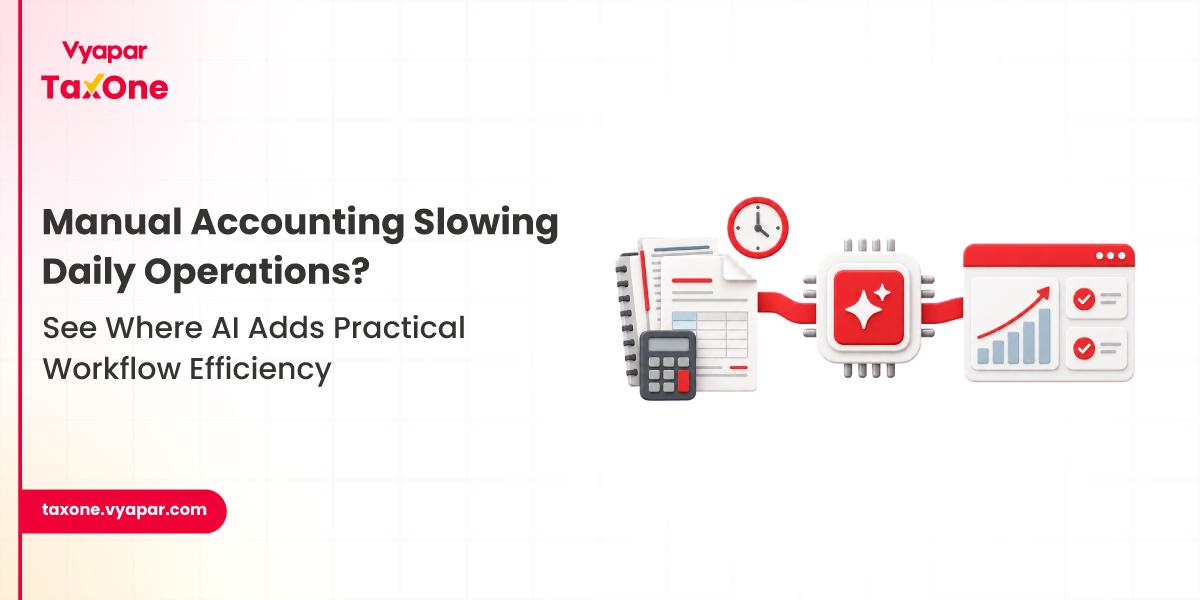
Every accounting team reaches a point where increasing workload starts affecting turnaround time rather than output. It usually becomes noticeable during month-end closing, GST filing periods, or when finance teams are handling multiple entities and thousands of transactions simultaneously. More people aren't always the answer. In many cases, the bigger challenge is the amount of manual work required to keep financial records accurate.
Even experienced accounting professionals spend a significant part of their day on repetitive activities like validating invoices, checking ledger postings, reviewing exceptions, matching transactions, and preparing data before it can be used for reconciliation or reporting. These tasks are essential, but they leave less time for review, analysis, and decision-making.
This is where conversations around AI in accounting have become more practical. Instead of asking whether AI can replace accountants, firms are asking a different question: Which parts of the accounting workflow can AI handle more efficiently while allowing professionals to focus on review and compliance?
The answer isn't every task. Accounting still relies heavily on professional judgment, regulatory knowledge, and business context.
However, AI is proving valuable in handling repetitive, rule-based activities that consume hours every week. When applied correctly, it helps reduce manual effort, improves consistency, and gives accounting teams more time to focus on work that requires expertise.
A few years ago, discussions around AI largely focused on automation. Today, the conversation has shifted toward operational efficiency.
Accounting teams aren't looking for technology simply because it's new. They're looking for ways to manage growing transaction volumes without increasing manual workload at the same pace.
For many firms, the pressure comes from multiple directions:
As transaction volumes grow, manual review processes become harder to sustain. A small mismatch overlooked during invoice processing can create additional work during reconciliation. Delayed document verification often affects month-end closing schedules. Missing supporting information may only surface during audit preparation, requiring teams to revisit completed work.
Rather than replacing existing accounting processes, AI is increasingly being used to reduce the manual effort involved in these routine activities.
The biggest contribution of AI isn't performing complex accounting decisions. It is helping teams process information faster while maintaining consistency across routine workflows.
Many accounting workflows begin with gathering information from invoices, purchase documents, bank statements, expense claims, or supporting records. Even when businesses use accounting software, teams often spend considerable time reviewing, validating, and entering information before it reaches the books.
AI helps simplify this stage by extracting relevant information, identifying common data patterns, and reducing the amount of manual entry required. Instead of entering every field manually, accounting professionals spend more time reviewing exceptions than processing standard documents.
For firms handling documents from multiple clients every day, this shift alone can save several hours each week.
Much of this efficiency starts with improving how accounting data enters the system in the first place. If you're exploring how AI extracts, validates, and processes accounting documents before they reach your books, our guide on AI-powered data entry explains the operational workflow in greater detail.
Transaction categorization is another area where repetitive manual work often affects consistency. Similar transactions may occasionally be posted differently by different team members, especially when multiple people work on the same books.
AI can assist by recognising patterns based on previous accounting treatments and suggesting appropriate classifications for review. The final decision still rests with the accountant, but the review process becomes faster because fewer routine entries require manual evaluation from scratch.
This becomes increasingly useful when processing high transaction volumes across multiple branches or GST registrations.
One of the biggest operational advantages of AI is changing where accounting teams spend their time.
Instead of reviewing every single transaction individually, teams can focus on entries that require attention. AI helps identify unusual values, missing information, duplicate records, or transactions that differ from historical patterns.
Rather than replacing professional review, it allows professionals to concentrate on exceptions while routine transactions continue through the normal workflow.
Many firms notice that this approach reduces review fatigue during month-end, when large transaction volumes would otherwise require lengthy manual verification.
The value of AI isn't measured only by how quickly tasks are completed. Its real impact becomes visible when multiple accounting activities depend on each other.
Consider a typical accounting cycle.
Invoices need to be recorded correctly before reconciliation begins. Ledger postings influence financial reports. Supporting documents affect audit readiness. GST compliance depends on accurate transaction records. A delay at one stage often creates additional work further down the process.
When repetitive activities are completed more consistently, downstream workflows also become easier to manage.
For example:
In other words, AI contributes to operational efficiency by reducing the number of interruptions that typically slow accounting teams throughout the month.
Despite rapid advancements, AI isn't a substitute for professional accounting expertise.
It cannot independently interpret changing tax regulations, understand commercial intent behind complex transactions, resolve disputes with vendors, or exercise professional judgment during financial reporting. These responsibilities continue to rely on experienced accountants who understand both compliance requirements and business context.
What AI does well is supporting those professionals by handling repetitive, structured work that follows consistent patterns. As accounting volumes increase, this balance allows teams to maintain quality without relying entirely on additional manual effort.
Instead of replacing accountants, AI is gradually becoming another operational tool that helps finance teams work more efficiently while keeping experienced professionals focused on higher-value review and decision-making.
Manual accounting processes don't usually fail because people lack expertise. In most cases, the challenge is the growing volume of work combined with limited time for review.
We've often seen this during month-end closing and GST filing cycles. Teams complete data entry on time, but the real delays begin when they start validating records, tracing missing documents, resolving mismatches, and checking whether everything has been posted correctly.
Some of the most common operational challenges include:
Individually, these issues may seem manageable. However, when finance teams are processing thousands of transactions each month, even small inconsistencies can add several hours of additional review work.
Many firms discover these issues only during reconciliation or audit preparation, when correcting them becomes more time-consuming than preventing them earlier in the workflow.
Consider a CA firm managing the books for around 20 clients. During month-end, the team processes close to 4,000 invoices collected from different businesses.
Most invoices are recorded without difficulty, but a small percentage require additional verification because vendor details are incomplete, duplicate documents have been uploaded, or transaction descriptions don't match earlier records.
Instead of focusing on financial review, the team spends two to three days manually identifying exceptions, checking supporting documents, and correcting entries before reconciliation can begin.
AI doesn't eliminate the need for review, but it can reduce the amount of routine checking by identifying duplicate records, extracting document information more consistently, and highlighting transactions that genuinely require human attention.
As a result, accountants spend more time reviewing exceptions and less time searching for them.
Now consider a manufacturing business operating through several GST registrations. The finance team processes purchase invoices from multiple vendors while maintaining separate books for different locations.
Because documents arrive through different channels and are reviewed by multiple team members, similar transactions are occasionally classified differently. These differences may not affect day-to-day accounting, but they often become visible during reconciliation or financial review.
Before returns are finalised, the team has to revisit hundreds of entries to verify classifications and supporting records. Although each correction takes only a few minutes, together they consume several working days.
AI-assisted transaction classification can help maintain greater consistency by recognising similar accounting patterns and presenting suggestions for review. The accountant still approves every posting, but repetitive categorisation becomes much faster.
Across accounting firms and finance departments, a few patterns appear repeatedly once transaction volumes increase.
One of the first signs is that review time grows much faster than data entry time. Recording transactions may take only a few hours, but validating those entries often takes significantly longer.
Another common observation is that most issues don't become visible immediately. They usually surface during reconciliation, audit preparation, or GST return reviews, when teams begin comparing records from multiple sources.
We've also seen that businesses rarely struggle because of one major error. Instead, it's dozens of small inconsistencies, slightly different ledger mappings, missing attachments, duplicate invoices, or incomplete descriptions, that collectively delay financial closing.
This is why many firms are shifting their attention from simply increasing processing speed to improving the overall quality and consistency of accounting workflows.
How AI Fits Into Existing Accounting Workflows
One common misconception is that adopting AI requires replacing existing accounting systems. In practice, most organisations use AI to strengthen specific stages of their existing workflow rather than changing the entire process.
A typical workflow often looks like this:
The accountant remains responsible for approvals, compliance, and professional judgment throughout the process. AI simply reduces the repetitive effort required before those decisions can be made.
For firms evaluating where automation fits within existing accounting processes, understanding the broader role of accounting automation can help identify which activities are suitable for automation and which should continue to rely on professional review.
This approach allows firms to improve efficiency without disrupting established accounting controls.
Before adopting AI within accounting operations, many finance teams evaluate whether their existing processes are ready. A few practical questions can help identify where AI is likely to deliver the greatest operational value:
Are repetitive data entry tasks consuming a significant part of the team's time?
If the answer to several of these questions is yes, the opportunity may not be to automate everything, but to introduce more structured workflows where repetitive activities can be handled more consistently.
As accounting operations become more complex, many firms gradually move away from managing every process through spreadsheets, manual reviews, and disconnected systems. The challenge isn't simply processing more transactions, it's maintaining accuracy and consistency as the volume grows.
This is the kind of workflow challenge structured systems like Vyapar TaxOne are designed around. Rather than replacing accountants, these systems help organise repetitive accounting activities so finance teams can spend more time on review, compliance, and decision-making instead of routine processing.
The objective isn't to remove professional judgment from accounting. It's to reduce the operational friction that builds up when manual processes no longer scale with business growth.
The discussion around AI in accounting has moved beyond whether automation is possible. Today, the more practical question is where AI can genuinely improve everyday accounting operations without compromising control or accuracy.
For most accounting teams, the biggest challenges aren't individual transactions, they're the cumulative effect of repetitive manual work, growing transaction volumes, and tighter compliance timelines. As these pressures increase, maintaining the same level of accuracy through manual processes alone becomes increasingly difficult.
This is why many firms are gradually adopting structured, AI-assisted workflows. The goal isn't to replace accountants or remove professional judgment. It's to reduce repetitive operational effort, improve consistency, and give finance professionals more time to focus on reconciliation, compliance, financial review, and client advisory work.
Every accounting process benefits differently from AI. Before introducing new tools into your workflow, it's worth understanding AI in accounting: what works and what doesn't so expectations are aligned with real operational use cases rather than assumptions.
When implemented thoughtfully, AI becomes less about automation and more about enabling accounting teams to work with greater confidence, efficiency, and operational control.
No. AI assists with repetitive and structured tasks, while accountants continue to make decisions involving compliance, financial interpretation, and professional judgment.
Tasks involving document processing, repetitive data entry, transaction classification, exception identification, and preliminary validation typically see the greatest efficiency improvements.
AI cannot replace reconciliation, but it can improve the quality and consistency of accounting records before reconciliation begins, reducing the number of manual corrections later.
Yes. Even firms managing a moderate number of clients often experience repetitive workloads during month-end and compliance cycles, where AI can help reduce manual effort.
They should first identify repetitive activities that consume the most time, evaluate existing workflow bottlenecks, and ensure that any AI-enabled process still supports appropriate review and approval controls.


Get started today and simplify your accounting process!