 Is Now Vyapar TaxOne | Same Trust, New Name!
 AI Weapon for Financial Soldiers


A lot of TDS work inside CA firms still starts with an old Excel tracker, a client message, an internal checklist or an SOP copied from the previous filing cycle.
That becomes a problem when the compliance framework itself changes.
From April 1, 2026, TDS obligations arising from payments or credits covered by the new framework are governed by the Income-tax Act, 2025, along with the Income-tax Rules, 2026. The change is not limited to section numbering. The TDS structure, forms and reporting processes have also been reorganised.
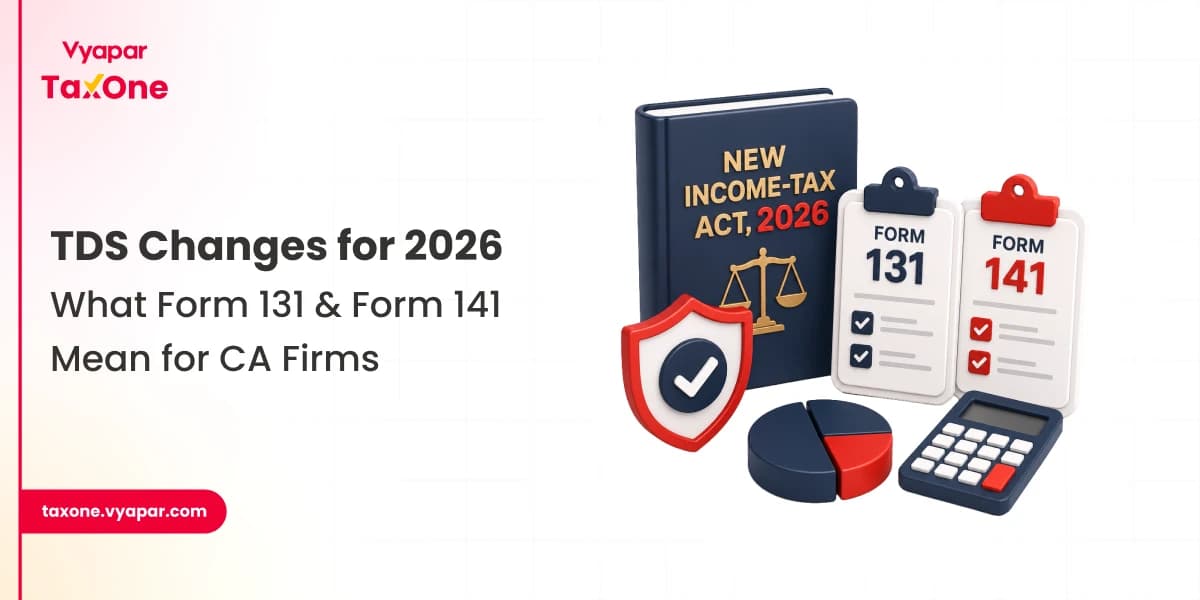
For CA firms, two changes that need particular attention are Form 131 and Form 141.
Form 131 replaces the earlier Form 16A reference for the relevant non-salary TDS certificate, while Form 141 brings specified transactions earlier reported through Forms 26QB, 26QC, 26QD and 26QE under a common challan-cum-statement structure.
The important part is what happens around these forms.
A staff member may still ask a client for “26QB details”. An internal checklist may continue to mention Form 16A. A tracker may follow only the quarterly TDS cycle even though certain Form 141 transactions need month-based tracking.
So the transition is not simply about learning two new form numbers. It is about changing the workflow built around them.
The new Income-tax Act, 2025 reorganises the way several direct-tax provisions are presented, including TDS provisions.
Under the new framework, salary-related TDS is covered under Section 392, while TDS on other payments is consolidated under Section 393. The department describes this as a simplified, tabular presentation of the earlier TDS provisions rather than a change in TDS rates or policy.
The forms used around TDS have also changed.
For the relevant non-salary TDS certificate, the earlier Form 16A reference has moved to Form 131. The quarterly statement workflow has also moved from Form 26Q to Form 140.
For certain specified transactions, the earlier Forms 26QB, 26QC, 26QD and 26QE are now covered through Form 141.
This matters for CA firms because these forms are connected to the documents, data requests, trackers and review checklists used by accounting teams every day.
The Income Tax Department's current e-filing guidance confirms that Form 141 is available through the e-Pay Tax functionality and is the challan-cum-statement for deduction of tax under Section 393(1), replacing the earlier 26QB/26QC/26QD/26QE structure.
The transition therefore needs to be handled at both levels: tax compliance and internal workflow.
The transition is based on when the TDS obligation arises, rather than simply on the filing year. For payments or credits up to March 31, 2026, the Income-tax Act, 1961 continues to apply. For payments or credits from April 1, 2026 onwards, the corresponding provisions of the Income-tax Act, 2025 apply.
This means CA firms may need to handle both frameworks during the transition period. An existing client file can contain transactions governed by the old Act while new transactions are governed by the new Act. Keeping the applicable Act and provision visible in the working papers can therefore prevent old and new references from being mixed during review.
Form 131 is the relevant TDS certificate under the new framework for non-salary TDS.
The change is therefore not just a renaming exercise. Form 131 sits within the revised TDS reporting structure introduced for Tax Year 2026-27, alongside the movement of the quarterly statement from Form 26Q to Form 140.
For teams that have worked with Form 16A for years, the change may initially look like a simple terminology update. In practice, old references can continue appearing in multiple places.
For example:
The filing team may know that the current reference is Form 131, but the surrounding workflow can still carry the old terminology.
The quarterly TDS cycle also needs to be considered separately. Form 131 should not be treated as an isolated replacement of Form 16A; it sits within the broader transition to the new TDS reporting structure, including the movement from Form 26Q to Form 140.
For CA firms, the immediate task is therefore to update certificate trackers, client communication templates, SOPs and review checklists instead of relying on individual staff members to remember the new terminology.
The bigger workflow change comes with Form 141.
Earlier, specified transactions were handled through Forms 26QB, 26QC, 26QD and 26QE. Under the new framework, these are brought into Form 141, a challan-cum-statement for deduction of tax under Section 393(1).
But “one form” does not mean that every transaction can simply be clubbed together.
Form 141 contains separate schedules for different transaction categories. These include specified transactions relating to:
The transaction therefore needs to be classified before the filing is prepared.
For example, where a transaction involves TDS on payments to a contractor, the team should first verify the applicable provision and corresponding table entry under Section 393 before moving the transaction into the relevant compliance workflow. The same applies to payments for professional or technical services. The old section references may still be useful as internal cross-references, but the current provision should be used for the new framework.
The practical lesson is simple: transaction classification needs to happen when the transaction enters the workflow, not when the staff member reaches the filing screen.
An old tracker containing only a “TDS Form” column may no longer provide enough information.
A better workflow should capture:
This is where a regulatory form change becomes an accounting workflow issue.
Form 141 also changes the way some TDS work needs to be monitored.
Unlike the broader quarterly TDS statement cycle, Form 141 follows a month-based filing timeline. The Income Tax Department's framework requires the tax deducted and corresponding Form 141 filing to be handled within one month from the end of the month in which the tax was deducted.
Different months cannot simply be treated as one quarterly batch.
Consider a CA firm handling property, rent and other specified transactions for multiple Individual/HUF clients.
A transaction may happen in July. The client may send the supporting documents in August. If the staff member is waiting for the regular quarterly TDS review to pick up the transaction, the Form 141 deadline can lose visibility.
This is not necessarily a tax knowledge problem.
It is a tracking problem.
The transaction has happened, but the compliance clock is not sitting alongside the transaction in the firm's working file.
The first problem is usually old terminology.
A client receives a request for 26QB information. The junior accountant opens the old checklist. The senior then has to explain which current Form 141 schedule should be considered.
The filing may still be completed correctly, but time has already been spent resolving an avoidable workflow issue.
The second problem is transaction classification.
If the transaction type is not captured when it enters the workflow, the staff member has to determine the applicable Form 141 schedule later, often while preparing the filing.
The third is month tracking.
If the firm's tracker records only the transaction date and does not separately capture the month of deduction, the applicable filing timeline may not be immediately visible.
The fourth is correction follow-up.
A correction should not simply remain as a note saying “to be corrected”. It needs an owner, status and follow-up date so that it does not disappear after the original filing is closed.
These issues tend to become more visible as the number of clients increases.
Consider a CA firm handling 40-50 Individual/HUF clients with different TDS transactions.
For a small number of clients, one experienced staff member may remember which transaction is pending, which document is missing and which deadline is approaching.
As the volume increases, that becomes harder.
One transaction may be waiting for PAN details. Another may have the payment confirmation but no supporting document. A third may already be filed but have its acknowledgement pending. Another may require correction follow-up.
The issue is not simply the number of transactions.
It is the number of moving pieces across different clients and months.
This is why firms should separate the Form 141 monthly workflow from the broader quarterly TDS calendar and keep Form 131 within the appropriate certificate and quarterly reporting cycle.
Keep a one-page internal reference:
| Earlier reference | Current reference |
|---|---|
| Form 16A | Form 131 |
| Form 26Q | Form 140 |
| Form 26QB / 26QC / 26QD / 26QE | Form 141 |
This prevents staff from having to reconstruct the mapping whenever an old template appears.
Record the transaction type, applicable schedule, deductee category, month of deduction, supporting documents and expected deadline when the transaction enters the workflow.
Do not bury Form 141 deadlines inside a quarterly TDS checklist. The month-based filing clock should have its own status.
Form 131 should be tracked as part of the applicable TDS certificate and quarterly statement process rather than being mixed with the monthly Form 141 workflow.
Track the complete sequence:
Data received > validated > filed > acknowledgement saved > reviewed > closed
If a correction is required, move it into a separate correction workflow with an owner and follow-up date.
Before the next TDS cycle, firms should check:
The difficult part of this transition is rarely remembering the form number.
It is the information sitting in different places.
The transaction may be in accounting software, the supporting document in email, the client's confirmation in WhatsApp and the deadline in an Excel tracker.
That becomes harder when client volume increases because the process starts depending on one staff member remembering what is pending.
This is where firms naturally move towards more structured workflows, keeping client documents, deadlines and compliance tasks visible in one place.
Systems such as Vyapar TaxOne can fit around this type of accounting workflow by helping teams organise information and follow-ups. The practitioner's judgement still determines the applicable tax treatment; the system should support the workflow around that decision rather than replace it.
The transition under the new Income-tax Act, 2025 and Income-tax Rules, 2026 is not just about replacing old form numbers.
For CA firms, the larger change is how TDS information is collected, classified, tracked and reviewed.
Form 131 changes the reference used for the relevant non-salary TDS certificate, while Form 141 changes how specified transactions previously handled through Forms 26QB, 26QC, 26QD and 26QE are brought into the new framework.
If the client email still asks for 26QB details, the checklist still says Form 16A and the tracker follows only a quarterly cycle, updating the portal process alone will not fix the workflow.
The practical response is to update the old references, classify Form 141 transactions early, keep the month-based deadline visible and make correction follow-ups part of the process.
For firms handling multiple clients, the goal is not to make staff remember every change manually. It is to make the updated TDS framework visible in the workflow itself.
The new Income-tax Act, 2025 reorganises several TDS provisions and introduces a corresponding new form structure. For CA teams, the visible changes include Form 131 for the relevant non-salary TDS certificate, Form 140 for the regular quarterly TDS statement and Form 141 for specified transactions previously covered by Forms 26QB, 26QC, 26QD and 26QE.
Yes, for the relevant non-salary TDS certificate under the new framework, Form 131 replaces the earlier Form 16A reference. CA firms should therefore update certificate trackers, client communication templates and internal checklists.
No. Form 141 brings these specified transactions into a common form structure, but the applicable transaction type and schedule still need to be identified. The team should classify the transaction before preparing the filing.
Capture the transaction type, applicable schedule, deductee category, month of deduction, tax amount, supporting documents, filing deadline and filing status when the transaction enters the workflow. This is more reliable than identifying these details only at filing time.
No. Form 141 has a month-based filing timeline, so it should have separate visibility in the firm's compliance tracker. Keeping it only inside the quarterly TDS review can cause relevant transactions to lose deadline visibility.
Update active client emails, Excel templates, SOPs, checklists and trackers. The old form numbers can remain as internal cross-references where useful, but they should not remain the primary instructions used by staff or clients.
Maintain an old-to-new form mapping, update frequently used templates together and introduce the transaction classification and deadline fields into the working tracker. This reduces dependence on individual staff memory during every filing cycle.



Get started today and simplify your accounting process!