 Is Now Vyapar TaxOne | Same Trust, New Name!
 AI Weapon for Financial Soldiers



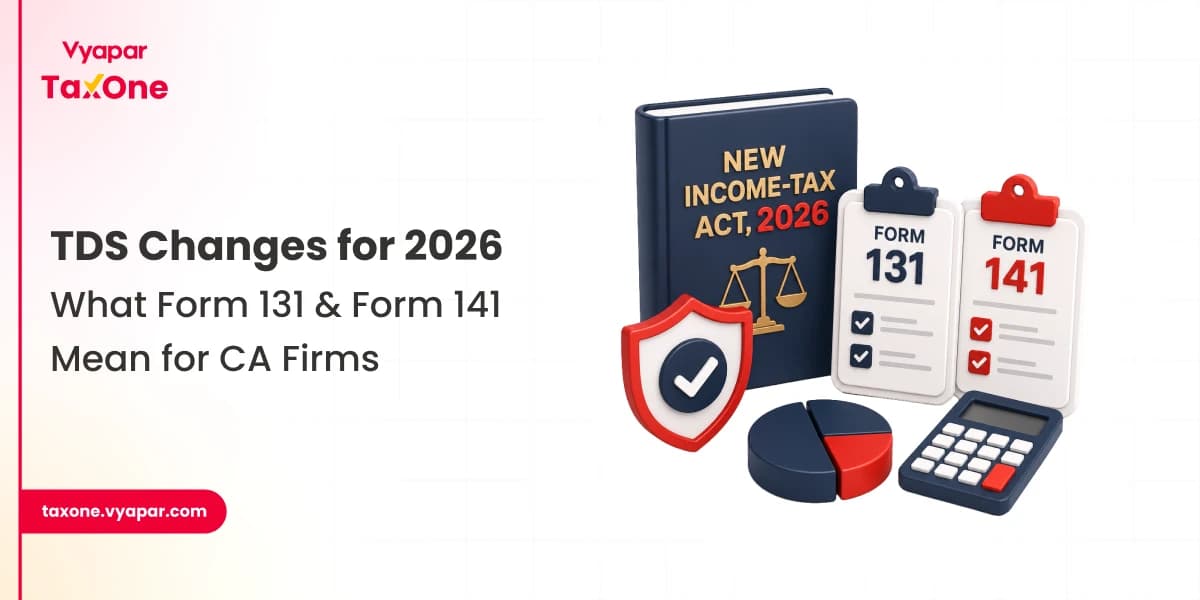
India's New Income Tax Act (via the Income-tax Bill, 2025) doesn't primarily change rates; it changes how the law is written, mapped, and consumed by systems.
That directly reshapes tax-return work: section references will shift, tables/formulae will replace long provisos, and return prep will become more "mapping + data-validation" than "reading + interpretation."
The common miss: people treat the New Income Tax Act like a "fresh code with new tax rules." The government's stated intent is different: no significant tax policy changes or modifications to tax rates, but a significant simplification of language and structure.
Why that matters for returns: when the Act changes its shape, your return workflow changes: section mapping, schedules, notices, and software logic start to move, even if the tax outcome often doesn't.
Also, remember what you're replacing: the Income-tax Act, 1961 has been amended nearly 65 times with 4,000+ amendments over time, so return preparation has become a patchwork of cross-references and exceptions.
If you view the New Income Tax Act through a return-prep lens, three shifts explain almost everything:
The Bill's simplification replaces long carve-outs with structure: far fewer sections/chapters/words, but far more tables and formulae.
For return work, that typically means:
The FAQs on the Bill describe removing about 1,200 provisos and ~900 explanations, and also call out eliminating the dual concepts of "previous year" and "assessment year" (a big documentation and form-label change if implemented in the ecosystem).
Practically: your client letters, computation formats, and templates will need dual-language during transition (old references for legacy matters + new references for future filings).
Return processing became centralized and tech-driven long before 2025:
So the New Income Tax Act is landing inside an ecosystem where your "best work" is often reconciliation + evidence + audit trail, not just computation.
| What’s changing (2025 Bill) | 1961 Act | Proposed (Bill 2025) | Return-prep impact for CAs |
|---|---|---|---|
| Total words | 512,535 | 259,676 | Less interpretive hunting; more structured referencing |
| Chapters | 47 | 23 | Fewer scattered provisions; cleaner navigation |
| Sections | 819 | 536 | Section numbers will move → update computation/notes/templates |
| Tables | 18 | 57 |
More “schedule/table-driven” logic: good for validations, but mapping-heavy | Formulae | 6 | 46 | Computations become standardized and easier to system-check | | Tax rates / major policy | — | “No modifications of tax rates” / “No major tax policy changes” | Your advisory shifts from “new rates” to “new references + process controls” |
Your fastest win under the New Income Tax Act is a durable mapping sheet.
Do this in your computation template:
Why: even if the substance is intended to stay aligned, the handles (numbers/structure) change, and those handles power notices, responses, and review checklists.
AIS is explicitly intended to support prefilling and voluntary compliance, and it encompasses more than just classic TDS/TCS.
So build your checklist like this:
For AY 2023–24 return statistics, the department's dataset is built from about 7.97 crore e-returns checked against consistency rules, with 7,97,12,145 returns used for analysis.
That scale is precisely why law + returns trend toward structured tables, validations, and centralized processing.
If your internal process still thinks in "XML upload," it's outdated: from AY 2021–22 onwards, offline utilities moved to JSON for prefilled data and uploads, and even support importing drafts from online mode.
Action: refresh staff SOPs and client instructions to avoid "format friction" from turning into deadline friction.
The Bill was tabled on 13 February 2025, and references indicate it is proposed to be brought into effect from 1 April 2026.
So: build a two-year communication plan:
What happens now: client's broker reports transactions; AIS/TIS shows capital gains/dividend values; prefill pulls it in. AIS also supports taxpayer feedback.
Your upgraded workflow under the New Income Tax Act:
CPC-era processing is built for scale; older departmental notes cite capacity constraints pre-CPC and faster processing post-centralization.
What you change: stop treating presumptive cases as "light review." Do:
With the Bill's push toward tables and removal of large volumes of provisos/explanations, expect exemptions/deductions logic to become more "table-driven" in how it's referenced and explained.
So your computation notes should evolve from: long paragraph citations
to: short citation + table row reference + working note.
The New Income Tax Act is less about "new taxation" and more about "new operating system."
Your edge as a tax professional will come from:
(1) Clean mapping, (2) AIS-led reconciliation, and (3) Airtight documentation that survives automated checks and fast central processing.
The government's executive summary explicitly states that no significant tax policy changes and no modifications to tax rates are guiding principles.
References around the Bill indicate it is proposed to be brought into effect from 1 April 2026.
Broken references. As sections/structure change (819 → 536 sections; more tables/formulae), legacy templates and review notes can silently become wrong unless you maintain a mapping layer.
AIS is explicitly designed to display complete information before filing, enable prefilling, and deter non-compliance, so its role in the return workflow is foundational regardless of how the law is renumbered.
Standardize your "prefill + reconciliation" SOP: lock AIS/TIS, reconcile, document feedback/actions, then finalize ITR. That prevents most late-stage surprises in a system-led filing world.



Get started today and simplify your accounting process!