 Is Now Vyapar TaxOne | Same Trust, New Name!
 AI Weapon for Financial Soldiers


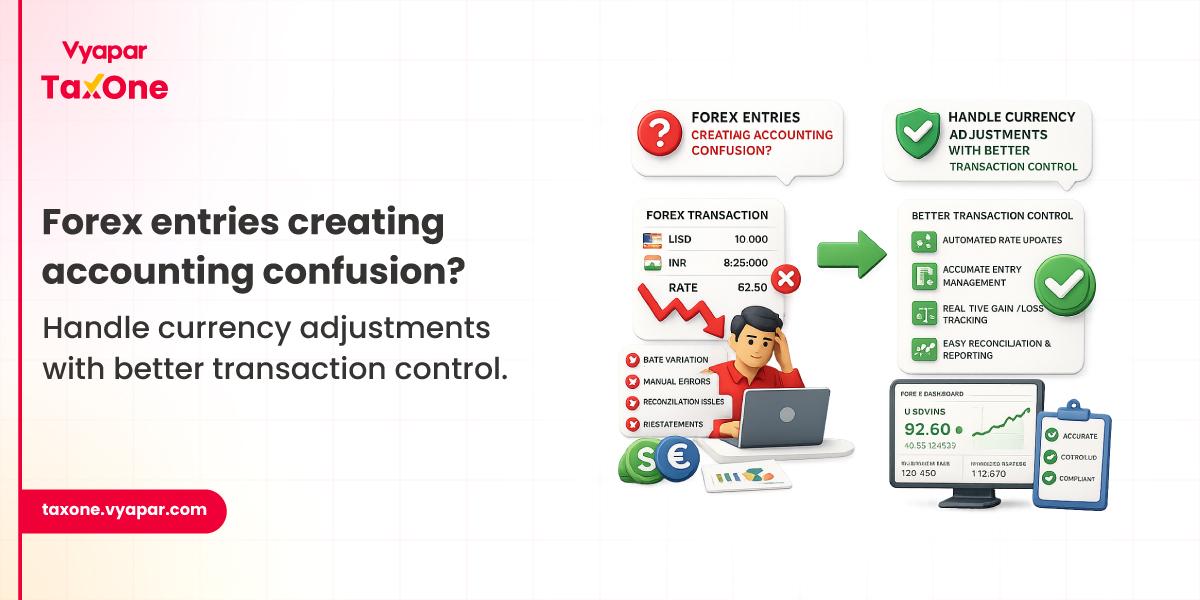
For Indian businesses handling overseas vendor payments, export receivables, or international subscriptions, foreign exchange transactions may seem manageable initially.
The challenge starts when transaction frequency begins increasing.
Now accounting teams need to record invoices in one currency, manage exchange rate differences when payment is settled later, maintain consistency across books, and review exchange adjustments before closing cycles begin.
At lower transaction volumes, teams often manage these tasks manually.
As these workflows become more complex, finance teams often realize that manual forex tracking starts creating repetitive operational work. This is one reason finance teams begin exploring solutions like accounting process automation when repetitive accounting tasks start slowing down transaction handling.
As cross-border transactions become regular, finance teams start depending more on accounting systems that can manage foreign currency transactions without creating reporting inconsistencies later.
The issue is rarely data entry itself.
The bigger challenge is maintaining accounting accuracy when currency values keep changing between booking and settlement.
Forex accounting introduces variables that normal domestic transactions simply do not create.
In day-to-day operations, finance teams often deal with:
The challenge here is that accounting teams are not just recording transactions.
They are managing transaction values that can change throughout the entire transaction lifecycle.
That is exactly why foreign exchange transactions often require accounting systems with stronger transaction-handling capabilities.
As foreign currency transactions start increasing, teams begin evaluating whether their current accounting system can handle recurring forex entries efficiently.
Here are the capabilities they typically look for.
Teams managing overseas payments need systems that allow direct foreign currency transaction recording without relying on separate spreadsheets or manual tracking.
This becomes more important when transactions happen regularly across multiple currencies.
Exchange rates can change between invoice booking and payment settlement.
Teams need systems where exchange rates can be captured accurately at different stages, so reporting inconsistencies do not build up later.
When payment settles at a different exchange rate, finance teams need proper accounting entries to record exchange differences.
Handling this manually at scale often creates correction work later.
Month-end reviews become harder when foreign currency transactions remain mixed with normal accounting entries.
Teams often need separate visibility while reviewing forex-related transactions.
Cross-border transactions usually require stronger transaction-level documentation because finance teams often revisit these entries during review and financial closing cycles.
Most finance teams handling regular foreign exchange transactions follow a structured workflow.
It typically looks like this.
The accounting system is configured based on the currencies the business regularly deals with.
This depends on overseas customers, vendors, and payment flows.
Once invoices are received or payments are expected, teams record entries using the exchange rate available on the booking date.
The transaction value gets recorded based on that exchange rate.
Once payment is processed or customer payment is received, teams update settlement values using the exchange rate applied at the time of payment processing.
This often differs from the original booked value.
If exchange rates changed between booking and settlement, accounting teams record separate exchange gain or exchange loss entries.
This is necessary for accurate reporting.
Before closing books, teams compare invoice values, settlement values, and exchange adjustments to ensure records remain accurate.
Foreign currency transactions often go through separate review because exchange adjustments can directly affect final reporting values.
The process sounds simple.
But execution becomes harder as transaction volume increases.
Imagine a trading business regularly paying overseas suppliers. Initially, the finance team manually tracked exchange rates while updating accounting entries inside their accounting software.
Over time, the team began noticing operational issues such as:
The transaction volume itself was manageable.
The real issue was the growing dependency on manual transaction monitoring.
Even when accounting systems are already in place, forex workflows often begin breaking at specific operational stages.
Teams commonly encounter:
Most issues remain unnoticed during transaction entry.
These operational gaps often turn into common accounting errors that stay hidden until final reporting validation begins and correction work starts increasing.
In most organizations, foreign exchange transaction handling follows a workflow like this.
1. Invoice received from overseas vendor
2. Accounting team records transaction using booking date exchange rate
3. Payment gets processed later through treasury workflow
4. Settlement happens using exchange rate applied at payment processing
5. Finance team compares booked value against settlement value
6. Exchange adjustment entries are reviewed and recorded based on exchange rate differences
7. Month-end reporting review identifies inconsistencies
8. Correction entries passed before final financial closing
The workflow usually slows down once exchange adjustment validation becomes manual.
Before financial closing cycles begin, teams usually review the following.
Managing foreign exchange transactions requires more than simply recording entries inside accounting software.
Finance teams need to maintain consistency across invoice booking, payment settlement, exchange adjustments, and reporting cycles while ensuring accounting accuracy throughout the transaction lifecycle.
As forex workflows become more operationally demanding, businesses gradually move toward structured accounting systems that reduce manual intervention and improve transaction control.
Solutions like Vyapar TaxOne are often introduced when businesses need stronger control over foreign currency accounting workflows while improving accounting accuracy across reporting cycles.
Most teams record the transaction using the exchange rate available on the booking date and later compare settlement values once payment is completed. The exchange difference is then recorded separately.
This happens because the exchange rate used when the invoice is recorded may differ from the exchange rate applied when the payment is actually processed. The adjustment entry gets recorded manually
Corrections usually happen when exchange differences are calculated manually, settlement updates are delayed, or inconsistent exchange rates are used during different reporting stages.
Teams should compare invoice values, settlement entries, exchange adjustments, and bank conversion charges separately during the month-end review before finalizing books.
The most common reasons include inconsistent exchange rate usage, delayed settlement updates, manual tracking outside accounting systems, duplicate correction entries, and exchange adjustments being reviewed too late during closing cycles.



Get started today and simplify your accounting process!