 Is Now Vyapar TaxOne | Same Trust, New Name!
 AI Weapon for Financial Soldiers


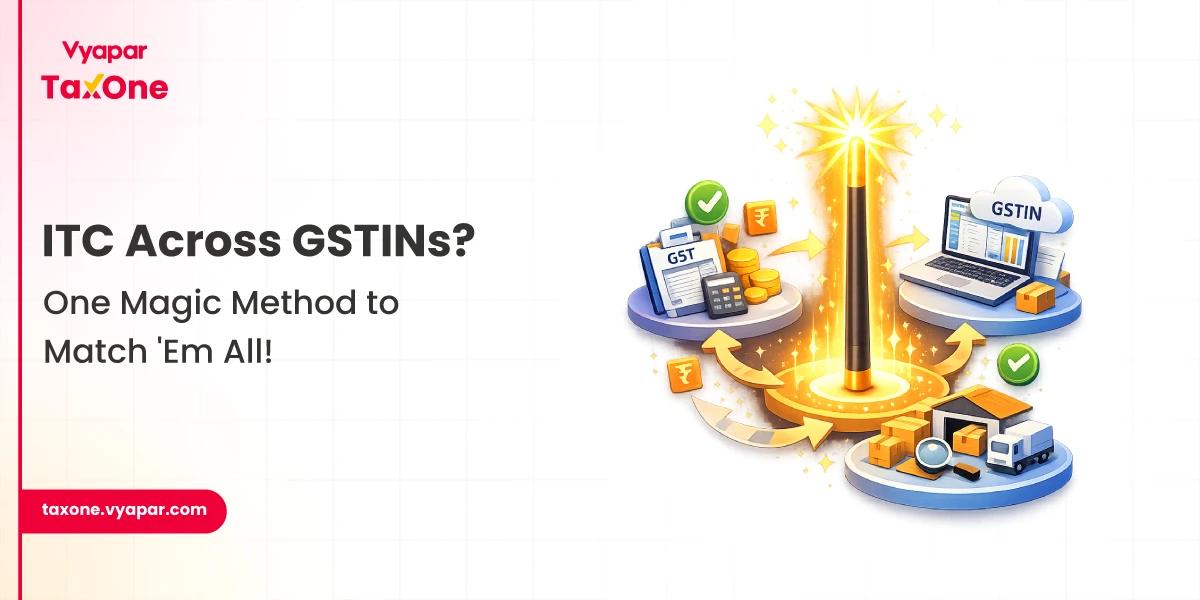
Multi-GSTIN reconciliation has become a cornerstone of GST compliance for Indian businesses operating across multiple states.
Tax professionals handling multiple GSTINs under a single PAN face unique challenges, such as branch-wise ITC mismatches and complex group-company GST structures.
This comprehensive 2026 guide presents the consolidated method for centralized reconciliation, helping you maximize Input Tax Credit (ITC) claims while minimizing audit risks.
Multi-GSTIN reconciliation refers to the systematic matching of ITC claims across multiple GST registrations under the same PAN.
Unlike single-GSTIN entities, businesses with branch-wise ITC requirements must aggregate data from various state registrations for accurate reporting.
The 2026 GST landscape demands precision due to enhanced GSTN portal validations and stricter ITC scrutiny. Centralized reconciliation at the PAN level ensures:
Without proper multi-GSTIN reconciliation, businesses risk denied credits, interest penalties, and protracted notices.
Multiple GSTIN management presents persistent hurdles that demand structured solutions:
Challenge 1: GSTR-2B vs Books Mismatch
Challenge 2: Branch-Wise ITC Tracking
Complex inter-branch transactions:
Challenge 3: Group Company GST Complications
Challenge 4: 2026 Portal Limitations
The consolidated method transforms chaotic multi-GSTIN reconciliation into a streamlined process.
Begin with granular accuracy for each registration:
Monthly Workflow:
Pro Tip: Use Excel's XLOOKUP or Python pandas for automated matching across 10,000+ invoices.
Centralized reconciliation happens here:
Aggregation Matrix Template:
| GSTIN | IGST Eligible | CGST Eligible | SGST Eligible | Total ITC Books | GSTR-2B ITC | Variance |
|---|---|---|---|---|---|---|
| State1 | ₹2,50,000 | ₹1,20,000 | ₹1,20,000 | ₹4,90,000 | ₹4,85,000 | ₹5,000 |
| State2 | ₹1,80,000 | ₹90,000 | ₹90,000 | ₹3,60,000 | ₹3,60,000 | ₹0 |
| PAN Total | ₹4,30,000 | ₹2,10,000 | ₹2,10,000 | ₹8,50,000 | ₹8,45,000 | ₹5,000 |
Key Adjustments:
Leverage 2026 GSTN enhancements:
Auto-Population Benefits:
✅ Table 4(A): ITC auto-populated from GSTR-2B
✅ Interest computation for late liabilities
✅ Mismatch alerts before final submission
Validation Checklist:
Targeted follow-up strategy:
Priority Matrix:
High Priority (>₹50k): Immediate supplier contact Medium Priority (₹10k-50k): Monthly follow-up Low Priority (<₹10k): Quarterly review
Communication Template:
Subject: Urgent GSTR-2B ITC Mismatch - Invoice [No.]
Dear [Supplier],
Our records show Invoice [No.] dated [Date] missing from your GSTR-1/GSTR-2B. Value: ₹[Amount] | GSTIN: [Your GSTIN]
Request immediate action by [Deadline].
Generate these essential reports:
1. January 2026 Portal Enhancements
New Features:
2. IGST Utilization Flexibility
New Rule (Effective Jan 2026):
CGST/SGST can cross-utilize against IGST (beyond statutory order, subject to availability)
Impact: Group company GST structures gain optimization opportunities.
ERP Solutions
TallyPrime Multi-GSTIN:
✅ Single dashboard for all registrations
✅ Auto GSTR-2B download
✅ Branch-wise ITC tracking
✅ PAN consolidation reports
Specialized GST Platforms
Excel Power Tools
Essential Formulas: =VLOOKUP(GSTR2B!A:A,Purchase!A:E,5,FALSE) // Basic matching =SUMIFS(ITC_Range,GSTIN_Range,"State1") // State-wise total =IF(ABS(Difference)>5000,"Follow-up","OK") // Threshold alerts
Implement these proven strategies:
Q4 Special Focus:
Training matrix by role: Accounts Head for PAN consolidation, GST Executive for GSTR-2B matching, Auditor for Documentation SOPs.
Daily (Ongoing)
Weekly
Monthly (Critical)
Quarterly
| Pitfall | Consequence | Prevention |
|---|---|---|
| Claiming books ITC > GSTR-2B | Notice + Penalty | Strict GSTR-2B ceiling |
| Ignoring small mismatches | Cumulative losses | Threshold-based follow-up |
| Manual aggregation | Human errors | Automated tools |
| Poor documentation | Audit failures | Structured reports |
Elevate your multi-GSTIN reconciliation with Vyapar TaxOne GST Reconciliation Feature.
Key Advantages: One-Click Multi-GSTIN Dashboard with real-time branch-wise ITC status, PAN-level consolidated view, GSTR-2B auto-import. AI-Powered Matching with fuzzy logic, credit note auto-linking, 95% automation rate. 2026 Compliance Ready with auto-populated GSTR-3B validation, IGST utilization optimizer, and audit trail generator.
Perfect for CA firms with 50+ clients, corporates with 10+ GSTINs, and group companies needing centralized reconciliation. Start your free trial today and transform GSTIN management from a compliance burden to a competitive advantage.
Multi-GSTIN reconciliation matches Input Tax Credit (ITC) claims across multiple GST registrations under one PAN, ensuring branch-wise ITC accuracy before PAN-level consolidation.
The 2026 GST updates (GSTR-3B auto-population, IGST flexibility) make centralized reconciliation essential to avoid ITC reversals, penalties, and audit issues in multiple GSTIN management.
Monthly, download GSTR-2B by Day 10, match discrepancies, and finalize before GSTR-3B filing to maximize claims and support group company GST compliance.
ERP solutions like TallyPrime, GST platforms (Vyapar, TaxOne), and Excel formulas streamline multi-GSTIN reconciliation with automated matching and PAN dashboards.
No, strictly limit claims to the available credit under the 2026 rules for GSTR-2 B to prevent notices and ensure smooth group company GST filings.


Get started today and simplify your accounting process!