 Is Now Vyapar TaxOne | Same Trust, New Name!
 AI Weapon for Financial Soldiers



Artificial Intelligence (AI) is transforming accounting for Chartered Accountants in India, Artificial Intelligence is changing how Chartered Accountants manage bookkeeping, GST reconciliation, invoice processing, client communication, reporting, and compliance work.
But the real question is not whether AI is useful. The real question is how safely and practically CAs can use it without losing accuracy, control, or professional judgment.
This guide explains the pros and cons of AI in accounting from a CA firm’s perspective.
You will understand where AI can save time, reduce manual effort, and improve financial visibility, as well as where it can create risks such as data privacy issues, poor-quality outputs, over-dependence, and implementation challenges.
AI accounting integrates machine learning, automation, and natural language processing (NLP) with core accounting workflows. It transforms manual processes such as data entry, invoice processing, GST filing, and reconciliation into intelligent, automated actions.
For Chartered Accountants, AI accounting is most useful in areas where the work is repetitive, rule-based, document-heavy, or data-heavy.
Common examples include:
However, AI accounting does not mean fully automatic accounting without human control. Accounting requires accuracy, understanding of compliance, professional judgment, and accountability.
AI can prepare, suggest, flag, or organise information, but a CA or trained accounting professional should still review and approve important entries, reports, filings, and advisory decisions.
| Pros of AI in Accounting | Cons of AI in Accounting |
|---|---|
| Automates repetitive tasks like data entry, invoice reading, and reconciliation | Requires clean, structured, and accurate data to work properly |
| Saves time for CAs and accounting teams | Initial setup, training, and workflow changes can take effort |
| Improves speed and consistency in routine processes | Wrong inputs can lead to wrong outputs if not reviewed |
| Helps identify mismatches, missing documents, and unusual transactions | Sensitive financial data needs strong privacy and security controls |
| Supports faster GST, tax, and compliance preparation | Staff and clients may resist changing from manual workflows |
| Allows firms to handle more clients without increasing manual workload in the same proportion | AI cannot replace professional judgment, audit reasoning, or final approval |
The best way to look at the pros and cons of AI in accounting is simple: AI excels at speed, automation, and pattern detection, but human expertise remains essential for judgment, compliance interpretation, client advisory, and accountability.
AI can make accounting firms more efficient, especially when used for repetitive, time-consuming tasks. For CA firms handling multiple clients, monthly GST work, document collection, reconciliation, and reporting, AI can reduce manual pressure and make workflows more predictable.
Manual bookkeeping, invoice reconciliation, and GST return filing consume valuable time. AI automates these routine tasks, drastically reducing errors and accelerating workflows. Vyapar TaxOne, for example, automates data extraction from diverse documents, streamlining Tally entries and GST compliance seamlessly.
AI’s ability to consistently apply rules and spot anomalies improves accuracy far beyond human limits. Automated reconciliation tools catch discrepancies instantly, ensuring reliable financial records. This does not remove the need for human checking, but it improves the first level of accuracy. Instead of manually searching for every error, the accounting team can focus on exceptions and high-risk entries.
Unlike traditional batch processing, AI provides real-time dashboards and reports that offer deeper insights into financial health, enabling swift corrective actions. This helps CAs move from only compliance work to more proactive advisory. Instead of telling clients what happened after the month is over, firms can help them understand what needs attention now.
AI can support compliance by checking data consistency, identifying missing information, and flagging potential errors before filing or reporting. In accounting and tax work, small mistakes can lead to notices, penalties, delayed filings, or client dissatisfaction.
AI tools can help by creating validation checks, tracking document status, and reducing last-minute manual pressure. Still, compliance decisions should always be reviewed by qualified professionals because laws, circulars, notifications, and case-specific interpretations require human understanding.
For Indian CA firms, GST reconciliation is one of the most important use cases of AI in accounting. AI can help compare purchase records, sales data, invoices, GSTR data, and ledger entries to identify mismatches faster.
This is especially useful during monthly filing periods when teams are under pressure to complete work quickly. AI can highlight missing invoices, incorrect GSTIN details, value discrepancies, duplicate entries, and reconciliation gaps, so the team can take corrective action before filing.
By automating transactional work, AI empowers Chartered Accountants to transition into trusted business advisors, offering strategic insights backed by data.
Many accounting delays happen because clients do not send documents on time or miss important communication. AI-enabled systems can help organise document requests, reminders, status updates, and client conversations.
This improves transparency for both the CA firm and the client. The team can quickly see which documents are pending, which clients need follow-up, and which tasks are ready for review.
AI brings clear benefits, but it also creates practical risks. CA firms should understand these limitations before depending heavily on AI-based accounting systems.
Adopting AI solutions takes time, investment, and careful process changes. Initial costs and training needs can be challenging, particularly for smaller firms.
AI systems are only as effective as the quality of data they receive. Poor-quality inputs or incomplete records limit AI’s accuracy and effectiveness.
Complex accounting judgments cannot rely solely on AI. Skilled intervention is needed to interpret nuanced transactions and regulatory exceptions.
Handling sensitive financial data requires robust cybersecurity frameworks to protect against breaches, an ongoing concern for AI platforms.
Employees and clients accustomed to traditional methods may resist AI adoption, requiring change management and clear communication.
Some AI tools provide recommendations or classifications without clearly explaining how they arrived at those results. This can be risky in accounting because every entry, adjustment, reconciliation, and report should be traceable.
If a tool cannot explain why a transaction was flagged, categorised, or matched, the team may struggle during review, audit, or client discussions. CA firms should prefer tools that provide clear logs, source references, confidence indicators, and review history.
One of the biggest risks of AI in accounting is unquestioningly trusting the system. Even if an AI tool works well most of the time, it can still make mistakes. If teams stop reviewing outputs properly, errors may pass into final reports, filings, or client records.
AI should never become a shortcut for professional judgment. It should be used as a productivity layer with clear review and approval controls.
To reap the benefits of AI without incurring unnecessary risk, CA firms should adopt it in a controlled, practical way.
Start with low-risk, high-volume tasks such as invoice data extraction, document reminders, reconciliation support, and internal reporting. These areas give quick efficiency benefits without handing over major professional decisions to AI.
Next, create review rules. Decide which tasks can be automated, which tasks need staff review, and which tasks need partner or senior approval. For example, AI may automatically extract invoice data, but GST filings, tax interpretations, audit comments, and final client reports should be reviewed by humans.
Firms should also maintain proper audit trails. Every AI-supported action should be traceable, including who reviewed it, what was changed, and when it was approved. This is important for accountability, client trust, and internal quality control.
A practical AI adoption checklist for CA firms:
The goal is not to make the firm fully dependent on AI. The goal is to combine automation with professional judgment.
Accounting will move toward end-to-end intelligent automation, covering everything from invoice capture to financial closing, minimising human intervention while maximising accuracy.
Advanced AI models will increasingly forecast cash flows, tax liabilities, and client financial health, helping CAs offer personalized, proactive advisory beyond crunching historical numbers.
Chatbots and virtual assistants will handle client queries, document reminders, and preliminary consultations, enhancing responsiveness and satisfaction.
AI systems will embed continuous risk assessments and anomaly detection directly into transactional workflows, enabling instant regulatory compliance checks.
Future AI solutions will seamlessly connect ERP, tax engines, banking, and accounting platforms, delivering a unified, transparent financial ecosystem.
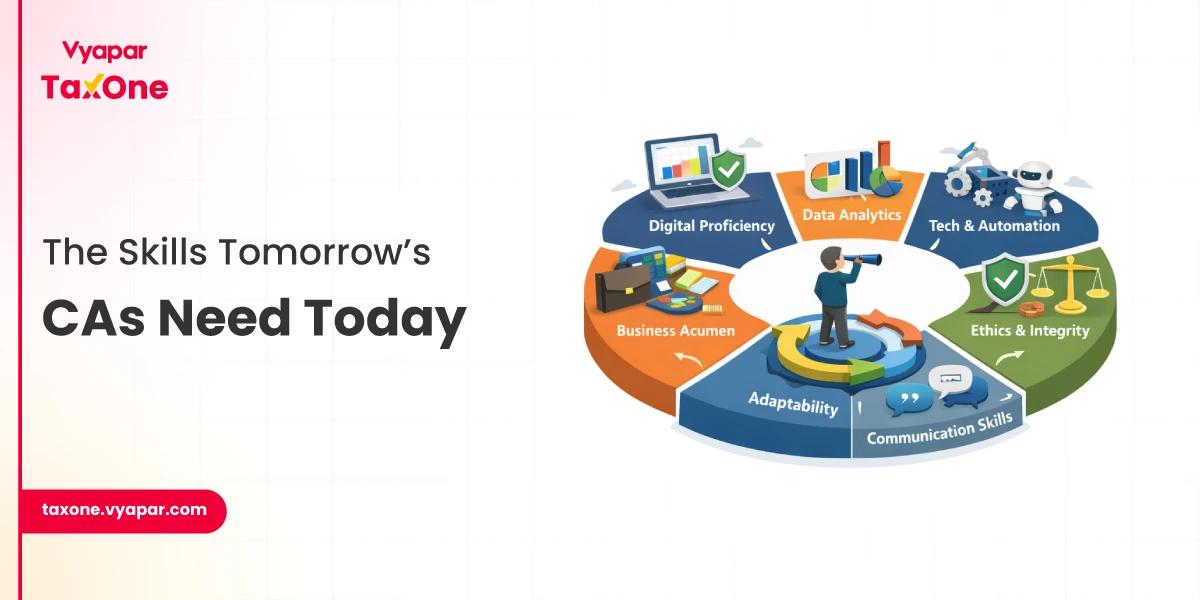
Indian Chartered Accountants must embrace new skills and mindsets:
Firms should assess readiness, plan phased AI adoption, and foster a culture that blends technology with expert human judgment.
AI accounting is a game-changer for Chartered Accountants in India, boosting efficiency, accuracy, and compliance while freeing time for strategic advisory. Tools like Vyapar TaxOne show how automation can streamline workflows and deliver real results. CAs who embrace AI now will be better equipped to adapt, grow, and lead in the evolving accounting landscape.
The main pros of AI in accounting are automation, faster data processing, improved accuracy, better reconciliation, real-time reporting, and scalable workflows. The main cons are setup complexity, poor data quality risks, security concerns, lack of explainability, staff resistance, and the need for human review.
AI automates data entry, bank reconciliation, GST return preparation, invoice processing, real-time reporting, fraud detection, and client communication.
Initial setup costs, need for high-quality data, employee resistance to change, and ensuring the security of sensitive client data are key challenges.
Leading AI platforms like Suvit follow strict encryption and GDPR-like compliance measures to protect financial data, but firms must still implement robust internal security policies.
Hyperautomation, deeper ERP integrations, predictive cash flow tools, AI-driven client chatbots, and continuous real-time audits will shape the profession.
No, AI is a tool to assist, not replace. It handles repetitive work so CAs can focus on higher-value tasks like advisory and strategic decision-making.


Get started today and simplify your accounting process!