 Is Now Vyapar TaxOne | Same Trust, New Name!
 AI Weapon for Financial Soldiers


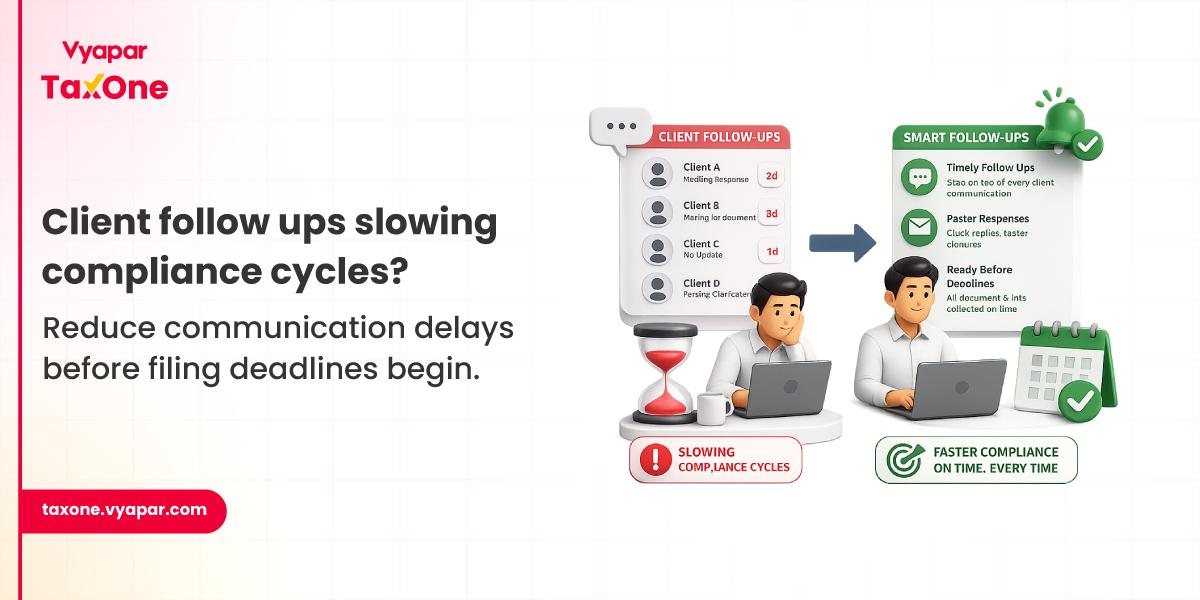
Most compliance delays do not begin during the GST or TDS filing week.
In many CA firms and accounting teams, delays begin much earlier when client communication starts becoming fragmented across WhatsApp conversations, email threads, spreadsheets, shared folders, and repeated follow-up cycles.
A missing invoice request that goes unanswered for three days can quietly delay bookkeeping review. A pending approval from a client can push reconciliation review further into the month-end cycle. Teams often assume filing pressure begins near deadlines, but in practice, communication breakdowns start creating operational bottlenecks much earlier.
As firms begin handling larger transaction volumes and more client accounts, communication management stops being an administrative task and starts becoming a workflow dependency.
This is why many accounting teams now evaluate software not simply for messaging convenience, but for improving how document collection, compliance coordination, approval tracking, and client communication are managed during active accounting cycles.
Below are 10 software platforms firms commonly evaluate when communication workflows begin affecting operational consistency.
Client communication inside accounting firms usually becomes difficult when firms begin handling multiple parallel compliance cycles.
In most firms, communication dependencies begin increasing when teams are managing:
Communication problems rarely come from a lack of effort.
They usually come from fragmented workflow systems.
Teams often depend on:
Once client volume increases, communication itself becomes an operational bottleneck.
We repeatedly see communication-related workflow failures affecting accounting execution in firms.
Common operational issues include:
These issues often remain unnoticed until compliance review begins. Many firms start noticing these patterns only after understanding why accounting workflows get delayed during high-volume compliance cycles.
By then, correction cycles become much harder to manage.
We often observe that communication-related workflow issues stay hidden until transaction volume begins increasing.
Most accounting teams manage communication reasonably well when handling smaller client portfolios.
Problems usually begin appearing when firms start managing larger operational volumes.
For example:
Small communication gaps usually remain invisible until the reconciliation review begins.
This becomes far more noticeable during month-end closure cycles.
A typical communication workflow inside accounting practices often looks like this.
The issue is rarely accounting complexity.
It is usually a communication dependency slowing execution.
CA firms managing multiple GST registrations often spend significant time collecting purchase invoices and vendor documents before reconciliation review can begin.
Some records arrive on WhatsApp, others through email, while certain approvals remain pending with clients.
Even small delays at this stage can push the entire filing cycle forward.
Accounting teams managing large compliance portfolios often depend on spreadsheets to track pending document requests.
As filing week approaches, staff members begin manually checking which clients have responded and which submissions remain incomplete.
This creates repeated follow-up cycles that slow bookkeeping review significantly.
Once communication dependencies begin affecting operational consistency, firms usually start evaluating systems that help improve document coordination, follow-up tracking, approval visibility, and communication management during active compliance cycles.
Below are the platforms firms commonly evaluate depending on workflow structure.
As firms begin managing larger compliance volumes, repeated client communication starts becoming difficult to track manually.
Workflow challenges such as pending document collection, follow-up dependency, scattered communication history, and approval bottlenecks often push accounting teams toward structured systems such as Vyapar TaxOne once manual coordination begins affecting operational consistency.
Operational areas firms typically evaluate:
Often evaluated by:
Accounting teams operating remote or cloud-based workflows often evaluate Zoho Books when document sharing and communication happen digitally rather than through offline coordination.
It is commonly considered that firms want communication and accounting workflows operating inside one connected environment.
Operational areas firms typically evaluate:
Often evaluated by:
Businesses frequently exchange invoices, billing records, payment details, and accounting documents with their accountants.
Many growing businesses evaluate the Vyapar App when day-to-day customer communication overlaps with accounting coordination and regular financial record sharing with external accountants.
Operational areas businesses typically evaluate:
Often evaluated by:
Firms already operating inside Tally-based accounting environments often evaluate TallyPrime when communication workflows need to stay closely connected with ongoing accounting processes.
It is usually considered when firms prefer working inside existing accounting systems rather than shifting workflows elsewhere.
Operational areas firms typically evaluate:
Often evaluated by:
Firms managing large client portfolios often face repeated communication cycles around payment reminders, document requests, and compliance coordination.
Busy is often evaluated when communication volume itself starts becoming difficult to manage manually.
Operational areas firms typically evaluate:
Often evaluated by:
Tax-focused firms often evaluate ClearTax when communication workflows operate closely with active compliance management and filing deadlines.
The need usually arises when compliance communication becomes tightly linked with tax filing execution.
Operational areas firms typically evaluate:
Often evaluated by:
Bookkeeping teams often evaluate Client Hub when communication begins getting fragmented across emails, messages, and document requests.
It is commonly reviewed when firms need better communication visibility during active accounting cycles.
Operational areas firms typically evaluate:
Often evaluated by:
Process-driven accounting teams frequently evaluate Financial Cents when internal workflow coordination and communication management begin overlapping.
It is often reviewed when internal collaboration becomes just as important as external communication.
Operational areas firms typically evaluate:
Often evaluated by:
Firms already operating inside QuickBooks-based accounting environments often evaluate QuickBooks Online when accounting communication needs to remain connected with billing and transaction workflows.
The requirement usually appears when communication and accounting activities operate together inside the same environment.
Operational areas firms typically evaluate:
Often evaluated by:
Larger accounting teams often evaluate Karbon when communication management becomes difficult across multiple internal team members and large client portfolios.
The focus usually shifts toward better workflow visibility rather than simple communication management.
Operational areas firms typically evaluate:
Often evaluated by:
| Workflow Challenge | Software Often Evaluated |
|---|---|
| Repeated client follow-ups | Vyapar TaxOne |
| Cloud-based document coordination | Zoho Books |
| Invoice sharing between the business and the accountant | Vyapar App |
| Existing Tally-based communication workflows | TallyPrime |
| High-volume reminder management | Busy Accounting Software |
| Compliance deadline coordination | ClearTax |
| Bookkeeping communication tracking | Client Hub |
| Internal workflow coordination | Financial Cents |
| Accounting communication inside cloud workflows | QuickBooks Online |
| Large team communication visibility | Karbon |
Building repeatable systems for managing client documents and deadlines helps firms reduce operational bottlenecks before filing pressure begins.
✓ Verify all pending client document requests
✓ Check unanswered communication threads
✓ Confirm invoice collection is complete before bookkeeping review
✓ Review approval dependencies pending with clients
✓ Check unresolved communication gaps before reconciliation review
✓ Verify payment-related communication status
✓ Confirm document collection tracking remains updated across staff members
Operational delays in accounting firms often do not originate from accounting work itself.
In many cases, execution begins slowing much earlier when communication workflows become fragmented across multiple channels, and teams lose visibility over pending document collection, approvals, and unresolved follow-ups.
As compliance volume grows, manual communication management becomes increasingly difficult to maintain consistently.
Many firms gradually move toward more structured operational workflows once communication dependency starts affecting month-end execution cycles.
This is exactly the kind of workflow challenge where systems such as Vyapar TaxOne often become part of a broader workflow shift when firms begin reducing dependence on fragmented manual coordination.
Month-end filing delays usually begin much earlier when accounting teams are still waiting for purchase invoices, bank statements, approval confirmations, or vendor documents from clients. If document collection remains incomplete, bookkeeping review and reconciliation cycles automatically get pushed forward.
This usually happens when firms depend on multiple communication channels simultaneously. Some documents arrive on WhatsApp, approvals come through email, and follow-up status is tracked manually in spreadsheets. As client volume increases, visibility starts breaking down.
WhatsApp works well for individual conversations, but firms managing large client portfolios often struggle when communication history remains scattered across multiple staff members. Teams frequently lose visibility over pending requests, previous approvals, and unresolved follow-ups.
Communication delays usually start affecting reconciliation once accounting teams begin transaction review and discover that supporting documents are still pending with clients. Missing invoices, incomplete records, or unresolved clarifications can delay review cycles significantly.
During active filing periods, accounting teams often handle multiple client accounts simultaneously. When approvals depend on manual follow-ups, small delays from individual clients begin accumulating and create bottlenecks across the entire compliance cycle.
When invoice requests, payment confirmations, purchase records, and document approvals are managed across disconnected systems, teams spend additional time manually verifying whether records are complete. This slows bookkeeping execution before review even begins.
As firms begin managing larger compliance portfolios, repeated document requests become harder to track manually. Teams often spend more time checking pending client responses than actually progressing accounting work, which gradually affects month-end execution consistency.
Accounting firms often use communication management systems that help centralize document requests, automate reminders, track approvals, and reduce dependency on manual follow-ups. Firms typically evaluate solutions based on workflow complexity, client volume, and compliance requirements.
Accounting firms usually reduce communication delays by standardizing document collection processes, automating follow-up reminders, centralizing client communication history, and improving visibility over pending approvals before active filing cycles begin.



Get started today and simplify your accounting process!