 Is Now Vyapar TaxOne | Same Trust, New Name!
 AI Weapon for Financial Soldiers


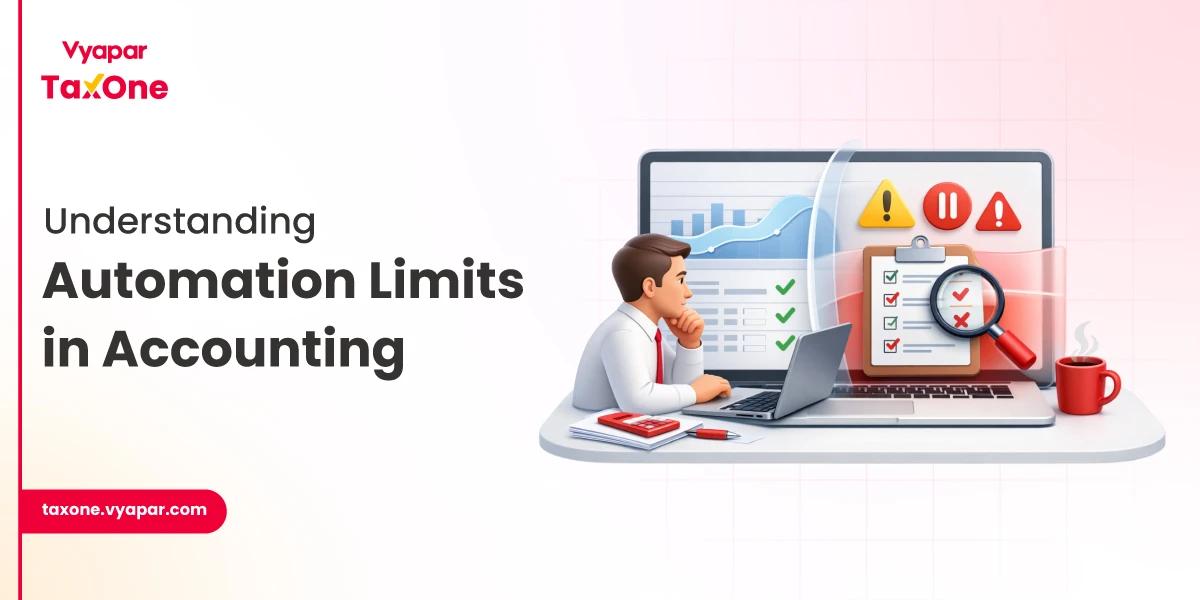
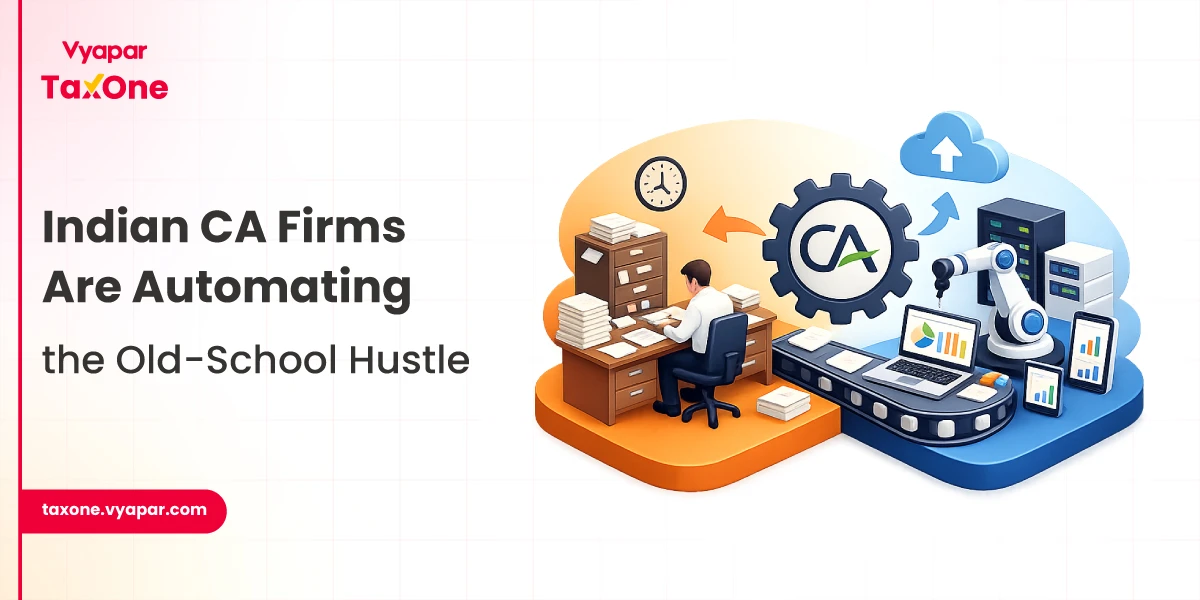
Automation is revolutionizing how accounting and taxation professionals operate, especially in India's rapidly evolving financial ecosystem.
From AI accounting software and cloud-based automation tools to GST compliance integrations, digital transformation is reducing manual work, minimizing errors, and improving client collaboration.
While automation increases efficiency, not every accounting function can or should be fully automated. This blog explores which parts of accounting can be safely automated, which still require human judgment, and how modern tools like Vyapar TaxOne empower Chartered Accountants (CAs) and tax professionals to achieve both precision and control.
In India, AI-integrated accounting platforms such as Tally Prime, Zoho Books, and Vyapar TaxOne are changing accounting. These systems connect directly with GSTN, banking networks, and WhatsApp, creating seamless workflows from data entry to tax filing.
AI-enabled systems now automatically extract key details from invoices, bank statements, and purchase ledgers, using OCR (Optical Character Recognition) and data mapping. This significantly reduces the time and risk associated with manual entry.
Automated reconciliation helps match transactions across multiple data sources: bank statements, client ledgers, and purchase records, with high accuracy. Modern accounting automation tools issue exception alerts for unmatched or duplicate entries, enhancing audit readiness.
Automated invoicing ensures GST-compliant invoice generation, scheduled payment reminders, and instant posting to accounting ledgers. Tools with e-invoicing API integration also enable direct upload to government portals.
Automation simplifies salary processing, TDS deductions, and PF/ESI compliance. Reports are generated instantly, and payslips can be distributed securely with minimal human intervention.
AI accounting software generates real-time dashboards, ratio analysis, and financial summaries, enabling management to make informed decisions faster. Custom reporting templates also allow accountants to compare performance periods effortlessly.
Automated workflows now handle reconciliations for GSTR-1, GSTR-3B, and the annual return. Integration with GSTN ensures seamless data transmission and automatic error detection before submission.
While automation greatly enhances speed and accuracy across most accounting tasks, certain areas still require human analysis, ethical oversight, and contextual judgment that artificial intelligence cannot replicate. Below are the key domains where professional expertise remains indispensable.
Tax advisory services involve much more than applying rules; they demand interpretive intelligence and a nuanced understanding of India's ever-evolving financial regulations.
Automation can assist auditors by flagging anomalies or generating analytical samples, yet it cannot replace professional skepticism or ethical assessment.
India's taxation and corporate laws change frequently and often include context-driven interpretations.
Decisions that shape a business's financial future demand a deep understanding of market dynamics, behavioural trends, and corporate goals, variables beyond automation's logical scope.
Accounting is as much a relationship-driven profession as it is a procedural one.
As accounting evolves, the future is not about replacing professionals; it's about empowering them through intelligent automation. Tools like Vyapar TaxOne exemplify this balance, allowing CAs and tax practitioners to automate document collection, transaction mapping, and GST filing without compromising data control or accuracy.
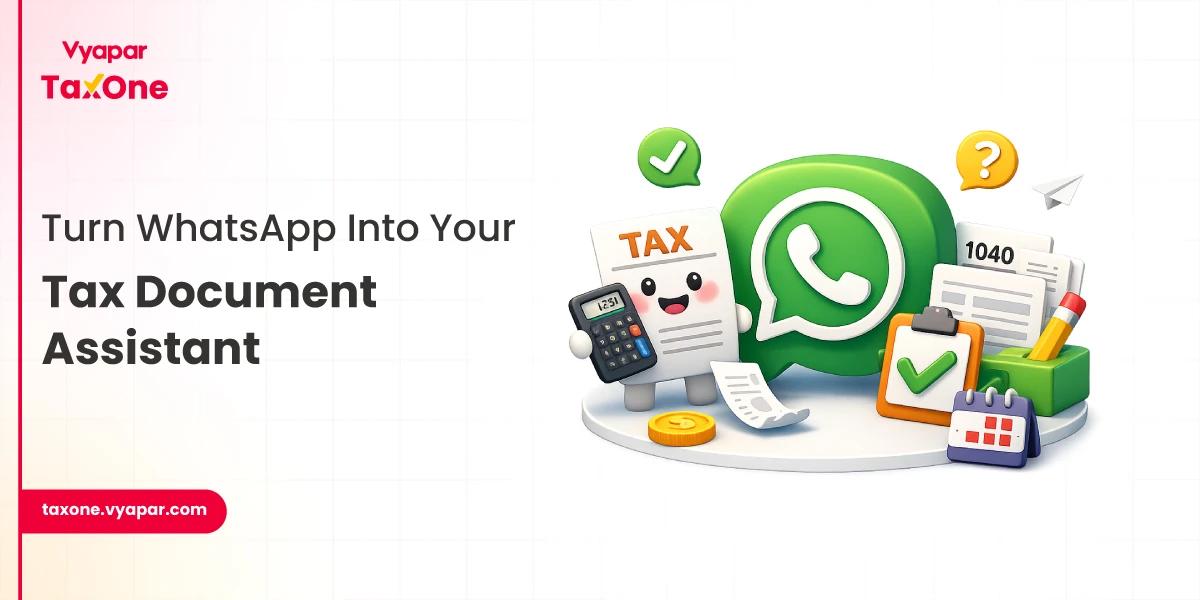
By seamlessly integrating with Vyapar Accounting Software, Tally, and Excel, Vyapar TaxOne automates repetitive tasks, such as collecting invoices via WhatsApp, validating entries, and reconciling ledgers, while ensuring human oversight at each review stage.
With built-in data security, 30+ validation checkpoints, and timely compliance alerts, it delivers safe, transparent, and scalable accounting automation designed for India's professional ecosystem.
For tax professionals seeking to streamline operations and focus on strategic work, Vyapar TaxOne is a proven tool that bridges the gap between automation efficiency and professional judgment in modern accounting practice.
Routine, rule-based tasks such as data entry, bank reconciliation, GST return preparation, invoicing, and payroll processing can be safely automated using AI-powered accounting software.
Functions involving professional judgment, like tax advisory, audits, regulatory interpretation, and strategic financial planning, should remain under expert oversight.
Automation minimizes manual errors by standardizing data input, flagging discrepancies, and running validations before report generation or GST filing.
Yes, reputable accounting automation platforms like Vyapar TaxOne use encrypted data transfers, access controls, and multi-layer validation to ensure compliance and data security.
Vyapar TaxOne automates document collection, ledger mapping, and GST reconciliation, allowing CA firms to handle more clients efficiently while maintaining accuracy and compliance.

Get started today and simplify your accounting process!