 Is Now Vyapar TaxOne | Same Trust, New Name!
 AI Weapon for Financial Soldiers


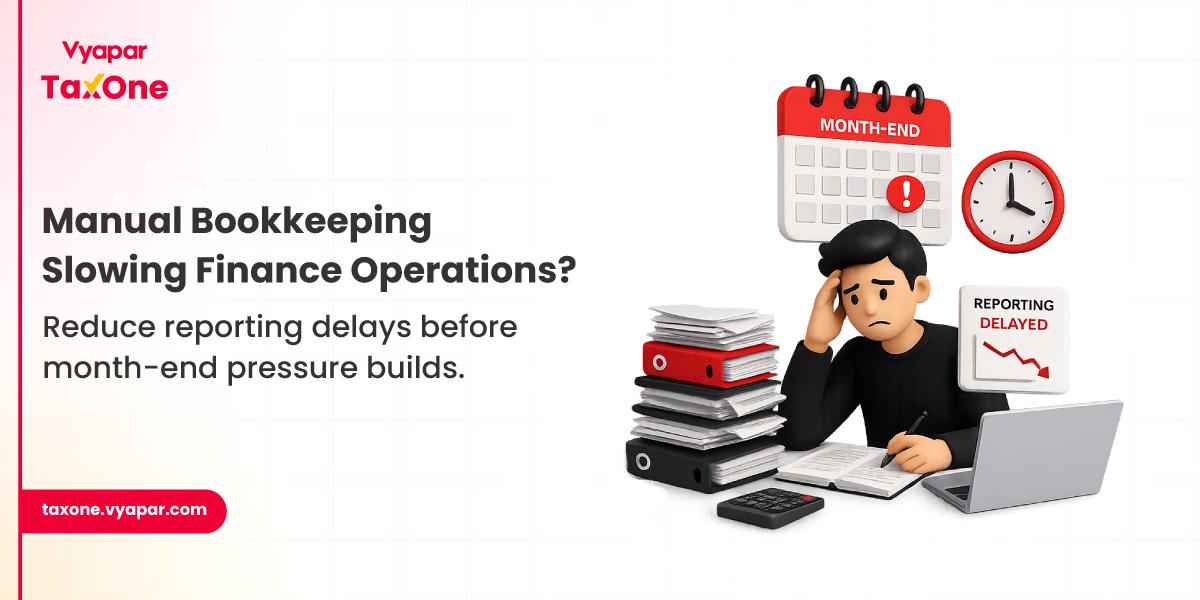
Most accounting teams do not notice bookkeeping inefficiencies early. The actual operational pressure usually starts building when finance teams begin spending more time recording transactions manually, reconciling mismatches, and correcting ledger errors before month-end reporting.
Sales entries are recorded manually. Vendor payments are updated separately. Bank transactions are checked at the end of the day. Purchase invoices are entered manually before reconciliation begins.
At lower transaction volume, this usually works without creating major operational friction.
In most cases, the problem does not come from accounting complexity alone.
The pressure usually becomes visible once daily bookkeeping begins consuming increasing time in transaction validation and repeated correction cycles before the reporting review begins.
We often see businesses reach this stage when accounting teams continue relying on spreadsheets and manual bookkeeping processes long after transaction volume has started increasing.
In most finance teams, bookkeeping rarely moves through a single continuous workflow. Sales transactions, purchase entries, vendor payments, bank reconciliation, GST classification, inventory accounting, and journal voucher processing often move through separate operational stages before final reporting review begins.
At lower accounting volume, these fragmented workflows usually remain manageable without creating visible operational pressure.
The challenge begins when transaction volume starts increasing across multiple accounting functions simultaneously. Teams begin spending more time consolidating records, cross-verifying entries across departments, and validating whether accounting records remain consistent before month-end review begins.
We often notice that businesses begin evaluating bookkeeping automation benefits only after these disconnected bookkeeping workflows start consuming increasing operational time every month.
Most bookkeeping delays happen because financial workflows remain heavily dependent on manual intervention. Common causes include:
When different teams maintain separate spreadsheets for sales, purchases, vendor payments, and reconciliations, finance teams often spend additional time consolidating records before final reporting.
In most businesses, these problems remain invisible early on.
They become noticeable only when month-end reporting cycles start taking longer than expected.
This is usually where finance teams begin losing operational time.
The most common breakdown points include:
Accounting teams manually record transactions coming from multiple business systems.
Result:
Bank transactions, invoices, and accounting records often require manual matching.
Result:
Duplicate entries often begin appearing when multiple team members handle repetitive transaction posting manually across disconnected accounting workflows without centralized validation.
Result:
Financial reports often depend on transaction verification before final reporting. Result:
When bookkeeping records are not updated accurately, compliance preparation usually requires additional correction work before filing cycles begin.
Incorrect GST classification often begins when accounting teams manually post invoices without verifying ledger mapping properly or apply incorrect tax categories during high-volume transaction processing, requiring additional correction before return preparation begins.
Result:
Manual bookkeeping errors often remain unnoticed because transaction entries are usually reviewed only during reconciliation or month-end verification stages. When accounting teams handle large transaction volumes manually, small posting mistakes, duplicate entries, or incorrect ledger classification may continue unnoticed for long periods before review begins.
Many of these operational breakdowns begin with common bookkeeping mistakes that gradually become harder to detect as transaction volume increases across accounting workflows.
Result:
We regularly see these issues becoming worse during reporting cycles when transaction volume increases sharply.
A CA firm managing bookkeeping for more than 30 recurring business clients was processing more than 3,000 accounting entries every month while continuing to manage bookkeeping through spreadsheets and manual ledger posting.
As transaction volume increased, the finance team spent more than 15 additional working hours every month verifying entries before reconciliation.
During the month-end review, hundreds of accounting entries required correction because duplicate invoice entries had been recorded during manual posting.
Final reporting preparation was delayed by nearly 4 business days.
The actual delay did not come from reporting itself.
It started much earlier during daily bookkeeping operations.
A retail business operating across 7 branch locations processed thousands of daily transaction records across sales, expenses, vendor payments, and inventory movement.
Since branch teams recorded transactions separately, the central finance team spent multiple additional working hours consolidating records manually before final accounting review.
Multiple duplicate entries and delayed reconciliation cycles forced management reporting to be pushed back by nearly 3 working days.
Most issues only became visible during the final month-end accounting review.
Across finance teams and accounting environments, we usually notice similar patterns once bookkeeping volume starts increasing.
We often see these issues becoming significantly more visible only when businesses begin handling larger transaction volumes during reporting cycles.
In many finance teams, bookkeeping still moves through multiple disconnected manual validation stages before final accounting records are considered ready for reconciliation and reporting review.
Step 1
Collect transaction data from sales systems, purchase records, bank statements, and invoices
Step 2
Record sales, purchases, expenses, and payment entries manually inside accounting software
Step 3
Verify invoice details and supporting transaction documents
Step 4
Post accounting vouchers and update ledger records
Step 5
Reconcile bank transactions with accounting entries
Step 6
Identify missing entries, duplicate transactions, or ledger mismatches
Step 7
Correct accounting discrepancies manually after verification
Step 8
Prepare financial reports after reconciliation review
The biggest operational breakdown usually happens during reconciliation and manual verification stages because finance teams spend excessive time validating whether transaction records have been posted accurately.
As accounting workload increases, finance teams often begin reassessing workflows that require repeated manual transaction handling across multiple operational stages.
Once finance teams begin reducing dependency on manual transaction handling, repetitive validation workload across reconciliation, reporting review, and compliance preparation usually starts reducing significantly.
Reduced Dependency On Repeated Manual Validation
Finance teams spend significantly less time repeatedly checking transaction records before reconciliation and reporting review begins.
Lower Ledger Posting Errors
Reducing repeated manual transaction handling lowers the frequency of duplicate entries, incorrect ledger classification, and posting inconsistencies.
Faster Reconciliation Review
Reconciliation cycles stop requiring repeated manual matching across accounting records before final month-end review begins.
Lower Compliance Correction Work
Compliance preparation usually requires fewer correction cycles once bookkeeping inconsistencies begin reducing during earlier accounting stages.
Lower Validation Work Before Final Reporting Review
Reporting preparation stops getting delayed when finance teams no longer spend excessive time manually validating accounting records before review cycles begin.
More Predictable Audit Review Cycles
Audit review becomes easier once accounting records require fewer repeated verification rounds during document review stages.
Reduced Spreadsheet Dependency Across Teams
Disconnected spreadsheets stop creating repeated record mismatches across departments handling accounting data separately.
Better Capacity To Handle Higher Accounting Volume
Growing accounting workload becomes easier to manage without continuously increasing correction effort and verification workload every month.
Before shifting away from manual bookkeeping processes, teams usually review:
✓ How much time is spent on daily manual entries
✓ Whether reconciliation cycles are regularly getting delayed
✓ How often duplicate accounting entries occur
✓ Whether reporting cycles regularly require manual corrections
✓ Whether teams rely heavily on spreadsheets for accounting workflows
✓ Whether audit preparation requires repeated manual validation
✓ Whether transaction volume is increasing faster than bookkeeping capacity
✓ Whether GST reporting preparation regularly depends on manual bookkeeping corrections
Most businesses do not actively rethink bookkeeping workflows early because manual accounting processes usually feel manageable when transaction volume is still relatively low.
But as businesses continue growing, finance teams gradually begin spending more time verifying entries, correcting ledger mismatches, reconciling transaction inconsistencies, and resolving reporting delays before month-end closing cycles begin.
In many cases, the operational pressure does not come from accounting complexity alone.
The bigger issue usually begins when bookkeeping workflows remain dependent on spreadsheets, repeated manual transaction posting, disconnected approval processes, and increasing validation work spread across multiple teams handling daily accounting operations.
We often notice that as accounting volume increases, small bookkeeping inefficiencies that previously seemed manageable begin slowing reconciliation timelines, increasing correction workload, and delaying reporting cycles much more frequently.
At this point, operational inefficiencies that previously remained manageable begin affecting accounting timelines more consistently across recurring reporting cycles.
This is often where businesses gradually begin moving toward more structured accounting workflows once repeated manual bookkeeping work starts affecting reporting consistency and increasing operational dependency on manual validation cycles.
These are the kinds of workflow challenges that often push growing finance teams toward structured systems like Vyapar TaxOne once manual bookkeeping processes become difficult to scale consistently under a growing accounting workload.
Because most accounting errors remain unnoticed during daily transaction posting and are only identified once finance teams begin validating records during reconciliation cycles.
Because increasing transaction volume creates heavier manual validation workload before finance teams can finalize accurate accounting records.
Because multiple teams often post repetitive transactions manually without centralized validation across workflows.
Because manual bookkeeping creates a larger validation workload before reporting.
Because records often require repeated manual verification and correction.
Because disconnected spreadsheet workflows often require repeated manual validation, which gradually increases correction workload before reconciliation and reporting cycles begin.
Manual bookkeeping usually starts affecting month-end reporting once finance teams begin spending increasing time correcting entry errors, reconciling mismatches, and manually validating transactions before final reporting preparation begins. This often becomes visible as transaction volume continues growing.



Get started today and simplify your accounting process!