 Is Now Vyapar TaxOne | Same Trust, New Name!
 AI Weapon for Financial Soldiers
CEO


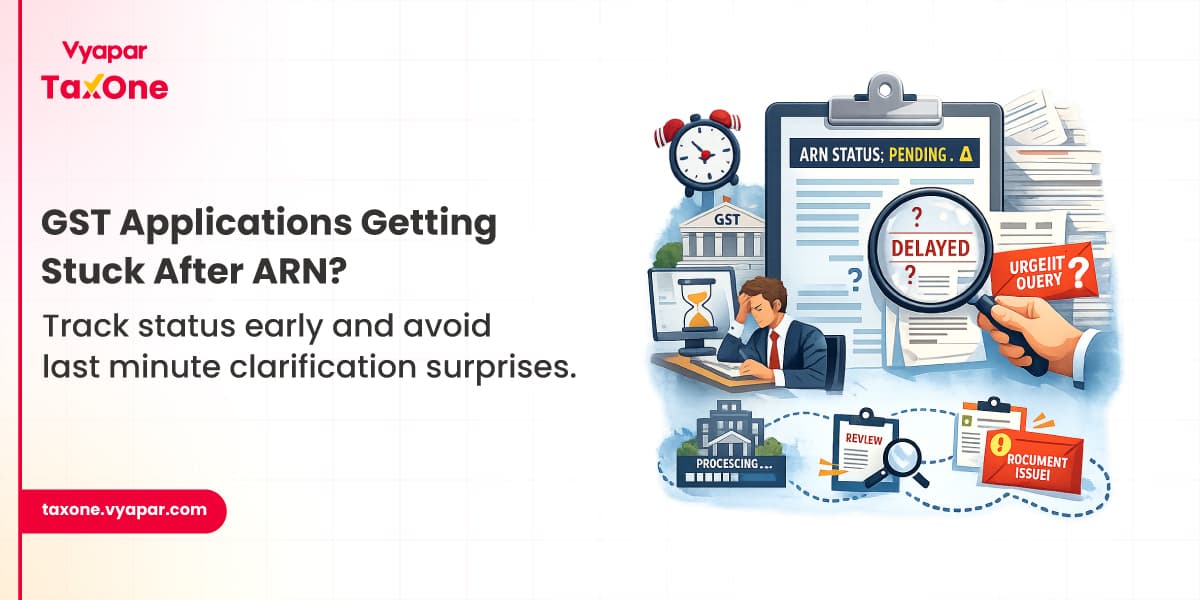
Most GST registration delays don’t happen during filing.
They show up after ARN generation, when applications move silently between “Processing” and “Clarification Required”.
We often see CA firms noticing issues only when clients follow up after 10-12 days, asking for GSTIN updates.
By then, response timelines are already partially lost.
ARN tracking is not about checking status updates.
In real GST workflows, it is about identifying:
They monitor stall patterns across applications.
In most CA workflows, delays rarely come from missing documents.
They come from mismatches that only appear during officer-level validation.
We regularly see issues like:
These are not filing errors.
They are validation mismatches discovered after submission.
We often see teams checking ARN after 7-8 days, while clarification was raised on Day 3.
Not document absence, but:
A CA firm managing 15-20 registrations often loses track of:
Supporting documents are often re-collected instead of being mapped to the original submission set.
A trading client filed GST applications in Maharashtra and Gujarat in the same week.
Same documents. Same process.
But ARN movement differed:
Later, clarification was raised related to the address proof format.
In such cases, the issue is rarely missing documents.
It is how different jurisdictions interpret the same set of documents.
Impact typically looks like:
Most teams notice this only during late ARN checks.
A CA practice handled around 12-15 GST registrations in one cycle.
All filings were correct.
All submissions were on time.
But after 10-12 days:
The issue was not filing.
It was a lack of unified ARN tracking.
In practice, updates were scattered:
By the time responses were compiled, the status had already changed.
What usually gets impacted:
GST registration doesn’t fail at filing.
It slows down in tracking after ARN generation.
From what we see in practice:
Most delays are not processing delays.
They are visibility delays inside the accounting workflow.
Store with:
Focus on:
Avoid re-collecting documents unless mandatory.
Ensures downstream compliance (GSTR-1, 3B mapping remains consistent).
In actual field-level processing, officers focus on:
Most delays occur when:
We often see similar visibility gaps in GST reconciliation workflow, especially when comparing GSTR-2B with purchase registers.
We regularly work with CA firms handling multiple GST registrations in parallel.
The challenge is not GST filing.
The challenge is tracking movement across multiple ARNs without missing intervention points.
For example:
This is where structured workflows matter. Most teams eventually move toward centralized tracking once application volume increases.
We regularly see accounting teams struggling with visibility across multiple ARN cycles, especially when follow-ups depend on email or manual reminders.
This is similar to workflow automation benefits for accounting teams managing repetitive compliance cycles across clients
Vyapar TaxOne helps accounting teams:
In most cases, the issue is not document availability
Delays usually happen during officer-level validation, where details like address format, PAN-trade name alignment, or jurisdiction mapping don’t match system expectations.
These mismatches are only visible after the ARN is generated.
Even when filings are identical, processing time varies by jurisdiction, workload, and validation checks triggered internally.
We often see applications with the same documents approved in 5-6 days in one state, while another stays under review for 10-15 days due to additional verification layers.
The clarification itself is not the problem.
The delay happens when the response is not mapped exactly to the original submission set.
In many cases, teams resend documents instead of aligning them with the specific query raised, which leads to repeated review cycles.
Yes.
“Under Processing” does not mean approval is guaranteed.
Rejection can still happen after internal verification if discrepancies are found in address proof, bank details, or jurisdiction validation during officer review.
Most firms rely on email or SMS alerts, which are not centrally tracked.
We often see clarification notices being raised and missed within 48-72 hours because they are not assigned to a specific owner or logged in a structured workflow system.
ARN tracking is critical because this is the only point where application movement becomes visible.
Without structured tracking, teams only react when clients follow up, by which time clarification windows may already be partially or fully missed.
Delays beyond 10 days are typically not due to processing backlog alone.
They are often caused by pending clarifications, incomplete responses, or mismatches that require re-validation at the officer level before approval can proceed.

Tax Professional & Business Finance Expert

Tax Professional & Business Finance Expert
Tax Professional & Business Finance Expert