 Is Now Vyapar TaxOne | Same Trust, New Name!
 AI Weapon for Financial Soldiers


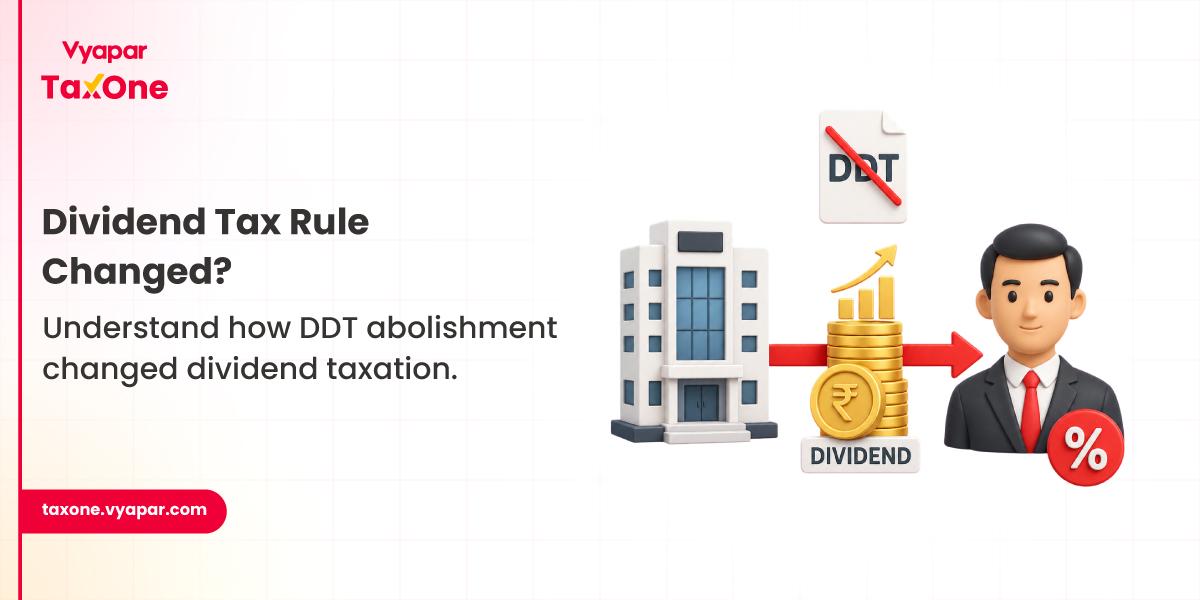
Although Dividend Distribution Tax (DDT) was abolished in 2020, it continues to be a common point of discussion during tax planning, financial analysis, and when reviewing older financial records.
Many investors still wonder why dividend taxation looks different today compared to a few years ago. Finance teams comparing historical dividend payouts also need to understand how the earlier tax regime differed from the current one.
The abolition of DDT marked a significant change in India's dividend taxation framework. Instead of companies paying tax before distributing dividends, shareholders are now responsible for paying tax on the dividend income they receive.
Let's understand how the earlier system worked, why it was replaced, and what this change means in practice.
Dividend Distribution Tax was a tax that companies had to pay before distributing dividends to their shareholders.
Instead of taxing the recipient, the company paid the tax on the dividend declared. After this tax was discharged, the remaining amount was distributed to shareholders.
While this simplified tax collection from the government's perspective, it also attracted criticism over time because many believed the actual tax burden ultimately reduced the amount available for distribution to shareholders.
The debate became stronger as dividend taxation evolved and concerns around fairness and double taxation increased.
Before 1 April 2020, every company declaring dividends had to calculate and pay Dividend Distribution Tax before making the payment to shareholders.
Although the base DDT rate was 15%, the effective tax outflow was higher after including surcharge and health & education cess.
For example, if a company planned to distribute ₹10 crore as dividends, it first had to account for the applicable DDT liability. Only after paying this tax would the remaining dividend be distributed to shareholders.
Because of this additional tax cost, dividend decisions weren't based only on profits or available reserves. Companies also had to consider the tax impact before announcing payouts.
The Government abolished Dividend Distribution Tax in the Union Budget 2020, with the new provisions becoming effective from 1 April 2020.
The abolition of DDT was one of several important tax reforms aimed at simplifying India's tax system. If you're interested in other major tax reforms, read our guide on 5 Major Reforms in India's Income Tax Bill'25 You Should Know.
The decision was primarily driven by three factors.
One of the biggest criticisms of DDT was that dividend income could effectively be taxed more than once in certain situations.
Companies paid tax before distributing dividends, and some shareholders also faced tax implications on the dividend income they received under the applicable provisions.
Moving the tax liability directly to shareholders was intended to create a more transparent taxation system.
Under the DDT regime, the same tax applied regardless of who received the dividend.
After the change, dividend income became taxable in the hands of shareholders based on the income tax provisions applicable to them. This made dividend taxation more closely linked to the taxpayer rather than the company declaring the dividend.
The earlier DDT regime also created challenges for certain foreign investors when claiming tax credit under tax treaties.
Taxing dividends directly in the hands of shareholders brought India's approach closer to the system followed in many other countries and made the tax treatment easier to understand.
The biggest change was straightforward.
Companies no longer pay Dividend Distribution Tax before distributing dividends. Instead, shareholders are responsible for paying tax on the dividend income they receive according to the applicable income tax provisions.
While the responsibility shifted from the company to the shareholder, companies still need to comply with applicable reporting and tax deduction requirements wherever relevant.
For investors, dividend income has become an important part of annual tax planning and income tax return preparation.
In the next section, we'll look at how this change affected companies and investors differently.
The abolition of DDT changed how companies approach dividend distribution.
Earlier, companies had to factor the additional DDT liability into every dividend declaration. Since this tax no longer applies, the tax burden of distributing dividends has been removed from the company.
This has simplified dividend planning, allowing companies to focus on business performance, available profits, cash reserves, and future investment plans when deciding dividend payouts.
However, companies are still responsible for complying with applicable tax deduction, reporting, and corporate governance requirements related to dividend payments.
Impact of DDT Abolishment on Investors
The impact is more noticeable for investors because dividend income is now taxed in their hands.
Instead of receiving dividends after the company had already paid DDT, shareholders must include dividend income while calculating their taxable income for the financial year.
The tax payable depends on the individual's applicable income tax provisions rather than a uniform tax paid by the company.
Since dividend income is now taxed based on your overall taxable income, understanding the applicable income tax slabs is equally important. Our guide on New & Old Regime Breakdown: Income Tax Slab Rate FY 2025-26 explains how the current tax slabs work.
This means the tax impact can differ from one investor to another based on their overall taxable income.
The shift from DDT to shareholder-level taxation brought several benefits.
The earlier DDT regime was often criticised because companies paid tax before distributing dividends, and certain shareholders could also face tax implications on the same income.
Taxing dividends directly in the hands of shareholders addressed many of these concerns and made the system more transparent.
Under the current system, dividend income is taxed according to the shareholder's applicable tax provisions.
This ensures that the tax treatment is linked to the recipient's income rather than applying the same tax burden through the company.
Many countries tax dividend income in the hands of shareholders instead of companies.
The abolition of DDT brought India's dividend taxation framework closer to this approach, making it easier for both domestic and foreign investors to understand the tax treatment.
While the new system offers greater transparency, investors also have additional responsibilities.
If you receive dividend income during the financial year, remember to:
Maintaining proper records of dividend receipts can also make tax filing much easier, especially if you receive dividends from multiple companies.
Suppose a company declares a dividend of around ₹10 crore.
Before April 2020:
The company first paid Dividend Distribution Tax before distributing the remaining amount to shareholders.
After April 2020:
The company distributes the dividend without paying DDT. Instead, shareholders are responsible for paying tax on the dividend income they receive according to the applicable income tax provisions.
Although the dividend declaration process remains the same, the responsibility for taxation has shifted from the company to the shareholder.
Before filing your income tax return, make sure you:
These simple checks can help avoid omissions and ensure accurate tax reporting.
The abolition of Dividend Distribution Tax marked a significant shift in the way dividend income is taxed in India.
Instead of collecting tax from companies before dividends are distributed, the current system taxes dividend income in the hands of shareholders. This makes the tax treatment more closely aligned with each taxpayer's own income while simplifying dividend distribution for companies.
For investors, the change also means paying greater attention to dividend income during tax planning and return filing.
Maintaining accurate records and understanding how dividend income is taxed can help avoid reporting errors and make compliance easier.
As tax regulations continue to evolve, finance and accounting teams benefit from organised documentation and structured compliance processes rather than relying on fragmented manual records. This is where structured accounting and compliance platforms like Vyapar TaxOne naturally fit into modern finance operations, helping teams manage financial records more efficiently as compliance requirements grow.
Along with reporting dividend income correctly, effective tax planning also involves understanding the deductions available under the Income-tax Act. You can explore our Tax Savings: Section 80C, 80CCC, 80CCD, 80D Deductions Guide for more information.
No. DDT was abolished with effect from 1 April 2020. Companies no longer pay tax before distributing dividends. Instead, dividend income is generally taxable in the hands of shareholders under the applicable provisions of the Income-tax Act.
The Government replaced DDT to address concerns around double taxation, make dividend taxation more transparent, and align India's tax framework more closely with international practices.
No. The tax has not been removed, it has shifted from the company to the shareholder. Investors must include eligible dividend income while computing their taxable income.
Companies no longer bear the additional DDT liability when declaring dividends. However, they must continue to comply with applicable reporting, tax deduction, and corporate governance requirements.
Although DDT is no longer applicable, tax professionals, finance teams, and investors often refer to the earlier regime when reviewing historical financial statements, dividend trends, or previous assessment years.



Get started today and simplify your accounting process!