 Is Now Vyapar TaxOne | Same Trust, New Name!
 AI Weapon for Financial Soldiers


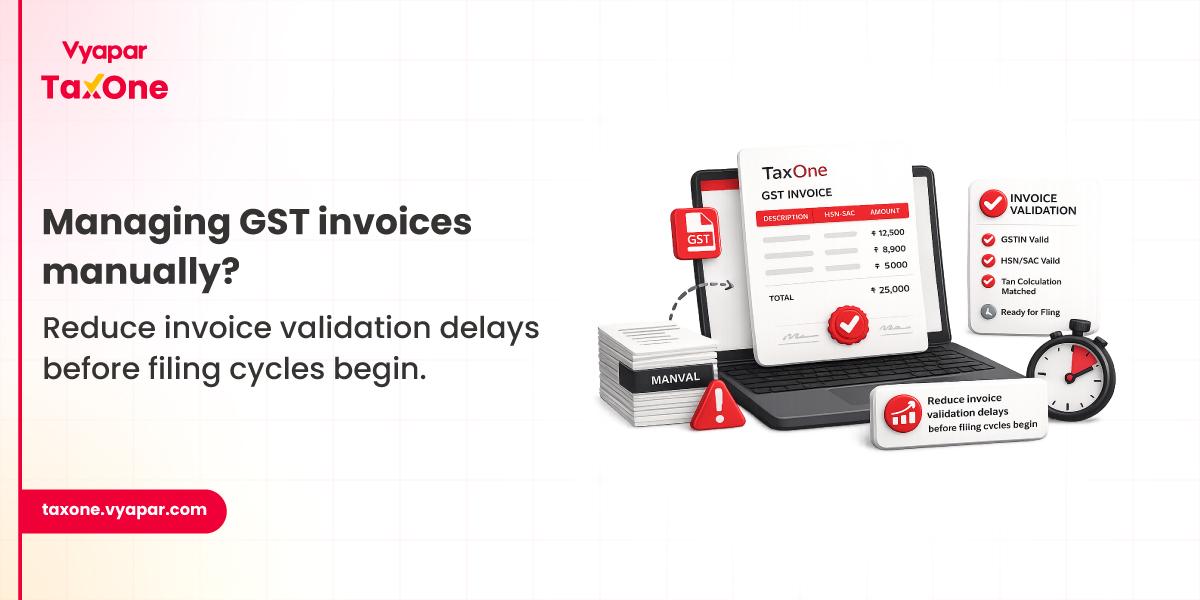
Invoice generation used to remain a largely internal business process for most organizations.
Businesses created invoices through ERP systems, accounting software, or billing tools, and transaction reporting happened later when GST filing cycles began.
The operational challenge started when tax authorities began identifying growing problems around fake invoicing, duplicate invoice reporting, incorrect input tax credit claims, and mismatches between supplier and buyer transaction records.
As invoice volume increased across GST systems, authorities needed invoice validation to happen earlier instead of waiting until return filing cycles began.
This is where e-invoicing gradually became an important part of India’s GST ecosystem.
Rather than allowing invoice data to remain disconnected until filing cycles began, the e-invoicing framework introduced invoice validation through the Invoice Registration Portal before invoice data entered downstream GST reporting systems.
For businesses, this changed how invoice generation, reporting, validation, and compliance workflows began functioning under GST operations.
E-invoicing under GST is not simply digital invoice generation.
It is a structured invoice authentication mechanism where certain business invoices must be validated electronically through the government’s Invoice Registration Portal (IRP) before becoming part of the GST reporting system.
Under this process, businesses generate invoices using their billing software, ERP systems, or accounting software just like before.
However, instead of directly issuing the invoice to the buyer, invoice details are first submitted electronically to the Invoice Registration Portal.
Once the invoice data is validated successfully, the system generates:
Only after this validation process is completed does the invoice receive a valid IRN and become part of the structured GST reporting workflow.
This created a more structured invoice reporting system where invoice data begins entering compliance workflows much earlier instead of waiting until return filing stages.
The GST ecosystem introduced e-invoicing primarily because invoice reporting had become increasingly difficult to monitor across businesses processing large transaction volumes.
Before e-invoicing, invoice generation remained largely independent from tax validation systems.
This created several operational challenges.
Authorities frequently observed:
The objective behind e-invoicing was not simply digitization.
The larger objective was to create a structured invoice validation mechanism where invoice authenticity could be verified before invoices entered GST compliance systems.
This helped strengthen invoice traceability across the GST reporting framework.
Under the e-invoicing framework, invoice generation now follows a more structured workflow compared to traditional billing systems.
The process usually works as follows.
Step 1
Supplier generates invoice through ERP system, billing software, or accounting software
Step 2
Invoice data is converted into the prescribed GST e-invoice schema format
Step 3
Invoice data is submitted electronically to the Invoice Registration Portal (IRP)
Step 4
The portal validates invoice information submitted by the business
Step 5
A unique Invoice Reference Number (IRN) is generated
Step 6
QR code and digital authentication are attached to the invoice
Step 7
Authenticated invoice is shared with the buyer
Step 8
Invoice data becomes available inside GST reporting systems for compliance processing
This changed invoice handling significantly because invoice validation now happens much earlier in the compliance cycle instead of during return filing stages.
One of the biggest changes introduced by e-invoicing is that invoice validation no longer remains disconnected from tax reporting systems.
This reduces several manual processes businesses previously handled during GST compliance cycles.
Businesses usually experience operational benefits such as:
Reduced repeated invoice data entry
Invoice data enters structured reporting systems earlier, reducing repeated reporting work later.
Lower duplicate invoice reporting risk
Unique invoice authentication helps reduce repeated invoice submission errors.
Better invoice traceability during audits
Invoice records become easier to track during audit and compliance review cycles.
Lower chances of incorrect reporting
Structured invoice validation reduces reporting inconsistencies across transactions.
Reduced fake invoice generation risk
Invoice authenticity can be validated earlier inside the reporting system.
Easier supplier-buyer invoice matching
Transaction visibility improves when invoice records remain standardized across reporting systems.
The biggest operational improvement comes from reducing dependency on manual invoice validation later during GST return preparation.
One of the major reasons e-invoicing was introduced under GST was to improve invoice traceability and reduce tax fraud risk.
Before structured invoice validation systems existed, authorities frequently faced situations where businesses generated invoices that could not be easily verified during compliance review.
E-invoicing helps reduce fraud risk in several ways.
Fake invoice detection becomes easier
Invoices are validated electronically before entering GST reporting systems, making it harder for businesses to introduce unverified invoices into compliance workflows.
As reporting requirements become stricter, GST automation helps businesses adapt to stricter compliance enforcement by reducing manual validation effort and improving filing accuracy.
Incorrect input tax credit claims become harder to process
Since invoice records are linked between supplier and buyer transactions, authorities can cross-verify invoice authenticity before input tax credit claims are processed.
Invoice-level transaction reporting becomes easier to monitor
Invoice records remain connected to GST reporting systems much earlier, giving tax authorities better visibility into transaction-level reporting activity.
Invoice authenticity can be validated independently
Invoice Reference Numbers and QR codes create additional verification mechanisms that allow invoice authenticity to be checked independently during compliance review.
E-invoicing applicability under GST has gradually expanded across turnover thresholds as compliance requirements evolved.
Businesses crossing the turnover threshold prescribed by GST authorities are required to generate e-invoices for applicable B2B transactions.
In practice, businesses falling under mandatory applicability rules must ensure that invoice generation workflows remain compliant with:
Businesses covered under e-invoicing rules cannot continue following traditional invoice generation workflows without completing the required invoice validation process.
This makes invoice compliance an active part of daily billing operations rather than a process handled later during filing cycles.
While e-invoicing creates a more structured invoice validation system, many businesses begin noticing operational issues once invoice generation becomes directly connected with compliance systems.
The challenge usually does not come from invoice creation itself.
It begins when invoice validation errors start interrupting billing workflows and compliance teams are required to correct invoices before reporting cycles continue.
Some of the most common operational issues businesses face include:
In smaller businesses, these issues may remain manageable.
But as invoice volume increases, small validation errors begin creating larger compliance delays across billing and reporting workflows.
As invoice complexity increases, AI-powered GST reconciliation tools can reduce manual compliance errors by helping teams detect reporting inconsistencies earlier before compliance deadlines begin approaching.
This is usually where businesses begin experiencing operational pressure.
Small invoice validation errors that initially seem minor often start affecting billing continuity, reporting timelines, and compliance execution.
The most common breakdown points usually include:
Invoices submitted to the Invoice Registration Portal may get rejected if mandatory fields are incomplete or invoice data does not match prescribed validation rules.
Result:
If businesses accidentally submit invoices using duplicate invoice references, the system may reject the invoice during validation.
This usually happens when invoice numbering is not managed consistently across multiple billing systems or branch locations.
Result:
Incorrect GST classification often happens when invoices are created under the wrong tax category before submission.
These mistakes usually become visible only after invoice validation or during later compliance review.
Result:
Invoice data submitted to the portal must follow the prescribed e-invoice schema structure.
Formatting inconsistencies sometimes trigger validation failure before invoice authentication is completed.
Result:
Businesses processing large invoice volume sometimes face operational delays when invoice validation errors begin affecting repeated invoice submission attempts.
This usually becomes more visible during high billing periods.
Result:
We often see these issues becoming significantly more visible once businesses begin processing large B2B transaction volume under mandatory compliance cycles.
A manufacturing business processing nearly 4,500 B2B invoices every month had recently shifted to mandatory e-invoicing compliance.
As invoice volume increased across multiple branch operations, invoice generation started becoming inconsistent because branch teams were using different billing formats before submission.
During invoice validation, several hundred invoices required correction because tax classification fields had been entered incorrectly before IRN generation.
The billing team spent multiple additional working days reviewing rejected invoices before month-end reporting could continue.
The actual operational problem did not begin during GST filing.
It started much earlier during invoice generation itself.
A CA firm managing GST compliance for more than 20 active business clients was regularly reviewing invoice data before monthly filing cycles.
As more clients shifted toward mandatory e-invoicing compliance, the team began receiving invoices that repeatedly failed validation because invoice fields were not generated correctly by client-side billing systems.
Several businesses submitted invoices carrying incorrect tax structure or incomplete mandatory invoice details.
This forced the compliance team to spend multiple additional working days coordinating invoice correction before return preparation could begin.
Most of these issues became visible only when compliance review had already started.
Across GST compliance environments, we usually notice similar patterns once businesses begin processing higher invoice volume under e-invoicing systems.
Most invoice-related errors become visible only after invoice submission begins.
Teams usually discover validation issues only when invoices start getting rejected repeatedly.
Incorrect invoice classification often remains unnoticed until reporting review begins.
Duplicate invoice reference issues become more common when multiple teams manage invoice generation independently.
Manual invoice review workload gradually increases once businesses begin handling larger B2B transaction volume.
We often see these operational issues becoming significantly more visible only when businesses begin handling invoice generation across multiple billing systems under strict compliance timelines.
For many businesses, invoice generation now follows a much more structured workflow compared to traditional billing systems.
A typical execution process usually looks like this.
The biggest operational delays usually happen during validation failure and correction stages.
Because invoice generation can no longer continue until invoice authentication is completed successfully.
Before processing invoice submissions, businesses usually verify:
✓ GSTIN details are validated correctly
✓ Invoice numbering sequence remains unique
✓ Tax classification is reviewed before submission
✓ Mandatory invoice fields are completed properly
✓ Invoice schema follows prescribed structure
✓ Invoice submission errors are reviewed immediately
✓ Rejected invoices are corrected before compliance review begins
✓ IRN generation status is verified successfully
✓ Invoice records remain consistent with reporting workflows
Many businesses initially assume e-invoicing simply changes the way invoices are generated under GST systems.
In practice, the operational complexity begins once invoice creation becomes directly connected with invoice authentication, tax validation, reporting accuracy, and compliance monitoring requirements.
At lower transaction volume, invoice generation usually feels manageable.
But as businesses begin processing larger B2B invoice volume, teams often start spending more time validating invoice data, correcting submission failures, resolving tax classification errors, and reviewing rejected invoices before reporting cycles can continue smoothly.
In most cases, the challenge does not come from invoice generation alone.
The bigger operational issue usually comes from disconnected billing workflows, inconsistent invoice validation processes, and repeated manual review before invoice submission.
As transaction volume grows, small invoice validation errors that previously remained unnoticed begin affecting billing continuity, reporting timelines, and overall compliance execution.
This is usually the stage where businesses begin realizing that e-invoicing is no longer just a billing process.
It gradually becomes an active part of day-to-day compliance operations that requires more structured workflow monitoring than traditional invoice systems allowed.
Workflow challenges like these often push businesses toward more structured systems such as Vyapar TaxOne once invoice validation starts affecting operational consistency. This usually happens when compliance requirements begin becoming harder to manage through traditional billing workflows.
IRN generation usually fails when invoice data contains incomplete mandatory fields, incorrect invoice schema formatting, or validation mismatches during submission to the Invoice Registration Portal.
Invoice rejection typically happens when GSTIN details are incorrect, tax classification is mapped incorrectly, invoice numbering is duplicated, or required invoice fields do not match prescribed validation rules.
The e-invoicing system validates invoice uniqueness before generating the IRN. If businesses submit invoices carrying duplicate invoice references, the portal rejects the invoice and requires correction before resubmission.
Invoices created under incorrect tax categories often fail validation because tax structure and invoice details no longer align correctly with compliance reporting requirements.
Once invoice authentication fails, businesses cannot proceed with invoice issuance immediately. Teams usually need to review the error, correct invoice data, and resubmit before billing workflows continue.
Most businesses continue using older billing workflows while compliance requirements become more structured. As invoice validation now happens earlier, operational mistakes that previously stayed unnoticed become visible immediately.
This usually becomes more visible once transaction volume increases and businesses begin handling larger B2B invoice volume where repeated validation failures start delaying reporting workflows and month-end compliance review.

Get started today and simplify your accounting process!