 Is Now Vyapar TaxOne | Same Trust, New Name!
 AI Weapon for Financial Soldiers


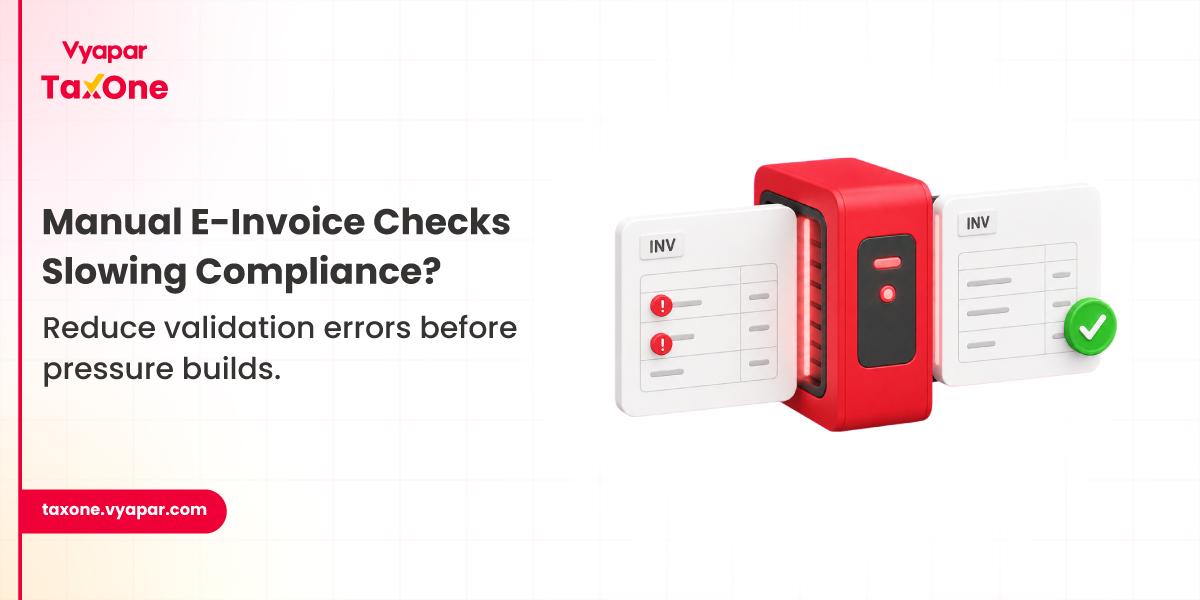
For most accounting teams, e-invoicing itself is not the difficult part.
The real challenge begins when invoice data moves through different stages, from accounting software to invoice validation, IRN generation, GST records, and reconciliation.
A finance team may prepare invoices correctly, but a mismatch in GSTIN details, taxable values, invoice numbers, or other required fields can create additional correction work later.
For CA firms managing multiple clients and finance teams handling large invoice volumes, these issues become more visible during GST filing cycles.
The problem is not only generating an invoice. The problem is ensuring that invoice data remains accurate, traceable, and consistent across every stage of the compliance workflow.
This is why many businesses are moving away from completely manual e-invoicing processes and adopting more structured workflows.
Under GST, applicable businesses need to generate e-invoices through the Invoice Registration Portal (IRP).
The IRP acts as the validation point where invoice details are checked before an IRN is generated. Understanding how the portal processes invoice information helps teams identify where errors occur during submission. Read our detailed guide on the Invoice Registration Portal (IRP) to understand the complete validation flow.
The operational flow usually involves:
From a compliance perspective, this process creates standardisation.
But from an accounting operations perspective, teams still need to manage:
This is where manual processes start creating pressure.
When invoice volumes are low, teams can manage many checks manually.
They may verify invoices through:
However, as transaction volume increases, the same approach becomes difficult to maintain.
Many businesses maintain invoice information across different systems:
When these records are not aligned, teams spend additional time identifying which system contains the correct information.
Small issues such as:
May not be noticed until invoice validation or reconciliation.
By that stage, correcting the issue requires coordination between multiple teams.
Most accounting teams do not experience e-invoice problems evenly throughout the month.
The pressure usually increases during:
At this stage, unresolved invoice issues can delay reporting activities.
Before an invoice receives an IRN, the invoice data needs to pass validation checks.
Issues can occur due to:
The challenge for teams is not only fixing the rejected invoice.
They also need to identify why the error occurred and prevent similar issues in future submissions.
When invoices require corrections, teams often maintain manual records to track:
For businesses handling large invoice volumes, maintaining this visibility manually becomes difficult.
Generating an e-invoice does not complete the accounting workflow.
Teams still need to ensure that:
Automation does not remove the need for accounting review.
Instead, it reduces repetitive manual checks and helps teams maintain consistency.
When invoice information flows from accounting systems into compliance workflows, teams spend less time manually preparing and checking data.
This reduces dependency on spreadsheets and repeated data entry.
Structured workflows help teams identify issues before they become filing problems.
For example:
Can be reviewed before they create larger reconciliation gaps.
In larger organisations, invoice processing involves multiple people.
A structured workflow helps teams understand:
This becomes increasingly important as transaction volume grows.
For finance teams handling high transaction volumes, reconciliation becomes one of the most important parts of the compliance cycle. Structured automated reconciliation workflows help teams identify mismatches faster and maintain consistency between accounting records and GST-related data.
A manufacturing business managing multiple GST registrations may initially handle e-invoice checks through manual trackers and accounting reports.
As invoice volumes increase to several thousand invoices every month, finance teams may spend more time reviewing rejected invoices, checking missing details, and coordinating corrections.
The challenge is not creating invoices.
The challenge is identifying which invoices require attention before GST filing deadlines approach.
This is where businesses usually start reviewing their existing e-invoicing workflows and look for better ways to manage validation and tracking.
A CA firm handling GST compliance for multiple businesses may receive invoice data from different clients using different formats and accounting systems.
During filing preparation, the team may need to verify invoice information, identify missing records, and follow up with clients for corrections.
When multiple clients face similar issues during the same compliance cycle, manual follow-ups increase quickly.
Many firms notice these workflow gaps only after their client base or transaction volume grows.
While working through e-invoicing processes, accounting teams often notice that issues rarely appear at the time of invoice creation.
The real problems usually surface when invoice data moves between systems and teams start validating records during GST cycles. Some common observations from accounting workflows:
We often see invoice-related issues during month-end closing when teams are trying to complete reconciliations within tight timelines.
Most data mismatches appear only when invoice records are compared with GST-related information.
Teams usually discover process gaps after audit reviews or when transaction volumes increase.
Manual tracking may work initially, but maintaining accuracy becomes difficult when multiple people and systems are involved.
For accounting teams, the focus gradually shifts from:
“Can we generate invoices on time?”
to:
“Can we ensure every invoice remains accurate throughout the compliance workflow?”
A typical e-invoicing workflow inside a business or CA-managed environment looks like this:
The sales or finance team creates invoices in their accounting system or ERP.
At this stage, teams verify:
Before submitting invoice details for IRN generation, teams check whether required information is complete.
This step often depends on manual verification, especially when invoice data comes from multiple sources.
Invoice details are submitted through the applicable IRP process.
Once validated, the invoice receives:
The updated invoice records then need to be maintained properly for future compliance activities.
After invoice processing, teams continue checking whether:
If mismatches occur, teams usually follow a manual correction cycle:
This final stage is where many teams spend additional time.
Many businesses begin with manual e-invoicing processes because they are manageable at smaller volumes.
However, as operations grow, challenges start appearing:
At this stage, the challenge is no longer only about generating e-invoices.
As businesses grow, staying updated with changing applicability rules and compliance timelines becomes equally important.
Understanding e-invoice applicability and compliance requirements helps teams plan their invoice processes better and avoid last-minute compliance issues.
Teams need better control over the complete workflow, from invoice preparation and validation to record matching and reconciliation.
We have seen accounting teams move toward structured workflows when manual tracking starts affecting reconciliation accuracy, month-end closure, and compliance preparation.
The requirement is not to replace accounting processes, but to reduce the gaps created when invoice data moves across multiple systems and teams.
This is the kind of workflow challenge structured accounting systems like Vyapar TaxOne are built around, helping teams manage reconciliation and compliance-related workflows more systematically as transaction volumes increase.
For finance teams and CA firms, the goal is simple: fewer manual follow-ups, better visibility into invoice status, and more confidence during GST compliance cycles.
Because invoice validation depends on multiple data points being accurate, including GST details, invoice information, and required fields.
Because invoice generation is only one stage. Teams still need to ensure accounting records and compliance-related data remain aligned.
Most teams maintain trackers, but structured workflows become more useful when invoice volume increases.
Because teams are working with fixed deadlines and multiple pending activities, making unresolved invoice issues more visible.
Usually when businesses handle higher invoice volumes, multiple GST registrations, or multiple approval points.
They should review invoice volume, existing accounting systems, validation processes, and reconciliation requirements.

Get started today and simplify your accounting process!