 Is Now Vyapar TaxOne | Same Trust, New Name!
 AI Weapon for Financial Soldiers


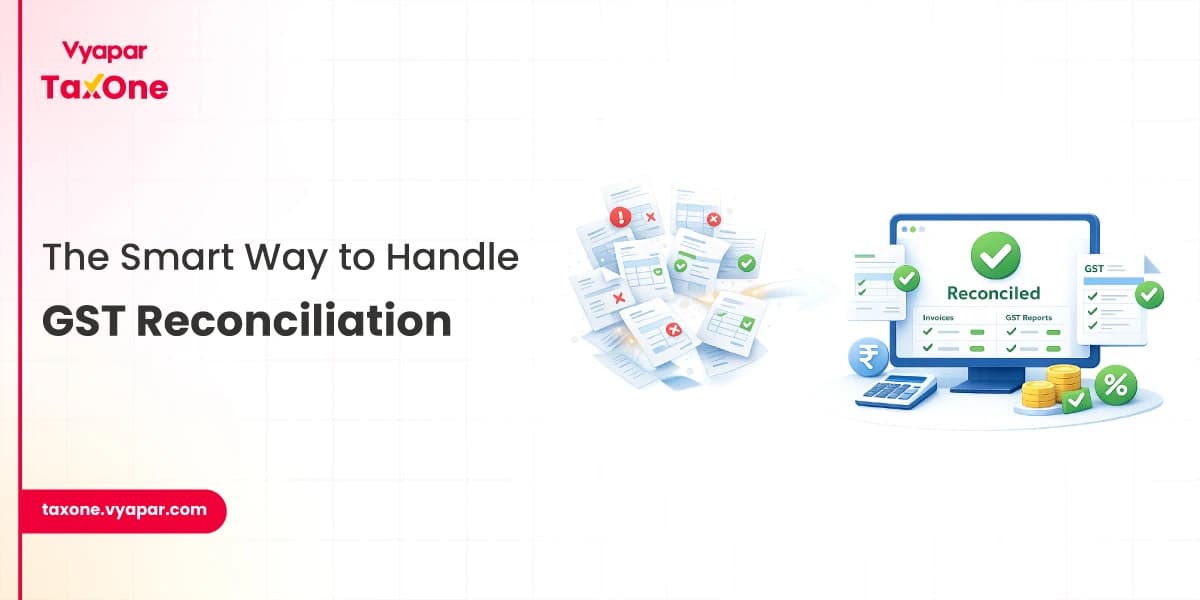
For Chartered Accountants and tax professionals in India, GST reconciliation has become a high-stakes monthly function.
Transaction volumes are larger, compliance timelines are tighter, and clients expect faster, cleaner reporting. GSTN describes itself as the technology backbone for GST in India, and its published ecosystem material shows the scale of invoices, return filings, and digital processing involved in today's compliance environment.
That is exactly why automated reconciliation software is now an operational necessity, not just a convenience tool. When used properly, it helps firms reduce manual review effort, identify mismatches more quickly, improve visibility into Input Tax Credit, and create a more standardized GST workflow.
Automated reconciliation software is a system that compares data from books, invoices, and GST return sources to identify matches, mismatches, missing entries, and potential risks.
In GST practice, this usually means reconciling:
For CAs, this is important because reconciliation is not just a matching exercise. It affects return accuracy, credit claims, vendor follow-up, internal review quality, and notice readiness.
Manual reconciliation still survives because Excel is familiar. But familiar does not always mean efficient.
The main problems with manual reconciliation
When a firm handles many GST registrations, spreadsheet-based workflows start creating bottlenecks. The team spends too much time on low-value comparison work and too little time on review, correction, and advisory.
GST compliance has become more data-intensive as digital tax systems are now deeply integrated with invoice reporting, return preparation, and broader compliance workflows.
GSTN notes that e-invoicing supports standardization, interoperability, and the auto-population of invoice details into returns and related forms, thereby increasing the value of clean, well-reconciled data.
In practice, firms now deal with:
This is where automated GST reconciliation delivers value. It helps firms move from scattered manual checks to a repeatable process.
The real benefit of automated reconciliation software is not just saving time. It is improving control.
Automation reduces the time spent on manual matching, allowing staff to focus on exceptions that require judgment.
A structured reconciliation process helps identify missing, mismatched, or delayed credits earlier.
Software makes review rules more consistent across team members and clients.
When mismatches are identified early, professionals can communicate issues more quickly and clearly.
A better-organized reconciliation trail helps when supporting returns or responding to scrutiny.
Not every tool marketed as reconciliation software for tax professionals is equally useful. The right product should support actual GST workflows, not just produce a basic report.
A good system should help your team do three things better:
1. Detect mismatches faster 2. Resolve them more systematically 3. Review returns with more confidence
Vyapar TaxOne is an AI-driven accounting and GST automation platform specifically designed for CAs and tax professionals. It does automated reconciliation, ITC tracking, return filing, validation checks before filing, and compatibility with Tally-connected workflows.
This makes it relevant for firms that want to reduce spreadsheet dependence without completely changing how they work.
What the Vyapar TaxOne GST feature highlights
It works with speed, accuracy, and gives improved visibility into discrepancies in reconciliation-heavy environments.
| Area | Manual Reconciliation | Automated Reconciliation Software |
|---|---|---|
| Data matching | Spreadsheet-based, repetitive | Rule-based and faster |
| Error risk | Higher due to manual handling | Lower with automated checks |
| ITC visibility | Often delayed | Easier to monitor and review |
| Team consistency | Depends on individual skill | More standardized process |
| Scalability | Weak for multi-client firms | Better suited for growth |
| Filing readiness | Slower review cycle | Faster exception-based review |
This is why automated reconciliation software is especially useful for CA firms handling recurring GST work at scale.
Monthly GST compliance for multiple clients
If your practice handles repeated GSTR-1, GSTR-2B, and GSTR-3B review cycles, automation can significantly reduce workload.
ITC-focused review before filing
Where ITC accuracy is critical, automated matching can improve visibility before final return submission.
Tally-heavy compliance environments
If your clients or firm rely heavily on Tally and Excel, integration becomes a major practical advantage.
Internal review and partner sign-off
Automation helps seniors and partners review exception summaries instead of raw spreadsheets.
The smartest way to adopt automated reconciliation software is to start small.
A practical rollout approach:
This prevents the common mistake of buying software first and thinking about workflow later.
Do not choose software only by the feature list
A long feature page does not guarantee practical value.
Do not ignore integration needs
If the tool does not fit your current accounting workflow, adoption will suffer.
Do not overlook validation and review controls
For professionals, the value lies in accuracy, not just automation.
Do not treat reconciliation as a one-time output
The best tools support an ongoing process of detection, review, and closure.
For Indian CAs and tax professionals, automated reconciliation software is now a serious productivity and compliance asset. It helps reduce manual effort, improve ITC control, ensure consistent reviews, and support a more scalable GST practice.
Vyapar TaxOne GST reconciliation software is built for accountants and tax teams handling GST automation, reconciliation, filing support, and Tally-connected workflows.
The best choice, however, is not the tool with the most features. It is the one that helps your firm reconcile faster, review more effectively, and file with greater confidence.
Automated reconciliation software matches books, invoices, and GST return data to identify mismatches, missing entries, and ITC-related issues faster than manual methods.
CAs need it to reduce manual effort, improve accuracy, speed up GST review, and manage multiple clients more efficiently.
It helps compare data across GSTR-1, GSTR-2A, GSTR-2B, and GSTR-3B, making it easier to spot discrepancies before filing.
Yes. Even small firms can save time, reduce errors, and create a more structured GST reconciliation process.
Vyapar TaxOne offers GST reconciliation, ITC tracking, validation checks, and workflow support designed for CAs and tax professionals.

Get started today and simplify your accounting process!