 Is Now Vyapar TaxOne | Same Trust, New Name!
 AI Weapon for Financial Soldiers
Vyapar TaxOne


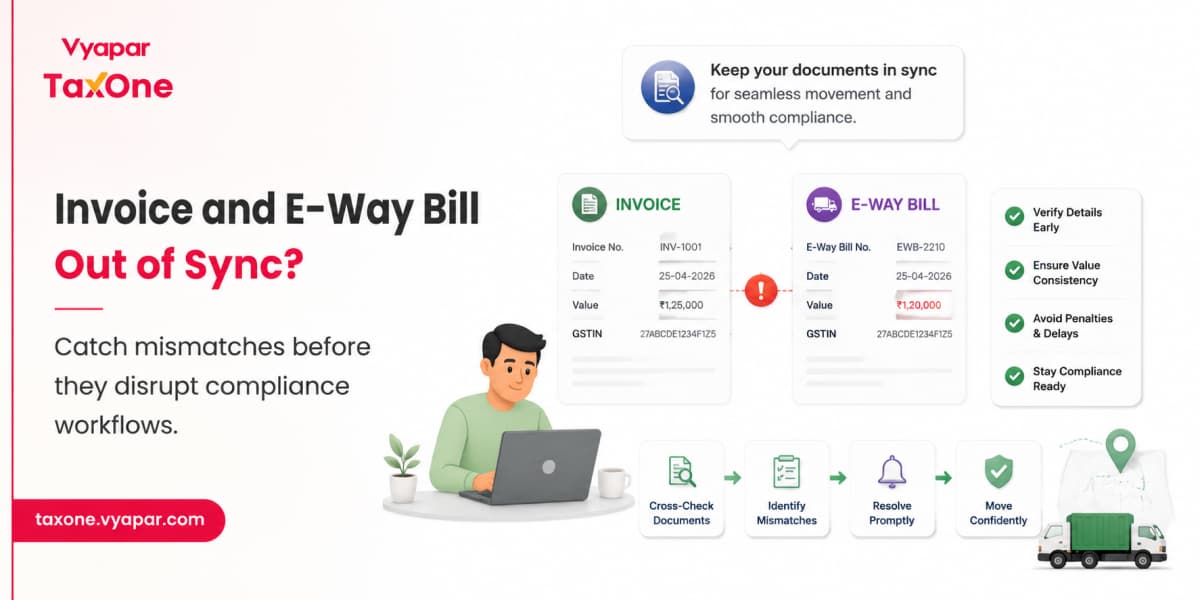
Many businesses believe that once the GST return is filed correctly, the job is done. But that's rarely where compliance ends.
We've often seen issues surface much later, during a transit inspection, an internal reconciliation, or even an audit review.
The GST return may be perfectly accurate.
The problem lies somewhere else.
It starts with the invoice and the e-Way Bill not telling the same story.
This has become even more relevant after the GSTN requirement that Ship-To GSTIN became mandatory on e-Way Bills from 1 August 2026. For businesses supplying goods across multiple branches, warehouses, or customer locations, every dispatch document now needs to stay aligned. A mismatch between invoice details and the e-Way Bill is easier to create if invoice changes are made after the transport document has already been generated.
Imagine this.
A distributor generates an invoice and immediately creates the e-Way Bill.
An hour later, the customer requests a commercial discount before dispatch.
The accounts team updates the invoice.
The e-Way Bill isn't updated.
Nobody notices the difference because the goods leave on time.
A few weeks later, during document verification, both records are compared.
The GST return is correct.
But the dispatch documents aren't consistent anymore.
This is the kind of issue accounting teams usually discover only after goods have moved, not while preparing the return.
And that's what makes these mismatches difficult to manage.
One mistake we often see is treating GST filing as the final checkpoint.
In reality, it isn't.
A single transaction passes through multiple stages.
Each document serves a different purpose.
But they all need to reflect the same transaction.
If one document gets updated while another doesn't, accounting teams end up spending time explaining the difference later.
That's why many CA firms don't just reconcile GST returns.
They also verify whether invoices, e-Way Bills, and supporting documents remain consistent before closing the transaction.
Many CA firms don't stop at reconciling GST returns. They also verify whether invoices, e-Way Bills, and supporting documents remain consistent before closing the transaction. Our guide on Advanced GSTR-1 Reconciliation for CA Firms | Reduce GST Mismatches explains how document-level reconciliation helps identify inconsistencies before they turn into compliance issues.
Not every mismatch leads to a penalty.
That's an important distinction.
A minor rounding difference or a simple typing mistake can usually be clarified.
Material differences are different.
For example:
These situations don't automatically attract penalties.
But they can trigger additional verification during transit, departmental scrutiny, or audit reviews.
And when transaction volumes are high, tracing the source of the mismatch becomes much harder.
In most firms, the problem doesn't start on the GST portal.
It starts much earlier.
Usually inside everyday accounting workflows.
A discount is approved.
Freight charges change.
The customer requests a correction.
The invoice is updated.
The e-Way Bill isn't.
By the time anyone notices, the goods have already been dispatched.
Sales updates one copy.
Accounts updates another.
Logistics prints an older version.
Everyone believes they're using the latest document.
They're not.
Many businesses still enter invoice values manually while generating the e-Way Bill.
During busy dispatch days, even a small typing error can create unnecessary reconciliation work later.
The order is dispatched in multiple lots.
Separate invoices are raised.
The e-Way Bill doesn't reflect the final movement correctly.
The mismatch isn't intentional.
It's simply the result of documents being updated at different stages.
This is something we often notice during month-end.
Teams are focused on moving goods quickly.
The final document review gets skipped.
The mismatch remains hidden until someone outside the business compares the records.
Many firms also include invoice validation as part of their GST filing workflow so that invoice values, GSTINs, HSN codes, and taxable amounts are reviewed before GSTR-1 is finalized. Our guide on GSTR-1 Pre-Validation Guide for Bulk Invoice Error Prevention explains the validation checks accounting teams use to catch errors before filing.
Most businesses don't notice an invoice and e-Way Bill mismatch while creating the documents.
It usually comes to light much later.
Sometimes during a transit inspection.
Sometimes while preparing for an audit.
And quite often during reconciliation.
Here are some of the most common situations where accounting teams discover these issues:
We've often seen teams spend more time tracing the source of a mismatch than fixing it.
The challenge isn't always the correction, it's identifying where the documents first went out of sync.
A trading company dispatches goods worth around ₹18 lakh to a customer.
The invoice is generated, and the e-Way Bill is created immediately.
Before the vehicle leaves, the customer negotiates an additional commercial discount.
The accounts team updates the invoice.
The transporter, however, carries the original e-Way Bill.
A few days later, the mismatch is noticed during document verification.
The business isn't accused of incorrect GST filing.
But the accounting team spends several days gathering revised invoices, dispatch records, and supporting documents to explain the difference.
The issue wasn't the tax calculation.
It was that two business documents reflected different versions of the same transaction.
A CA firm manages GST compliance for a manufacturing client operating across multiple GST registrations.
During month-end, the team processes more than 4,000 invoices within a short period.
One branch updates invoice values after freight adjustments, while another has already generated the corresponding e-Way Bills.
The difference isn't noticed immediately.
It surfaces only during internal reconciliation before the next compliance cycle.
Correcting the records takes time because multiple teams need to verify invoice versions, dispatch records, and supporting documents.
We often see issues like this once transaction volumes increase.
It's rarely a single mistake.
It's usually several small workflow gaps happening together.
Across CA firms and accounting teams, these patterns appear repeatedly.
By the time the mismatch is identified, the accounting team is no longer preventing the issue.
They're explaining it.
Before goods leave the premises, many firms include a quick validation step to reduce avoidable mismatches.
A five-minute review before dispatch is often easier than spending days tracing document inconsistencies later.
Many accounting teams reduce these risks by following a standardized GST documentation process before every filing cycle. Our 2026 GST Filing Checklist: Essential Documentation for Teams outlines the key documents and verification steps that help keep invoices, e-Way Bills, and GST returns aligned.
Invoice and e-Way Bill mismatches rarely begin on the GST portal. Compliance expectations continue to evolve as well. For example, the mandatory inclusion of Ship-To GSTIN on e-Way Bills from 1 August 2026 means businesses handling multi-location deliveries need to pay even closer attention to document consistency before goods move.
They usually start much earlier.
A last-minute invoice revision.
A freight adjustment after the e-Way Bill is generated.
Different teams working from different document versions.
Or manual data entry across multiple systems.
Individually, these may seem like small operational gaps.
But when businesses handle hundreds or even thousands of transactions, those gaps become much harder to track.
We've often seen CA firms discover these inconsistencies only during reconciliation, transit verification, or audit preparation.
By then, the focus shifts from preventing the issue to explaining why the documents don't match.
This is why many accounting teams move toward structured workflows as their transaction volumes grow.
Instead of relying on manual coordination, they standardize invoice validation, maintain consistent master data, and ensure every team works from the latest document version before goods are dispatched.
This is the kind of workflow challenge that structured systems like Vyapar TaxOne are built around.
By helping accounting teams maintain cleaner invoice data, centralized document management, and consistent validation processes, they reduce the chances of upstream errors turning into downstream compliance issues.
Ultimately, avoiding invoice and e-Way Bill mismatches isn't just about filing GST returns correctly.
It's about ensuring every document supporting the transaction remains consistent throughout the accounting and dispatch workflow.
That's what helps businesses spend less time resolving discrepancies and more time keeping compliance processes on track.
No. Minor clerical errors can often be clarified. Material discrepancies, however, are more likely to invite scrutiny depending on the facts of the transaction.
Yes, but businesses should ensure that related documents remain consistent. Any revisions should be reviewed carefully to avoid operational mismatches.
Because different teams often work with separate documents. The inconsistency becomes visible only when records are compared during reconciliation or audit preparation.
They may become a point of scrutiny during verification and could require additional clarification or supporting documents.
By validating invoice data before dispatch, maintaining consistent document versions, and following a structured reconciliation process.

Tax Professional & Business Finance Expert
Tax Professional & Business Finance Expert
Tax Professional & Business Finance Expert