 Is Now Vyapar TaxOne | Same Trust, New Name!
 AI Weapon for Financial Soldiers


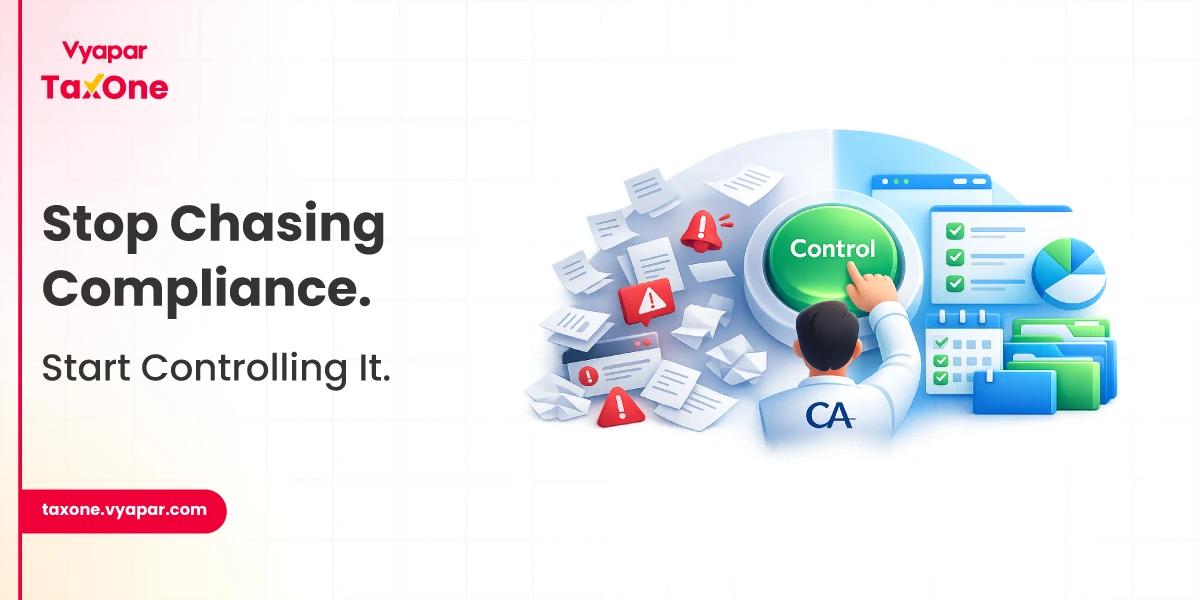
Choosing the right GST Software for CAs in 2026 is no longer a routine software decision. For Chartered Accountants, GST work now involves high-volume return preparation, tighter reconciliation timelines, stronger documentation standards, and greater client expectations for speed and accuracy.
The right solution should do more than help file returns. It should reduce repetitive manual work, improve visibility across clients, strengthen review controls, and support better reconciliation outcomes.
This guide explains how CA firms can evaluate GST software with a practical, workflow-focused approach.
A CA firm today is expected to manage compliance efficiently without compromising review quality. Manual trackers, scattered spreadsheets, and disconnected filing processes often create avoidable delays.
They also increase the risk of mismatches, incomplete follow-up, and inconsistent documentation. A well-designed GST compliance software for CA firms helps create structure.
It brings return preparation, reconciliation, review, and reporting into a more disciplined process. For firms handling multiple GST registrations, this can directly improve turnaround time and reduce operational stress during filing periods.
The best GST Software for CAs should support daily practice needs, not just offer broad feature lists. For most firms, the real value comes from how effectively the software handles routine compliance work.
A strong platform should help firms:
In practical terms, the software should help teams work faster while giving partners and managers better confidence in the quality of output.
At a basic level, the software should support structured GST return preparation and filing workflows. It should reduce manual errors, improve data validation, and make submission readiness easier to review.
This is one of the most important decision points for CA firms. A good GST reconciliation software for chartered accountants should provide meaningful comparison between books and return-related data, not merely surface-level summaries.
It should ideally support:
For firms handling reconciliation-heavy engagements, this capability often matters more than simple filing speed.
A CA firm usually needs multi-client GST software, not a single-entity tool. Teams should be able to view multiple client accounts, filing stages, and compliance status from one place.
This becomes especially useful when:
Workflow control is essential where multiple users are involved. Software should support accountability, clarity, and review discipline.
Look for:
These features make it easier to maintain consistency across teams and reduce dependence on informal review methods.
Many firms choose software based on demonstration quality instead of actual operational pain points. A better approach is to begin with the problems that need solving.
Problem 1: Excessive spreadsheet dependence
Spreadsheets remain common, but they are difficult to manage at scale. Multiple file versions, manual formulas, and fragmented review notes can increase effort instead of reducing it.
Problem 2: Weak visibility across clients
Without a centralized dashboard, firms may struggle to track which returns are pending, under review, or ready for filing.
Problem 3: Reconciliation bottlenecks
A large portion of the GST effort goes into identifying and resolving mismatches. This is where a capable GST return filing software for CAs with strong reconciliation support can create meaningful savings in time and effort.
Problem 4: Inconsistent internal review
Where review depends mainly on personal follow-ups or email trails, output quality may vary from one team member to another. Software with structured controls helps standardize compliance work.
| Evaluation Area | What to Check | Why It Matters for CA Firms |
|---|---|---|
| Return Filing | Validation checks, filing workflow, error reduction | Improves submission accuracy |
| Reconciliation | Invoice-level matching, vendor-wise view, exception tracking | Reduces manual review burden |
| Multi-Client Handling | Dashboard, GSTIN-wise status, bulk actions | Supports scale and supervision |
| Workflow Control | Roles, approvals, audit trail | Strengthens internal discipline |
| Reporting | Reconciliation summaries, filing reports, exception reports | Helps review and client communication |
| Ease of Use | Navigation, data import, onboarding effort | Improves adoption by staff |
| Support Quality | Response time, implementation help, deadline support | Reduces operational risk |
Before comparing vendors, define the firm's actual operating needs. That includes client count, return volume, reconciliation complexity, number of users, and internal approval structure.
A product that looks impressive in a demo may still be unsuitable if it does not fit the firm's real workflow.
The best way to assess software is to test practical tasks. Ask the vendor to show how the system handles common day-to-day situations, such as:
This reveals far more than a polished general presentation.
Pricing should never be the only decision factor. A lower-cost tool may still become expensive if it requires heavy manual effort, weak support, or poor adoption by staff.
A better buying decision focuses on:
Avoid these common errors
Each of these mistakes can reduce the long-term value of the purchase and create more manual work than expected.
Use this checklist when shortlisting options:
This checklist helps keep the evaluation grounded in operational value rather than marketing language.
Not every practice has the same requirement level, but advanced GST Software for CAs is especially relevant for:
Small firms may benefit if they want to build process discipline early and improve scalability over time.
The best GST software for chartered accountants in India should improve both efficiency and control. It should help teams prepare returns systematically, reconcile data more accurately, review work more confidently, and manage more clients without operational disorder.
In simple terms, good software should help a CA firm do four things well:
If a tool does not improve these outcomes, it may not be the right fit, even if it appears attractive on price or presentation.
CA firms reviewing available solutions should also include Vyapar TaxOne in their shortlist, particularly where GST reconciliation, workflow efficiency, and multi-client handling are important evaluation factors.
As with any option, it should be assessed through practical criteria such as reconciliation depth, usability, reporting clarity, control features, and support quality.
Try Vyapar TaxOne for free for a week!
The best GST software for CAs is one that improves return filing, reconciliation, multi-client management, and review control practically.
GST reconciliation software helps CAs identify mismatches, track exceptions, and improve accuracy before filing returns.
CAs should look for reconciliation tools, multi-client dashboards, workflow controls, reporting features, and ease of use Tracking multiple GSTINs.
Not always. Many CA firms also need reconciliation, approval workflows, and better visibility across multiple clients.
CA firms should compare software based on workflow fit, reconciliation depth, usability, reporting quality, and vendor support.

Get started today and simplify your accounting process!