 Is Now Vyapar TaxOne | Same Trust, New Name!
 AI Weapon for Financial Soldiers


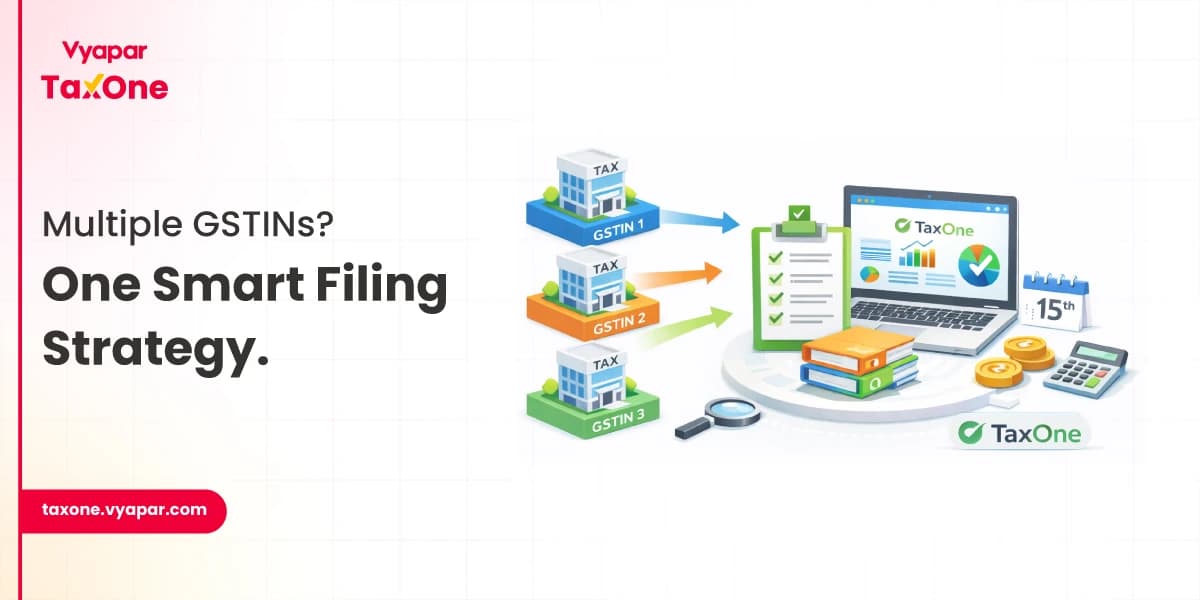
Businesses operating across multiple states or holding multiple registrations under a single PAN must file GST returns separately for each GSTIN, significantly increasing compliance complexity and risk exposure.
This guide provides tax professionals with practical steps for efficiently, accurately, and at scale filing GST returns for multiple GSTINs.
Under Section 25 of the CGST Act, each registration in a different state or union territory is treated as a distinct person for GST purposes, even when they share the same PAN. This means each GSTIN is independently responsible for registration, invoicing, input tax credit (ITC), tax payment, and return filing.
Where a business opts for separate registrations for different business verticals or branches in the same state, those GSTINs also function as distinct persons with separate compliance obligations.
In all such cases, GST returns cannot be consolidated at the PAN level and must be filed GSTIN‑wise.
For tax professionals, understanding this legal structure is fundamental to designing GSTIN‑wise compliance workflows, especially for clients with pan‑India presence.
A business with multiple GSTINs must file all applicable returns separately for each registration, even though there is only one PAN. Typical return obligations include:
GST liabilities, ITC claims, and late fees or interest are computed and discharged at the registration level, with no facility to offset the liability of one GSTIN against the credit or cash ledger of another.
For each GSTIN, the business is expected to maintain separate records, including the sales register, purchase register, ITC register, stock records, and key supporting documentation.
This includes documents relating to branch transfers, imports/exports, common cost allocations, and reconciliations (GSTR‑2A/2B vs purchase register).
Well‑maintained GSTIN‑wise records form the backbone of accurate return filing, audit preparedness, and dispute management.
Tax professionals should design a central compliance calendar that maps due dates, forms, and timelines for each GSTIN, particularly for units that are monthly filers and others that are quarterly under QRMP.
Clearly defined roles across the head office, branch finance teams, and external consultants help avoid missed filings or inconsistent data.
A robust governance framework typically includes documented SOPs, approval hierarchies for returns, and a standard documentation checklist per GSTIN.
Before initiating any filing, ensure that for each GSTIN:
This data discipline is critical when managing tens or hundreds of GSTINs across multiple clients.
GSTR‑1 must be filed separately for each GSTIN, capturing invoice‑level outward supply details for the relevant period. Critical points for multi‑GSTIN clients include:
Errors in GSTR‑1 at one registration can cause ITC issues for recipients and trigger notices, making proactive validation essential.
GSTR‑3B is filed GSTIN‑wise, summarising outward supplies, inward supplies (liable to reverse charge), ITC availed, and tax payable under each head. For multiple GSTINs, you should:
Strong internal reconciliation between GSTR‑1, GSTR‑3B, and books is vital for each registration.
Where applicable, GSTR‑9 and GSTR‑9C are filed per GSTIN based on turnover thresholds, audit requirements, and exemption criteria. These returns require GSTIN‑wise reconciliation of annual figures with financial statements, GSTR‑1, and GSTR‑3B, which can be intensive for multi‑location entities.
Log in to the GST portal separately for each GSTIN using the respective username and password. Maintain a secure credential repository and ensure DSCs/EVC credentials are correctly mapped to each registration and authorised person.
For each GSTIN:
Well‑structured data and pre‑filing validations reduce amendment requirements and client disputes.
Using the GSTIN‑wise books and reconciliations:
This process should be repeated for each registration, with worksheets and approvals maintained at the GSTIN level.
For each GSTIN:
Retain acknowledgements, challan copies, and reconciliation workings as part of the audit trail.
Supplies between units having different GSTINs (even under the same PAN) are generally treated as taxable supplies between distinct persons. This covers stock transfers, inter‑unit service charges, and head‑office allocations, for which invoices must be raised and tax applied in accordance with the valuation rules.
Failing to document and report these inter‑GSTIN supplies properly can distort ITC, profitability, and compliance risk for both locations.
The receiving GSTIN must account for the supply as inward supplies, record ITC in its books, and ensure the credit appears in GSTR‑2A/2B for that registration. Tax professionals should monitor:
Common issues encountered by tax professionals handling multiple GSTINs include:
Systematic calendars, automation tools, and regular status reviews help minimize these risks.
Poor quality data, missing documentation for branch transfers, and unresolved reconciliation differences can result in notices and litigation.
Maintaining detailed GSTIN‑wise working papers, reconciliation reports, and management sign‑offs is essential to defend positions during audits or investigations.
For tax professionals managing multiple GSTINs, manual reconciliation across GSTR‑1, GSTR‑3B, GSTR‑2A/2B, Tally, Excel, and e‑commerce data is time‑consuming and prone to error.
Vyapar TaxOne provides an AI‑powered GST automation and reconciliation layer that centralises data while still respecting GSTIN‑wise compliance requirements.
Its intelligent reconciliation engine compares invoices across GSTR‑1, GSTR‑2A/2B, and internal invoice management systems, flagging mismatches in real time. This is particularly useful where the same client has multiple registrations and a high volume of cross‑location transactions.
For tax professionals handling multiple GSTINs across clients, Vyapar TaxOne helps improve turnaround time, accuracy, and documentation quality while making GST return filing and reconciliation more scalable in an AI‑driven compliance environment.
Yes. Each GSTIN is treated as a distinct person under GST, so GSTR-1, GSTR-3B, and applicable annual returns must be filed separately for every registration.
No. Electronic cash and credit ledgers are GSTIN-specific and cannot be cross-utilised across different registrations.
Maintain GSTIN-wise books and registers for sales, purchases, ITC, and stock, and ensure clear documentation for inter-branch supplies and common cost allocations.
Yes. Supplies between branches having different GSTINs (even under the same PAN) are generally treated as taxable supplies between distinct persons, and proper tax invoices must be issued.
It automates GST reconciliation and consolidates invoice data while preserving GSTIN-wise accuracy, reducing manual effort and errors in multi-GSTIN return filing.

Get started today and simplify your accounting process!