 Is Now Vyapar TaxOne | Same Trust, New Name!
 AI Weapon for Financial Soldiers


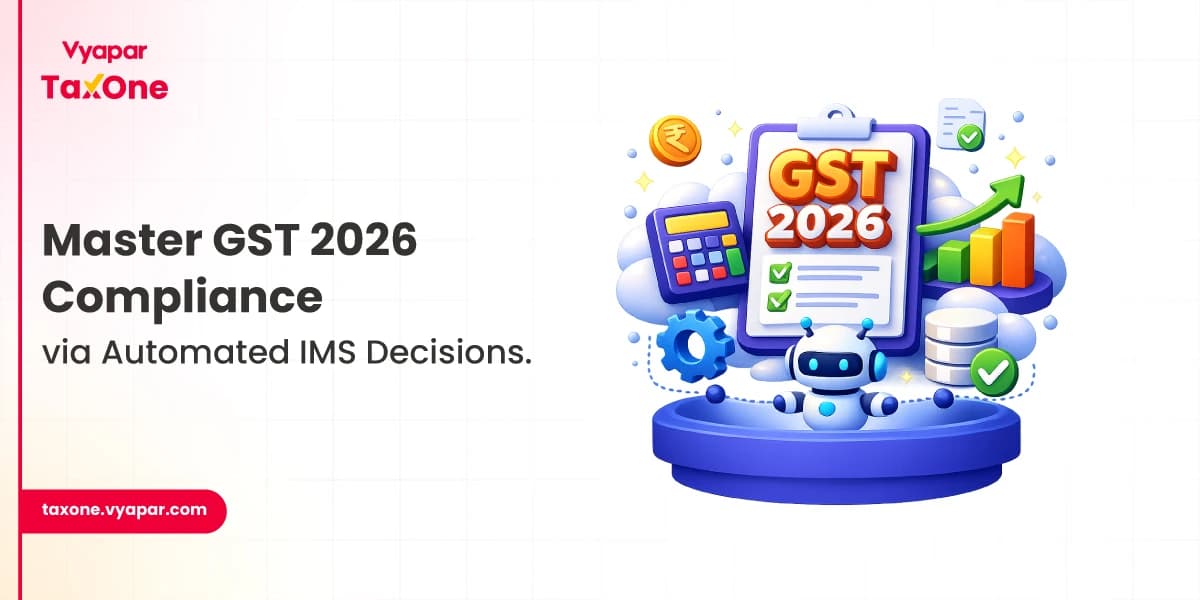
India's GST compliance has undergone a structural shift.
Invoice Management System (IMS), launched on the GST portal on October 14, 2024, is no longer a peripheral tool. For tax professionals managing high-volume clients, IMS bulk invoice processing has become one of the most demanding operational challenges of FY 2025–26.
From January 2026, stricter ITC validations and the Finance Act 2025's mandate to adopt IMS require professionals managing 5,000+ invoices per tax period to rethink their workflows.
This guide offers a practical framework for large-scale IMS management, covering bulk actions, automated decisions, mass accept/reject workflows, and compliant invoice matching.
The Invoice Management System is a real-time dashboard embedded within the GST portal that allows recipient taxpayers to take action on invoices filed by their suppliers in GSTR-1 or GSTR-1A.
Before IMS, the ITC process was largely passive, and invoices were auto-populated in GSTR-2B without recipient control.
IMS fundamentally changes this by placing decision authority in the hands of the recipient.
| Action | Meaning | ITC Impact |
|---|---|---|
| Accept | Recipient confirms the invoice | Flows into GSTR-2B for ITC claim |
| Reject | Recipient disputes the invoice | Excluded from GSTR-2B |
| Pending | Held for further review | Deferred to next GSTR-2B cycle |
| Deemed Acceptance | No action taken before cutoff | Auto-accepted into GSTR-2B |
The deemed acceptance rule is the most critical compliance risk for high-volume taxpayers. Inaction is not neutrality; it is an implicit approval with real ITC consequences.
Most discussions of GST compliance assume a manageable volume of invoices. For large manufacturers, exporters, trading companies, and multi-GSTIN entities, processing 5,000 invoices per tax period is routine, not exceptional.
The challenge is structural:
Without a disciplined process for IMS bulk invoice processing, even a well-staffed tax team can miss critical rejections, allow wrongful ITC to accumulate, and expose clients to demand notices.
Accurate invoice-matching criteria are the foundation of reliable bulk processing. Before any mass acceptance or rejection decision is made, invoices must be validated against the following parameters:
1. Supplier Compliance Status
An invoice is only eligible for IMS action if the supplier has filed their GSTR-1 or GSTR-1A. Invoices from non-filers do not appear in IMS and must be tracked separately.
2. ITC Eligibility Under Section 16
Invoices beyond the ITC claim window under Section 16(4) are automatically excluded from IMS. Professionals must flag these before beginning bulk review.
3. RCM Applicability
Invoices attracting the Reverse Charge Mechanism (RCM) do not flow through IMS in the standard manner and require separate treatment in GSTR-3B.
4. POS Rule Exclusions
Place of Supply mismatches and certain B2C invoices do not appear in the IMS dashboard and must be reconciled independently.
5. Credit Notes and Debit Notes
As of October 2025, credit notes linked to accepted invoices can remain in "Pending" status for up to one additional tax period, giving professionals greater flexibility in resolving them.
Applying these invoice-matching criteria systematically before initiating bulk portal actions dramatically reduces post-filing corrections.
This workflow is designed for tax professionals managing 5,000+ invoices per GSTIN per month.
Do not wait until the 14th. Download the available IMS dashboard data at the start of the month to begin preliminary review. Early action allows time to reach out to suppliers for corrections.
Navigate to the IMS dashboard on the GST portal and export the full invoice list in Excel. This enables offline analysis, a prerequisite for high-volume processing.
Using Excel filters or your reconciliation tool, separate invoices into:
For volumes above 1,000 invoices, manual Excel processing introduces unacceptable error rates. Third-party platforms that use automated IMS decisions employ rule-based and AI-powered matching to categorize invoices at scale, comparing PO data, ERP records, and supplier GSTR-1 entries simultaneously.
Upload your processed action file back to the GST portal in batches of up to 500. Confirm submission status for each batch before proceeding to the next.
The October 2025 update introduced a structured remarks facility for rejected invoices. Use it. Documented rejection reasons create an audit trail and accelerate supplier-side corrections.
After completing all bulk actions, trigger a GSTR-2B recomputation. Verify that the accepted ITC aligns with what you intend to claim in GSTR-3B before filing.
Manual processing at scale is neither practical nor defensible from a compliance standpoint. Automated IMS decisions powered by third-party platforms offer:
The ROI of automation is not merely time-saving; it is risk reduction. A single wrongful ITC claim arising from a missed rejection can far outweigh the annual cost of a compliant platform.
Mass accept reject workflows, while efficient, carry specific compliance obligations that professionals must enforce:
For tax professionals seeking an integrated, India-specific solution for IMS bulk invoice processing, Vyapar TaxOne offers a purpose-built GST Reconciliation feature designed to address the exact challenges outlined in this guide.
Vyapar TaxOne's GST reconciliation platform is built to handle the end-to-end IMS workflow, from data import to bulk portal actions, with the following capabilities:
Vyapar TaxOne is particularly well-suited for Chartered Accountants, GST practitioners, and in-house tax teams managing multiple clients or GSTINs, where a consolidated, platform-driven approach to automated IMS decisions is the only scalable path forward.
In a compliance environment where manual processing is neither efficient nor safe, Vyapar TaxOne bridges the gap between the GST portal's 500-invoice batch limitation and the real-world processing needs of India's large taxpayer base.
The professionals and firms that invest in disciplined invoice-matching criteria, systematic bulk-portal actions, and intelligent automated IMS decisions today will be the ones their clients trust most tomorrow.
The portal supports bulk portal actions for up to 500 invoices per batch. For 5,000 invoices, process in multiple batches via offline Excel export/import.
Use mass accept/reject after applying invoice-matching criteria such as supplier compliance and ITC eligibility. Accepted invoices flow to GSTR-2B; rejected ones are excluded with remarks.
Yes, third-party tools enable automated IMS decisions via fuzzy matching and rule-based logic, reducing errors for 5,000+ invoices while maintaining audit trails.
Complete reviews before GSTR-2B generation on the 14th. Unreviewed invoices are auto-accepted, risking wrongful ITC claims.
Yes, it offers IMS bulk invoice processing with automated matching, mass accept/reject, and multi-GSTIN reconciliation for efficient 2026 compliance.


Get started today and simplify your accounting process!