 Is Now Vyapar TaxOne | Same Trust, New Name!
 AI Weapon for Financial Soldiers


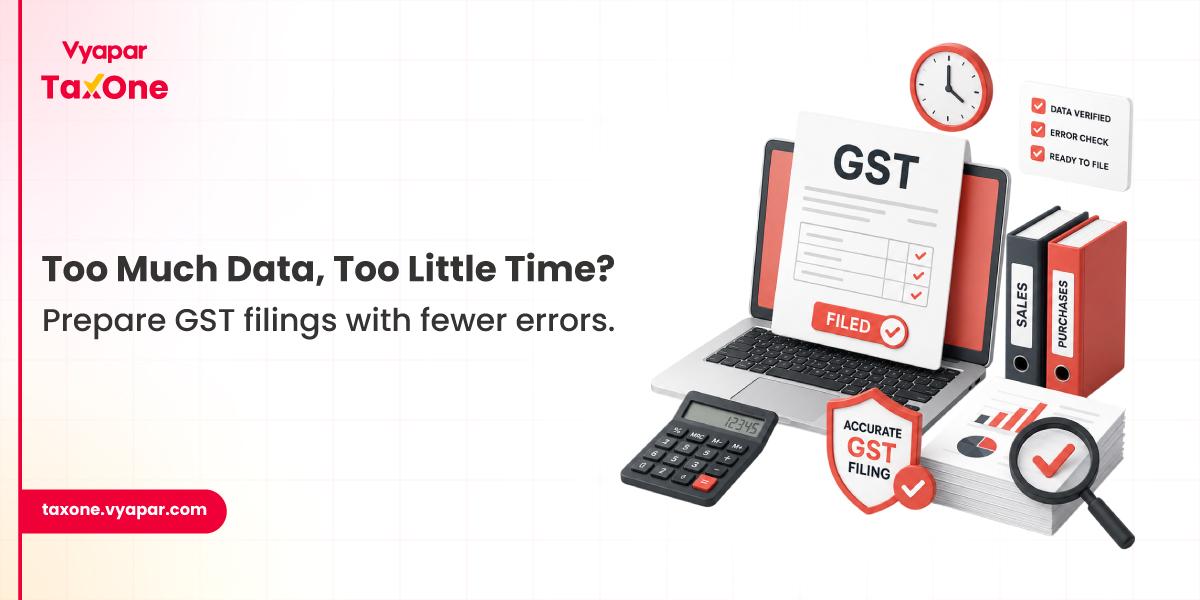
During tax season, accounting teams often spend more time preparing data than filing returns.
Purchase registers need review.
GSTR-2B must be reconciled.
Invoices need validation.
Client documents arrive late.
And multiple deadlines continue moving closer.
We regularly work with CA firms, GST practitioners, and finance teams handling large filing volumes. One common challenge we notice is that the return filing itself is usually not the problem.
Preparing reliable data is.
Most delays actually begin weeks before filing.
By the time reconciliation starts, teams are already dealing with missing invoices, GST mismatches, Excel versions, and client follow-ups.
Tax season automation is the practice of reducing repetitive activities involved in GST preparation, reconciliation, invoice review, and filing readiness.
It does not replace accounting review.
Instead, it reduces the time spent collecting, validating, reconciling, and organizing data before returns are prepared.
We often see accountants spending hours reviewing transactions that could have been identified as exceptions much earlier through structured GST workflows.
The pressure rarely comes from GST calculations alone.
It usually comes from operational issues that build up throughout the filing cycle.
Common causes include:
In many cases, the calculation is correct, but the supporting data is not.
This issue usually becomes visible when GSTR-2B is compared with the purchase register.
This issue usually becomes visible when GSTR-2B is compared with the purchase register. Many teams address these differences through a structured ITC matching and reconciliation process.
A CA firm managing multiple GST clients had completed bookkeeping well before filing deadlines.
However, return preparation slowed down because client data was arriving through:
The team spent several days validating GSTINs, checking duplicate invoices, and reviewing reconciliation differences.
The challenge wasn't filing GST returns.
The challenge was preparing data that was ready for filing.
We regularly see similar situations where reconciliation takes longer than compliance itself.
A trading company completed its monthly accounting activities on time.
Everything appeared ready.
However, when the purchase register was compared against GSTR-2B, multiple invoices were missing from GST records.
Several supplier filings had been delayed.
The finance team spent two days identifying differences and updating working papers before filing could proceed.
We often see teams discovering these issues only during reconciliation.
By then, filing pressure is already high.
Most filing issues are operational.
They are usually discovered late because the source data has not been reviewed continuously.
Invoices exist in books but are missing from GST records.
Incorrect GSTIN capture creates validation issues and reconciliation gaps.
Transactions imported from multiple sources may be recorded more than once.
The invoice exists in the purchase register but does not appear in GSTR-2B.
Corrections made later may not match earlier working papers.
Teams spend hours locating invoices when verification begins.
One common challenge we noticed is that accountants often discover these issues only after reconciliation starts.
This is one reason why many firms now focus on maintaining a structured GST reconciliation workflow throughout the filing cycle.
The firms that manage tax season smoothly usually follow a repeatable process.
Gather:
Review:
Compare:
Focus on mismatches instead of reviewing every transaction manually.
Once reconciliations are complete, return preparation becomes much easier.
Teams handling multiple clients often face additional challenges around deadline tracking. Firms handling large client volumes often benefit from a more structured GST deadline management approach, especially when multiple filing cycles overlap.
Some accounting teams maintain these reviews throughout the month using centralized GST workflows available through Vyapar TaxOne.
| Activity | Manual Process | Structured Workflow |
|---|---|---|
| Invoice Validation | Multiple reviews | Exception-based review |
| GST Reconciliation | Separate spreadsheets | Centralized tracking |
| GSTIN Verification | Manual checking | Earlier identification |
| Supporting Documents | Scattered folders | Organized records |
| Filing Readiness | Difficult to assess | Better visibility |
| Error Detection | During filing | Before filing |
Many teams focus heavily on filing returns.
Verification usually focuses on supporting records.
GST officers commonly review:
We frequently see clarification notices issued even when the tax calculation itself is correct.
The issue is usually a mismatch between supporting records and reported figures.
This is why maintaining reconciliation evidence throughout the filing period is important.
Before filing returns, accounting teams should confirm:
While working with accountants, GST practitioners, and finance teams, we've noticed a consistent pattern.
The filing activity itself usually takes less time than preparing the supporting data.
Teams spend considerable effort:
This is why many firms move away from managing these activities through separate spreadsheets.
Vyapar TaxOne helps accounting teams maintain GST reconciliation, invoice review, GST validations, ITC reporting, and compliance workflows from a single process.
We built these workflows because we frequently saw teams spending more time locating problems than resolving them.
Many firms are now using AI-assisted GST data preparation to identify exceptions earlier and reduce repetitive review work.
We often see teams spending more time preparing data than completing the actual compliance activity.
As transaction volumes grow, managing reconciliation, validation, and reporting through separate spreadsheets becomes difficult. Structured workflows help reduce this effort by keeping data organised throughout the process. Vyapar TaxOne was built to support these workflows and help accounting teams manage GST operations more efficiently during tax season.
This usually happens because supplier filings are delayed, invoices contain GSTIN errors, or GST records have not yet been reconciled against books.
In many cases, accountants spend more time validating invoices, reviewing ITC balances, and reconciling GST data than completing the actual filing process.
We often see teams postponing reconciliation until filing week. Most discrepancies become visible only after comparing GSTR-2B with purchase records.
The return may be accurate, but supporting invoices, ledger balances, and reconciliation records may not fully align with the reported figures.
Maintaining continuous GST reconciliation and invoice validation throughout the filing cycle usually reduces the amount of review work required before deadlines.


Get started today and simplify your accounting process!