 Is Now Vyapar TaxOne | Same Trust, New Name!
 AI Weapon for Financial Soldiers


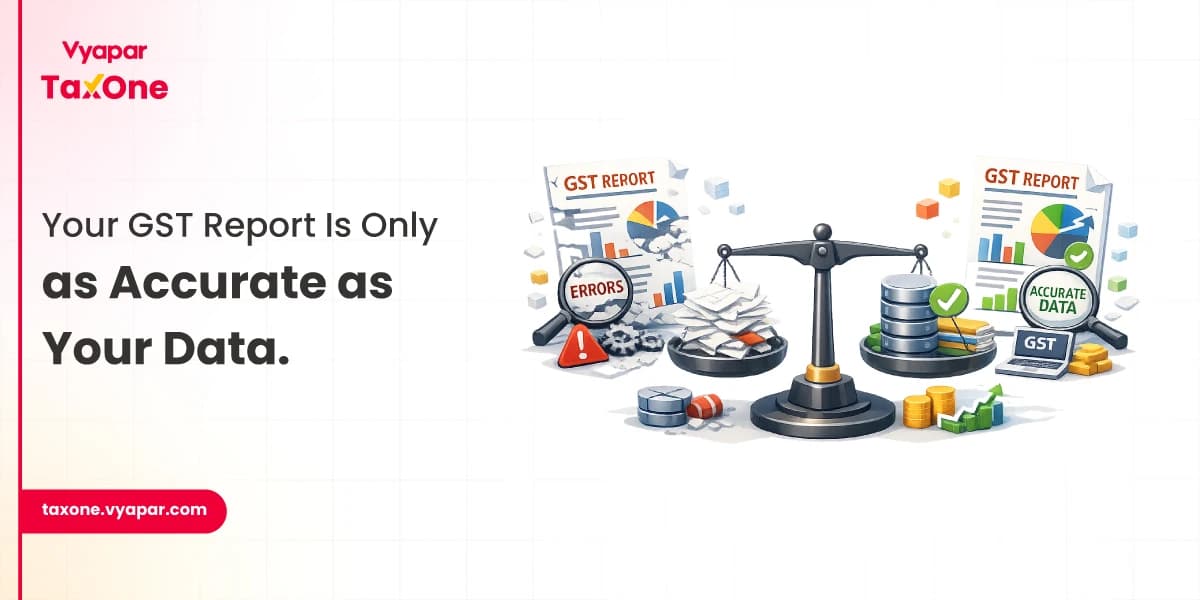
Accurate data entry is the foundation of reliable GST reports for tax professionals in India, where even minor errors can trigger mismatches in GSTR-1 and GSTR-3B, ITC rejections, and costly notices.
These GST reconciliation issues persist amid tighter 2026 compliance rules, resulting in penalties under Section 73 of the CGST Act.
This comprehensive guide uncovers the most prevalent GST data entry mistakes, their ripple effects, and practical solutions to safeguard your filings.
Invoice inaccuracies top the list of GST filing errors, as GSTR-1 requires granular details like numbers, dates, GSTINs, and values for auto-population in buyer GSTR-2B. A single slip here cascades into reconciliation nightmares during monthly closings.
Non-sequential or duplicate invoice numbers confuse the GST portal's matching algorithm, leading to underreported supplies and an invitation to DRC-01B intimation.
Tax pros managing multiple clients should audit invoice logs weekly to pre-empt these GST return filing mistakes.
Transposed digits in supplier or customer GSTINs block transaction visibility in GSTR-2A/2B, a frequent culprit in ITC disputes.
Common pitfalls include:
Actionable Advice: Integrate GSTIN validation APIs from the official portal into your invoicing workflow.
For bulk entries, use Excel's VLOOKUP with the GST public search database to verify 95%+ accuracy upfront.
Manual entry of taxable values, CGST/SGST/IGST, or cess often leads to mismatches in summation between invoice totals and GSTR summaries.
Switch to OCR scanning for physical invoices or direct API pulls from billing software like Tally, reducing typing errors by 80%.
HSN/SAC misclassification remains a stubborn GST data entry error, especially in diverse sectors like e-commerce and manufacturing, where rate changes (e.g., 12% to 18%) go unnoticed.
HSN codes apply to goods (e.g., 0101 for livestock), while SAC governs services (e.g., 9983 for IT). Mixing them inflates tax liabilities or blocks ITC.
| Code Type | Applicability | Common Error | Consequence | Prevention Tip |
|---|---|---|---|---|
| HSN | Goods (tangible) | Using SAC for raw materials | Wrong 0%/5% rate on exempt items | Update library quarterly via GSTN advisories |
| SAC | Services (intangible) | HSN on consultancy fees | Nil-rated ITC denial | Train on composite supply rules (Notification 11/2017) |
Pro Tip: For mixed supplies, segregate line items and reference the latest GST rate finder tool during invoicing.
Applying 28% to 12% slabs (e.g., electronics accessories) or ignoring RCM for unregistered suppliers distorts liability ledgers.
Best Practice: Embed dynamic rate lookup in your accounting dashboard, cross-verified against the GST Council's meeting outcomes.
Unreconciled outward (GSTR-1) and summary (GSTR-3B) returns account for 40% of notices, per recent GSTN data. Provisional ITC without GSTR-2B backing risks full reversals.
Sales omitted from GSTR-1 but booked in GSTR-3B trigger auto-flags; duplicates inflate turnover.
Reconciliation Steps:
This monthly ritual catches 90% of discrepancies before submission deadlines.
Claiming ITC on ineligible purchases (e.g., personal use under Section 17(5)) or unmatched supplier GSTR-1 filings leads to Rule 88D demands.
Fix Protocol: Auto-reconcile GSTR-2B vs purchase ledger; reverse excess ITC in next GSTR-3B with interest disclosure.
Despite digitisation, high-volume data handling for SMEs exposes tax firms to transposition and fatigue errors, peaking during quarter-ends.
Switching digits (e.g., ₹1,234 to ₹12,34) or pasting from wrong sheets corrupts totals.
Mitigation Strategies:
GST portal rounds aggregates differently (banker's rounding), clashing with invoice-level math.
Standardise:
GST lacks retrospective edits; errors require debit/credit notes (DN/CN) or voluntary disclosures, which are mishandled in 30% of cases.
Late inclusions attract 18% interest from the invoice date to payment.
Correct Path:
Over-adjusting via DN without tax reduction mismatches the ledgers.
Guidance: Link DN/CN to original invoice numbers; reconcile pre-filing.
Forward-thinking tax professionals layer in tech, processes, and people to deliver zero-error GST workflows.
Adoption of Integrated Accounting Systems
Some ERPs or custom GST suites auto-sync invoices to portals, slashing manual entry by 70%.
Regular Reconciliation and Review Protocols
Training and Standard Operating Procedures
Annual workshops on 2026 updates (e.g., tweaks to the QRMP scheme) and SOP binders ensure team alignment.
Mastering these common GST data entry mistakes, from invoice slips to ITC pitfalls, empowers tax professionals to deliver audit-proof reports amid India's stringent regime. Proactive reconciliation and automation not only curb penalties but also elevate client retention.
Vyapar TaxOne, tailored for Indian tax experts, revolutionises workflows with its GST reconciliation feature. It auto-matches GSTR-1, GSTR-2A/2B, and IMS with AI-driven anomaly detection, Tally/Vyapar integration, and one-click ITC maximisation, cutting reconciliation time by 70%.
Key perks include real-time error flags, bulk amendment handling, and compliance dashboards.
Try Vyapar TaxOne for free to see your GST challenges become seamless efficiency today.
Primarily omitted or duplicate invoice entries, wrong GSTINs, and tax value discrepancies, leading to auto-flags and ITC delays.
Use the official GST portal's API or Excel VLOOKUP with public search data for real-time checks, preventing 95% of party detail errors.
Reconcile monthly against GSTR-2B, reverse ineligible claims in the next GSTR-3B, and disclose interest to avoid Rule 88D notices.
Yes, quarterly reviews via GSTN advisories ensure accurate classification, avoiding rate mismatches in sectors like food and textiles.
It automates GSTR-1/2B/3B matching with AI flags, Tally integration, and ITC optimisation, reducing errors by 70%.

Get started today and simplify your accounting process!