 Is Now Vyapar TaxOne | Same Trust, New Name!
 AI Weapon for Financial Soldiers
Vyapar TaxOne


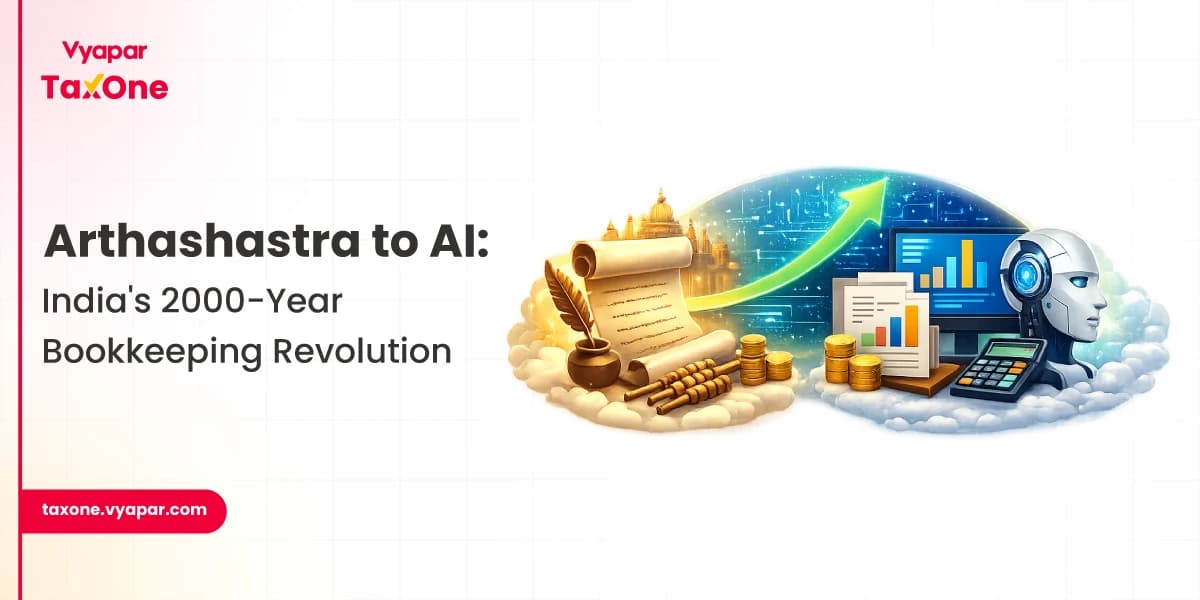
The history of bookkeeping in India reveals a remarkable evolution from ancient Arthashastra principles to cutting-edge AI-driven systems, shaping the nation's economic backbone.
This comprehensive guide to the evolution of Indian bookkeeping delves into traditional Indian bookkeeping practices such as Bahi-Khata, colonial-era shifts, ICAI standards, Ind AS adoption, and modern GST accounting.
For Indian CAs, MSMEs, and finance professionals based in cities like Ahmedabad, understanding this trajectory addresses challenges such as manual reconciliation errors, e-invoicing compliance, and automation gaps.
By blending historical wisdom with AI in Indian bookkeeping, businesses can reduce GST discrepancies by up to 30% and scale efficiently using tools like Vyapar TaxOne.
Indian accounting's roots trace back over 2,000 years, emphasizing ethical, systematic record-keeping that remains relevant for today's GST-compliant workflows.
Chanakya's Arthashastra, a Mauryan treatise, established foundational accounting practices in ancient India. Key innovations included:
This framework sustained empires through trade, agriculture, and taxation, offering timeless lessons in fraud prevention amid rising cyber risks in Indian bookkeeping systems.
Actionable Advice: Adopt Arthashastra-inspired checklists in Vyapar TaxOne:
Temples served as ancient financial hubs, recording donations, loans, and assets in accordance with Manusmriti guidelines.
These systems built trust in pre-digital economies, guiding MSMEs in informal transaction tracking.
Actionable Advice: Mirror temple logs with Vyapar's inventory features:
Medieval merchants powered India's trade networks with resilient, indigenous methods.
The Bahi-Khata ("watch-account") dominated from the 13th century, fueling Silk Road commerce. Here's a breakdown:
| Ledger Type | Purpose | Modern Vyapar TaxOne Equivalent |
|---|---|---|
| Jama-Khata | Receivables (debts owed to you) | Accounts Receivable dashboard |
| Len-Den | Payables (your debts) | Accounts Payable module |
| Rukham | Daily cash summaries | Bank reconciliation reports |
| Godrej | Yearly balances | Trial balance & GST reports |
Often supplemented by oral traditions, it adapted to illiteracy while scaling vast operations.
Actionable Advice: Digitize Bahi-Khata via Vyapar TaxOne's OCR:
These fostered adaptability, paralleling digital transition challenges in Indian accounting for SMEs.
British colonialism standardized practices, blending East and West.
The East India Company enforced double-entry for revenue, leading to the 1850 Companies Act.
Hybrids emerged, teaching compliance resilience, key to Ind AS convergence today.
Actionable Advice: Use Vyapar:
Professionalization via ICAI set the stage for accounting standards in India.
Post-1947 reforms navigated economic shifts toward digital standardization.
Liberalization and Y2K spurred the adoption of cloud accounting in India.
Actionable Advice:
| Modern Challenge | Historical Parallel | Vyapar TaxOne Solution |
|---|---|---|
| Hyperinflation | Mauryan audits | Predictive cash flow analytics |
| Liberalization | Colonial hybrids | Cloud ERP integration |
| GST Errors | Bahi-Khata mismatches | Auto-validation & backups |
AI accelerates double-entry evolution, tackling automation challenges in India.
40% CA adoption projected by 2026.
Actionable Advice:
The history of Indian bookkeeping from the Arthashastra to AI empowers tackling GST hurdles and competition. Integrate historical prudence with Vyapar TaxOne for ROI.
Supercharge with Vyapar TaxOne & Vyapar App
Vyapar TaxOne automates end-to-end bookkeeping in India, from WhatsApp docs to GST filing for 30,000+ pros, slashing work by 80%. Complement with the Vyapar app: free GST billing, inventory tracking, 50+ reports, payment reminders, and backups for 1Cr+ SMEs. Start your free trial today.
Bahi-Khata refers to traditional Indian single-entry bookkeeping used by medieval merchants, with ledgers such as Jama-Khata (receivables) and Len-Den (payables) to record barter, credit, and daily cash transactions. It is ideal for digitizing with Vyapar TaxOne's OCR features.
Chanakya's Arthashastra introduced systematic audits and inventory tracking over 2,000 years ago, principles that inspire the daily reconciliation checklists in Vyapar TaxOne today, reducing GST input tax credit errors by 20-30%.
Vyapar TaxOne automates CA workflows (WhatsApp docs to GST filing), while the Vyapar app handles SME daily operations, including free GST billing, inventory alerts, and 50+ reports, and together they enable seamless end-to-end bookkeeping.
AI tools in platforms like Vyapar TaxOne use OCR/ML for invoice scanning, anomaly detection, and predictive analytics, cutting manual errors by 15% and audit costs by 25% for MSMEs facing GST and Ind AS challenges.
The Institute of Chartered Accountants of India (ICAI), formed in 1949, standardizes post-independence accounting and drives adoption of Ind AS, which is essential for professionals using Vyapar TaxOne to meet evolving compliance needs.

Tax Professional & Business Finance Expert
Tax Professional & Business Finance Expert
Tax Professional & Business Finance Expert