 Is Now Vyapar TaxOne | Same Trust, New Name!
 AI Weapon for Financial Soldiers


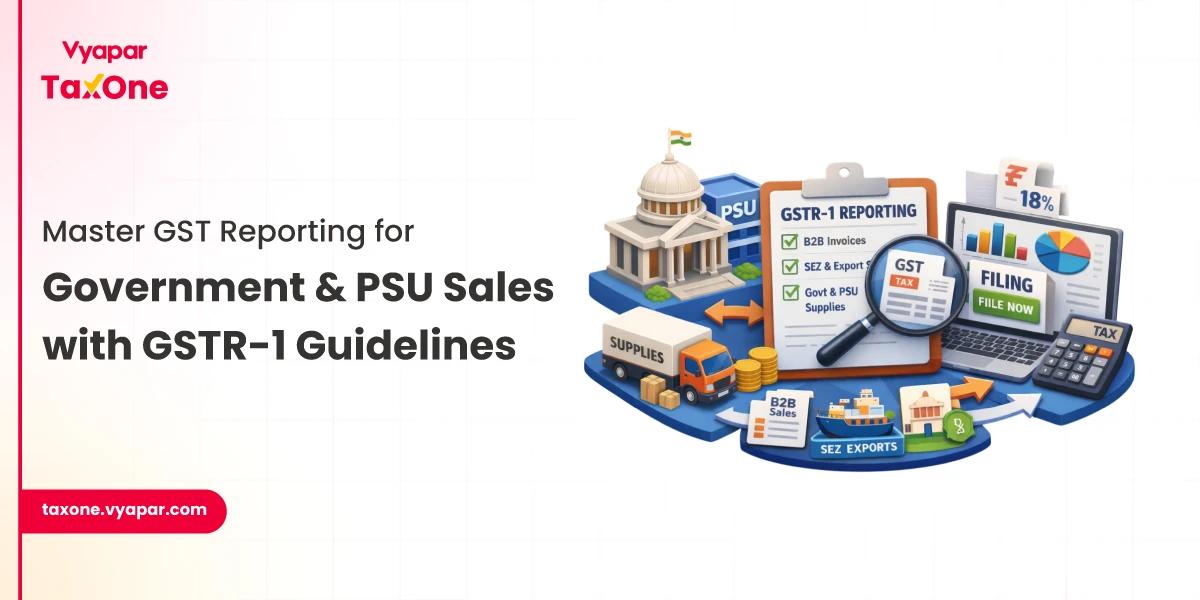
The Goods and Services Tax system has streamlined tax processes in India. However, the sale of goods and services to Government departments and Public Sector Undertakings (PSUs) requires special reporting in the GSTR-1 return.
Tax professionals must navigate these reporting challenges to ensure compliance and avoid penalties.
This blog covers the essential aspects of GST reporting for sales to the Government and PSUs, providing actionable advice and best practices.
Sales to Government entities and PSUs often have specific requirements under GST, including taxability and reporting. Tax professionals must understand these nuances to comply with the regulatory framework effectively.
Correct reporting of transactions involving the Government and PSUs in the GSTR-1 is necessary for:
Under GST, transactions with the Government and PSUs are treated similarly to other taxable supplies, but certain exemptions and reverse charge mechanisms (RCMs) may apply. The following provisions are essential for tax professionals:
Certain notifications and circulars issued by the GST Council provide clarity on the treatment of Government and PSU sales. These include:
Tax professionals should keep up to date with these guidelines to ensure correct reporting in GSTR-1.
Understanding the taxability and place of supply is crucial. The place of supply rule helps determine if IGST or CGST/SGST is applicable:
When issuing invoices to the Government and PSUs, ensure the following:
It’s essential to maintain proper documentation to avoid any compliance issues.
In GSTR-1, transactions with the Government and PSUs must be accurately categorized in the correct sections. These transactions usually fall under:
Tip: Always check the specific codes for reporting sales to the Government or PSU customers.
The GSTR-1 form includes special codes and fields for transactions involving the Government and PSUs.
| Column 1 | Column 2 |
|---|---|
| B2B (Exempt or RCM) | Report reverse charge transactions or exempt sales. |
| Government/PSU Code | Unique code to identify transactions with Government and PSUs. |
It is critical to use these codes to differentiate between regular B2B transactions and those involving Government/PSU entities.
When selling directly to a Government entity or PSU, the transaction is reported in GSTR-1 under the B2B section. For example:
Steps to report:
In cases where a contractor or subcontractor facilitates the sale to a Government or PSU, the reporting becomes more complex. The sale must be captured from both the supplier’s and the contractor’s perspective.
Steps to report:
GST treatment of advance receipts needs special attention. If you receive an advance for supplies to the Government or PSUs:
Example: A PSU pays an advance for the supply of machinery. This advance is reported in GSTR-1 upon receipt, and the final supply is updated in the subsequent return.
To ensure your GSTR-1 is accurate, reconciliation of sales records with GSTR-1 is a must. Regularly match invoices, contracts, and other supporting documents to ensure completeness.
Establish precise internal controls to verify the accuracy of sales to the Government/PSUs reported in GSTR-1.
Checklist:
Tip: Designate a dedicated team to manage these entries to avoid oversight.
Frequent errors in reporting Government/PSU sales include:
Tip: Regular training and awareness of the latest GST notifications can help mitigate these common issues.
Failure to report correctly can lead to:
Tax authorities often scrutinize Government and PSU transactions. Ensure that all records and invoices are complete and accurate to withstand audits.
As digital platforms evolve, reconciling software tools and ERP systems can present challenges. Ensure that your ERP tool is compatible with the latest GSTR-1 requirements.
Tip: Invest in automated GST compliance tools to streamline data entry and reporting.
E-invoicing has added a layer of complexity to GSTR-1 reporting. Ensure that e-invoices are integrated with your GSTR-1 return to avoid discrepancies.
Accurate reporting of sales to the Government and PSUs in GSTR-1 is critical for tax professionals to ensure GST compliance. By following guidelines, implementing best practices, and staying up to date on legal changes, businesses can avoid penalties and ensure smooth compliance.
By adopting these strategies, tax professionals can streamline sales reporting to the Government and PSUs, ensuring compliance with the latest GST laws.
GST is applicable on most sales to the Government and PSUs, unless specific exemptions or reverse charge mechanisms apply.
Sales to Government and PSUs should be reported in the B2B section of GSTR-1, with special codes for exempt supplies or reverse charge transactions.
RCM applies when the Government or PSU is liable to pay the GST instead of the supplier. This must be indicated in GSTR-1 using the RCM field.
Yes, GST is applicable on advances received for supplies to the Government or PSUs, and these should be reported in GSTR-1 when the advance is received.
Incorrect GST reporting can lead to penalties and interest, as well as the risk of audits or scrutiny by tax authorities.

Get started today and simplify your accounting process!