 Is Now Vyapar TaxOne | Same Trust, New Name!
 AI Weapon for Financial Soldiers


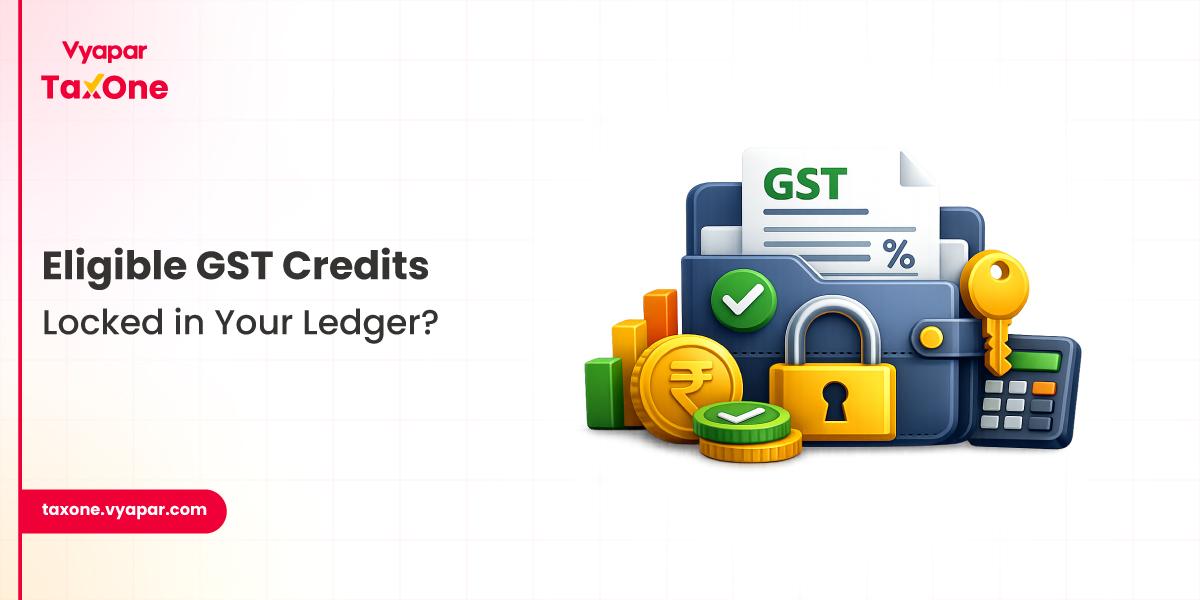
Many businesses regularly claim GST credits on purchases.
Yet the ITC balance keeps increasing every month.
The credit sits in the GST ledger.
But a large portion remains unused.
This is a common problem for businesses operating under an inverted duty structure.
For finance teams, the issue is not just GST compliance.
It's working capital getting locked unnecessarily.
The challenge becomes bigger when businesses try to recover this excess ITC through refund claims.
Invoices need to match.
GST returns need to reconcile.
Supporting documents need to be ready.
Even small errors can delay refunds.
In this guide, we'll understand why ITC accumulates, when refunds can be claimed, and how accounting teams can simplify the refund process.
This usually happens when GST paid on purchases is higher than GST charged on sales.
In GST terms, this is called an inverted duty structure.
A simple example:
A manufacturer purchases raw materials attracting 18% GST.
The finished product is sold with 12% GST.
Every month, more GST is paid on purchases than collected from customers.
The difference keeps accumulating as Input Tax Credit (ITC).
The credit remains available in the electronic credit ledger.
But, it cannot be fully utilized against output GST liability.
Over time, businesses may accumulate substantial ITC balances that remain unused.
GST law allows eligible taxpayers to claim refunds of accumulated ITC arising due to an inverted duty structure.
The refund mechanism is covered under Section 54 of the CGST Act.
Generally, refund eligibility arises when:
GST paid on purchases exceeds GST payable on outward supplies
Unutilized ITC exists in the electronic credit ledger
Required GST returns have been filed
Refund timelines are met
Supporting records are available
A textile manufacturer was regularly filing GST returns.
Everything appeared compliant.
But, the finance team noticed that the ITC ledger balance kept growing every month.
After reviewing the GST data, the issue became clear. Most raw material purchases attracted 18% GST.
Finished products were being sold at lower GST rates.
The business had accumulated more than ₹11 lakhs of unused ITC over time.
The refund opportunity existed.
But the supporting records required significant preparation before filing.
This is a common situation in industries such as:
A footwear manufacturer had already prepared its refund working showing ₹4.8 Lakhs.
The eligible refund amount appeared correct.
But, during review, several purchase invoices could not be matched with the GST records used in the refund calculation.
A few supplier GSTINs were also captured incorrectly in the purchase register.
The refund amount itself wasn't the issue.
The supporting records were.
The team spent nearly two days reconciling invoices, validating GSTINs, and rebuilding parts of the refund working before the application was ready.
We regularly see similar situations where data validation takes longer than the actual refund calculation.
Most refund delays are not caused by GST law.
They usually happen because the supporting data is not fully ready when the refund application is filed.
We often see purchase registers showing ITC that doesn't fully match GSTR-2B. Regular GSTR-2B reconciliation can help identify these mismatches much earlier.
In some cases, suppliers file returns late. The invoice exists in books, but it doesn't appear in GST records for the relevant period.
Amendments create another challenge.
The figures used in refund workings may not match the latest GST return if corrections were made later.
Documentation is also a common issue. Invoices may be available, but teams spend hours locating supporting records when verification begins.
Common reasons include:
Even small differences in GSTINs, invoice values, or ledger balances can trigger clarification requests from GST officers.
The refund calculation may be correct.
But if the supporting data doesn't reconcile, the refund process often slows down.
Many accounting teams focus heavily on calculating the refund amount.
But, GST officers spend more time verifying whether the supporting records actually justify the claim.
During verification, officers commonly review:
We often see clarification notices being issued even when the refund amount is correct.
The reason is usually not the calculation itself.
It's a mismatch between refund workings, GST returns, invoices, or ledger balances.
For example, an invoice included in the refund calculation may not appear in GSTR-2B for the same period. In other cases, turnover figures in the refund working may differ from the figures reported in GST returns.
When supporting records are incomplete or do not reconcile properly, verification takes longer and additional documentation may be requested.
This is why refund readiness is not just about calculating the claim amount. It's about ensuring every figure can be traced back to supporting GST records and documentation.
| Particular | Eligible for Refund |
|---|---|
| ITC on Inputs | Yes |
| ITC on Capital Goods | Generally No |
| Properly Documented Eligible ITC | Yes |
| Unsupported Claims | No |
| Expired Refund Claims | No |
Understanding eligibility before filing helps reduce avoidable rejections.
Most accounting teams spend far more time preparing data than filing the actual application.
A practical workflow usually looks like this:
Verify:
Review:
Keep ready:
Upload documents and complete filing through the GST portal.
Track:
Before filing any refund claim, accounting teams should confirm:
Completing these checks early reduces last-minute filing pressure.
| Activity | Manual Process | Structured Workflow |
|---|---|---|
| Invoice Validation | Multiple manual checks | Centralized review |
| GST Reconciliation | Separate comparisons | Unified workflow |
| Refund Working | Excel-heavy process | Standardized process |
| Documentation | Scattered records | Organized repository |
| Refund Readiness | Time consuming | Faster preparation |
As refund volumes increase, maintaining separate Excel files, invoice folders, GST reports, and reconciliation sheets becomes difficult.
We often see teams spending hours collecting information from multiple sources before even starting the refund application.
This is one reason many firms are moving toward structured GST workflows.
By maintaining reconciliations, invoice records, ITC reporting, and GST reviews throughout the year, refund preparation becomes significantly easier.
Instead of scrambling for data during filing, teams already have most supporting records ready.
While working with accountants, GST practitioners, and finance teams handling GST refunds, we've noticed a common pattern.
The refund application itself is usually completed in a few hours.
Preparing the supporting data often takes days.
Teams spend considerable time:
This is why many accounting teams use GST workflows that centralize reconciliation, reporting, and ITC analysis.
With Vyapar TaxOne, teams can review GST data, monitor ITC positions, identify reconciliation gaps, and prepare supporting reports from a single workflow.
If refund preparation is consuming more time than the refund application itself, it may be worth reviewing how your GST reconciliation, ITC tracking, and supporting documentation are being managed. Vyapar TaxOne helps accounting teams bring these activities into a single workflow, making refund preparation faster and easier to manage.
Teams that maintain clean GST records throughout the year typically spend far less time handling refund applications, officer queries, and supporting document requests.
This is exactly why many finance teams are moving toward more structured GST workflows.
This usually happens when GST paid on purchases is higher than GST collected on outward supplies. Filing returns does not automatically utilize accumulated ITC.
Most rejections happen because of documentation gaps, reconciliation mismatches, or incorrect refund calculations.
Accounting teams should review purchase registers, sales registers, GST invoices, GSTR-1, GSTR-3B, GSTR-2B, and electronic credit ledger balances.
Additional documents are often requested when transaction values, turnover figures, or ITC balances require verification.
Yes.
Regular reconciliation helps identify mismatches early and reduces issues during refund processing.
This usually happens because of unreconciled entries, reporting differences, ineligible credits, or errors in refund working papers.

Get started today and simplify your accounting process!