 Is Now Vyapar TaxOne | Same Trust, New Name!
 AI Weapon for Financial Soldiers


GST classification errors delaying compliance cycles?
If you manage business accounting regularly, you probably know that GST filing issues rarely begin during return preparation.
In most cases, the actual problem starts much earlier during invoice processing, bookkeeping, or tax classification, where even small mistakes can create reconciliation mismatches later.
This is why understanding where each GST category applies becomes important for businesses handling regular accounting operations.
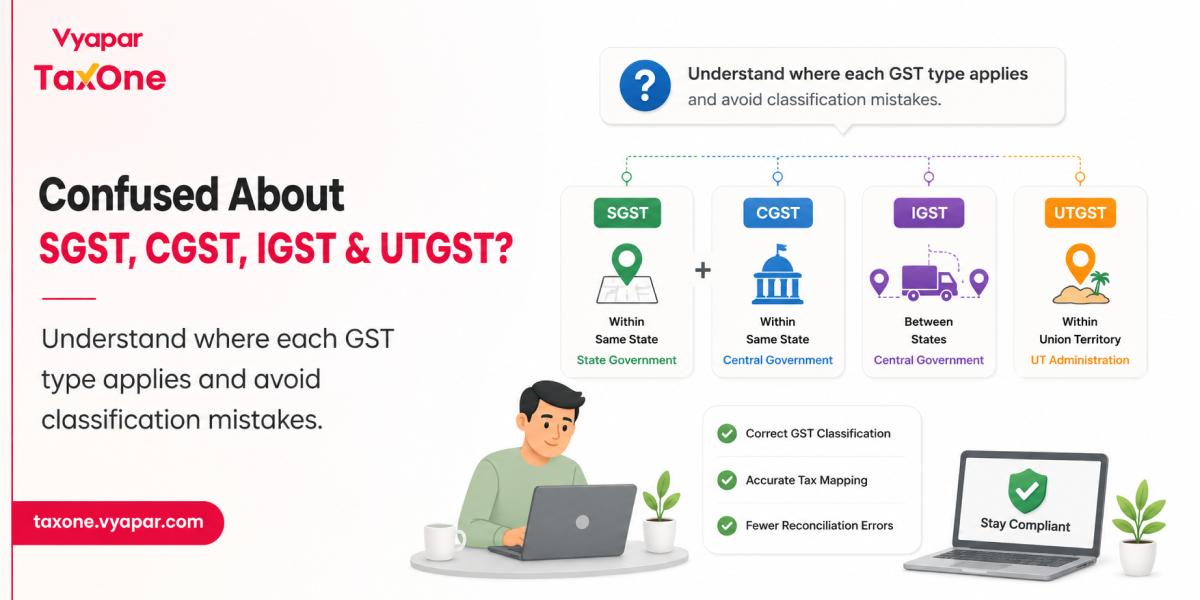
Under India’s GST framework, different tax categories apply depending on where a transaction happens, within the same state, across states, or within union territories.
Choosing the wrong tax category may seem like a small accounting mistake at first, but over time, it can create compliance delays, additional correction work, and problems during GST return filing cycles.
So before businesses focus on GST filing, they first need to understand where each GST type actually applies.
When businesses operate at a small scale, GST classification usually feels straightforward.
But once transaction volume increases, accounting teams start dealing with multiple operational scenarios at the same time.
This often includes:
At this stage, teams often begin classifying invoices manually while processing hundreds or thousands of transactions.
That is where small mistakes start creeping in.
A wrongly selected tax category during invoice entry may not create an immediate issue, but later, during reconciliation, businesses often discover tax mismatches that require manual correction.
In many businesses, recurring GST ledger management errors in software like Tally create additional correction work during month-end reviews.
In most cases, GST filing itself is not the real problem. The bigger issue usually begins much earlier during daily accounting operations.
Let’s start with the most common GST classification businesses deal with.
Whenever a transaction happens within the same state, GST gets divided into two parts:
Both taxes apply together during local or intra-state transactions.
For example, if a business based in Gujarat sells goods to another buyer within Gujarat, GST liability gets divided between SGST and CGST before accounting entries are posted.
This usually affects day-to-day processes like:
The problem starts when local transactions accidentally get classified under the wrong tax category, creating mismatches later.
Things work differently once a transaction happens across two different states.
In such cases, businesses no longer split tax between SGST and CGST.
Instead, the transaction gets classified under:
IGST (Integrated Goods and Services Tax)
For example, if a Gujarat-based business sells goods to a buyer in Maharashtra, the invoice should carry IGST.
At smaller transaction volumes, this seems simple.
But businesses processing thousands of invoices across multiple locations frequently run into classification errors.
Common cases where IGST usually applies include:
One incorrectly classified interstate invoice can later force finance teams to manually correct ledger entries during reconciliation.
Businesses operating inside union territories deal with another GST category called UTGST.
UTGST stands for:
Union Territory Goods and Services Tax
It applies when transactions happen within eligible union territories.
In these cases, the tax gets divided between:
UTGST commonly applies in places such as:
For businesses managing transactions across different tax jurisdictions, tracking these classifications manually often becomes difficult as invoice volume increases.
Even small mistakes usually become visible much later during compliance review.
If you want a quick overview, here is a simple comparison showing where each GST category applies.
| GST Type | When It Applies | Tax Authority | Common Use Case |
|---|---|---|---|
| SGST | Local transaction within the same state | State Government | Local sales invoices |
| CGST | Local transaction within the same state | Central Government | Domestic billing |
| IGST | Interstate transactions | Central Government | Cross-state transactions |
| UTGST | Transactions within union territories | Union Territory Administration | Territory-based billing |
Conceptually, GST categories are easy to understand.
The bigger challenge is applying them correctly while processing daily transactions.
Most compliance delays happen because classification mistakes remain unnoticed for weeks.
Some common issues businesses run into include:
Interestingly, most of these problems begin during invoice processing, not during GST filing itself.
One common problem in accounting workflows is timing.
Teams process invoices every day, but tax validation usually happens much later during reconciliation and GST filing review workflows.
So mistakes stay hidden until finance teams begin checking:
By that point, correction work starts piling up right before filing deadlines.
This is why businesses often feel GST filing is difficult.
In reality, the operational issue usually starts much earlier.
In many businesses, the process usually looks like this:
The filing issue happens at the end.
The mistake usually happens at the beginning.
Before return preparation begins, finance teams usually verify the following:
✓ Interstate transactions are classified correctly under IGST
✓ Local transactions are mapped correctly under SGST and CGST
✓ Union territory transactions carry correct UTGST classification
✓ Purchase invoices match tax ledger records
✓ Input tax credit records are validated properly
✓ Ledger entries are reviewed before reconciliation
✓ Duplicate invoices are checked before filing
✓ Unmatched invoice records are corrected early
Even small classification errors can create larger compliance delays later.
Manual GST classification works reasonably well when transaction volume is low.
But as businesses grow, accounting teams start processing larger invoice volumes across multiple states, tax jurisdictions, vendors, and GST registrations. At that point, managing GST classification manually becomes far more difficult.
Teams often start facing issues like:
The challenge is that small classification errors usually do not show up immediately.
Most problems only become visible later when reconciliation begins, and finance teams suddenly have to spend extra time correcting entries before filing deadlines.
This is why businesses often assume GST filing is becoming difficult.
In reality, the bigger issue usually lies in the manual accounting workflow itself.
As transaction volume increases, many businesses gradually move toward more structured accounting systems that reduce manual dependency, improve classification accuracy, and make reconciliation far easier to manage.
This is exactly the type of operational challenge solutions like Vyapar TaxOne are designed to solve once growing businesses start finding manual GST compliance increasingly difficult to manage consistently.
Because invoice processing happens daily, while tax validation usually happens later during reconciliation cycles.
Manual bookkeeping workflows increase the chance of classification mistakes when transaction volume grows.
Finance teams need to review invoices, correct ledger entries, and reclassify transactions before filing begins.
Usually, when businesses start handling larger transaction volumes across multiple tax jurisdictions.
Because higher transaction volume creates greater dependency on manual review and repeated validation cycles.

Get started today and simplify your accounting process!