 Is Now Vyapar TaxOne | Same Trust, New Name!
 AI Weapon for Financial Soldiers


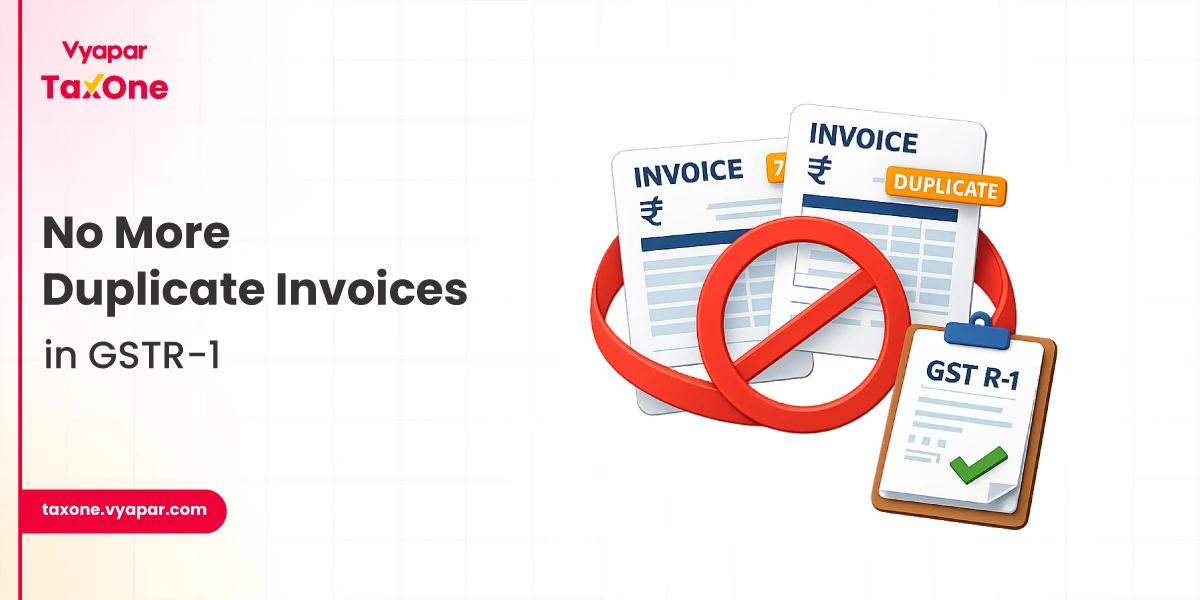
In the evolving GST compliance environment, duplicate invoices in GSTR-1 are among the most common causes of return discrepancies, portal rejections, and reconciliation challenges.
As businesses generate thousands of invoices monthly through ERPs, e-invoicing systems, and manual uploads, the risk of duplicate invoice numbers has increased significantly.
For tax professionals, CA firms, and GST practitioners, GSTR-1 duplicate detection is no longer just a review step; it is now a necessary compliance control. Even a small duplication error can:
To address these risks, professionals must adopt a structured bulk-duplicate-scanning method to detect and resolve duplicate invoices before filing.
This guide explains how to detect duplicate invoices in bulk in GSTR-1, the common causes of duplication, and practical steps to prevent portal errors in 2026.
A duplicate invoice in GSTR-1 is an invoice reported more than once in the return dataset. This duplication typically occurs due to workflow errors rather than intentional misreporting.
Common indicators of invoice number duplication include:
Even if the GST portal allows data editing before submission, duplication can still lead to portal rejection, mismatched reconciliations, or recipient disputes.
Several operational and technological changes have increased the risk of duplication.
1. Multi-Source Data Uploads
Businesses now generate invoices through multiple systems:
When these sources are not synchronized, duplicate records can appear.
2. Auto-Population From E-Invoicing
Invoices generated through the IRP automatically populate into GSTR-1. If teams manually re-upload the same invoices, it leads to duplicate invoice reporting.
3. Large-Volume Filing
High-volume businesses often process thousands of invoices per return period, making manual verification nearly impossible.
4. Re-Uploads of Corrected Files
When teams upload corrected Excel or JSON files without deleting previous data, duplicates remain in the portal.
5. Multiple Users Handling GST Compliance
Large organizations often have multiple staff members involved in return preparation, increasing the chances of duplicate invoice entries.
Understanding how duplication occurs helps tax professionals implement better controls.
Manual Upload + Auto-Populated Invoice An e-invoice-generated invoice automatically appears in GSTR-1. A staff member later uploads the same invoice through Excel or JSON.
Amendment Entered as New Invoice Instead of amending the original invoice, a revised invoice is entered as a fresh record.
Duplicate File Uploads Teams upload the same outward supply sheet multiple times while correcting errors.
Cancelled Invoices Included Cancelled invoices remain in internal reports and get uploaded during the final return compilation.
For high-volume businesses, manual verification is not feasible. Tax professionals must rely on bulk duplicate scans to quickly identify duplicates.
Below is a structured workflow for bulk duplicate detection.
Begin by creating a master dataset containing all outward supply data for the period. Include records from:
Combining all records into a single file enables effective analysis of duplicate invoice finders.
Before performing a duplicate scan, normalize the data. Ensure consistency in:
Remove formatting inconsistencies such as:
Standardized data improves the accuracy of bulk duplicate scans.
Create a unique identifier using key invoice fields.
A common formula used by tax professionals is:
GSTIN + Invoice Number + Invoice Date
Additional verification fields may include:
This combination helps identify potential duplicate invoice numbers.
Apply duplicate detection rules across the dataset.
Exact Match Detection
Identify records with identical:
These are the most obvious duplicates.
Near-Match Detection
Detect records where:
This helps detect hidden duplication.
Cross-Source Verification
Compare:
This ensures the same invoice was not reported from multiple systems.
Not every flagged entry is necessarily a true duplicate.
Verify whether the record is:
Tax professionals must review the context before deleting records.
Create a duplicate resolution sheet containing:
Maintaining such logs enhances audit readiness and prevents portal rejections.
Professional firms should implement standardized controls to prevent duplicate reporting. Recommended practices include:
Maker-Checker System
Every return should be reviewed by a second professional before submission.
Upload Version Control
Maintain clear naming conventions for working files.
Example: GSTR1_April2026_Final_v2.xlsx
IRP vs GSTR-1 Reconciliation
Compare IRP downloads with portal draft data before filing.
Amendment Tracking
Maintain a separate amendment log to avoid fresh invoice entries.
Centralized Data Source
Avoid multiple independent data exports.
These controls strengthen GST compliance and reconciliation accuracy.
Many duplicate issues arise from avoidable errors.
Tax professionals should avoid:
Effective GSTR-1 duplicate detection offers several advantages.
Prevents Portal Errors
Duplicate records may lead to submission errors or mismatches.
Protects the Recipient ITC
Incorrect invoices affect customer input tax credit claims.
Reduces GST Notices
Duplicate reporting may trigger departmental scrutiny.
Improves GST Reconciliation
Clean invoice data simplifies reconciliation between GSTR-1, GSTR-2B, and books.
Saves Compliance Time
Automated bulk duplicate scans reduce manual review effort.
For high-volume businesses, automation is becoming essential.
For tax professionals handling large datasets, manual Excel reviews can become inefficient. Tools like Vyapar TaxOne help streamline GST compliance processes.
Vyapar TaxOne offers an advanced GST reconciliation feature that simplifies compliance workflows.
Key capabilities include:
By integrating reconciliation and validation processes, the platform helps professionals identify duplicate invoices, mismatches, and reconciliation gaps before filing.
This improves GSTR-1 accuracy, prevents portal rejections, and enhances compliance efficiency.
As GST compliance becomes increasingly data-driven, GSTR-1 duplicate detection must evolve from manual review to systematic bulk analysis.
Tax professionals who implement structured bulk duplicate scan workflows, strong internal controls, and reconciliation technology will be better equipped to:
In 2026, the firms that adopt automation-assisted duplicate invoice detection will lead the next phase of GST compliance efficiency.
GSTR-1 duplicate detection is the process of identifying the same invoice reported more than once in outward supply data before filing the return.
It usually happens due to repeated file uploads, manual entry errors, auto-populated e-invoices being uploaded again, or amendments being entered as fresh invoices.
They can use a bulk duplicate scan to consolidate invoice data, standardize fields, and identify duplicate invoice numbers, dates, GSTINs, and tax values.
Yes, duplicate invoices can cause reconciliation mismatches, portal errors, recipient disputes, and increase the risk of GST notices.
Vyapar TaxOne helps by improving GST reconciliation, highlighting mismatches, and reducing the manual effort required to identify duplicate invoice risks.

Get started today and simplify your accounting process!