 Is Now Vyapar TaxOne | Same Trust, New Name!
 AI Weapon for Financial Soldiers


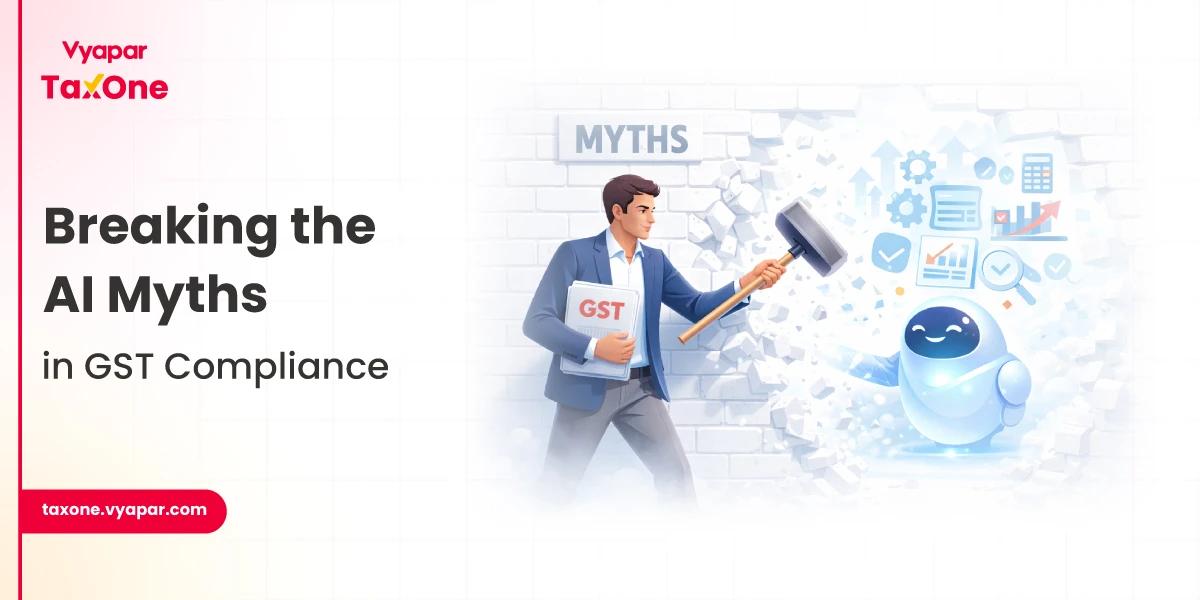
In the rapidly evolving world of GST compliance, Artificial Intelligence has gained significant attention.
With tax professionals exploring ways to integrate AI into their workflows, it is essential to separate fact from fiction.
Several myths surround the use of AI in GST filing, creating confusion and hesitation.
This blog aims to debunk these myths, clarify the realities of AI's role in tax filing, and offer actionable insights to help professionals make informed decisions.
Artificial Intelligence refers to the simulation of human intelligence processes by machines. In the context of GST filing, AI is primarily used to automate repetitive tasks, enhance data accuracy, and provide predictive insights.
Unlike traditional automation, which follows predefined rules, AI systems can learn from data patterns, making them adaptable to changes in GST laws, tax rates, and filing requirements.
AI's applications in GST filing include:
These functions streamline compliance processes, improve efficiency, and reduce human errors.
AI is gradually becoming an integral part of GST filing in India. While large firms have been early adopters, small and medium-sized tax practices are also recognising their benefits.
However, the regulatory environment, including compliance with the Goods and Services Tax Network (GSTN) and the Central Board of Direct Taxes (CBDT), ensures that AI tools used in GST filing adhere to stringent standards. Professionals must understand these regulations before adopting AI in their workflows.
One of the most common misconceptions is that AI will replace human tax professionals. In reality, AI is designed to augment the role of tax experts rather than replace them.
AI can automate routine tasks, freeing up professionals to focus on complex cases that require human judgment and expertise.
Actionable Advice: Tax professionals should view AI as an assistant, enabling them to focus on higher-value activities like advising clients on tax strategy, handling audits, and ensuring compliance with the latest regulations.
Another myth is that AI can autonomously file GST returns without human intervention. While AI can help automate data entry and validate information, human oversight is necessary to ensure the accuracy of returns, especially for complex transactions or adjustments.
AI tools are only as reliable as the data they are fed, and input errors can lead to costly mistakes.
Actionable Advice: Establish robust quality assurance (QA) processes and review mechanisms to cross-check AI-generated outputs before submitting returns. Tax professionals should ensure that AI tools align with the latest tax laws and requirements.
AI is a powerful tool, but it is not infallible. One myth is that AI can guarantee complete compliance accuracy. While AI can detect anomalies and flag discrepancies, it cannot fully replace the fine understanding of tax laws and regulations that professionals possess.
AI tools may also suffer from biases due to incorrect or incomplete training data.
Actionable Advice: Always validate AI suggestions with the latest legal provisions, particularly for complex transactions. Professionals should use AI as a tool to support decision-making rather than relying on it entirely.
Some tax professionals fear that adopting AI for GST filings could violate compliance regulations. In reality, AI tools can be compliant as long as they adhere to government standards on data privacy and security.
AI providers must ensure their tools align with GSTN guidelines to maintain data accuracy and transparency.
Actionable Advice: Tax professionals should carefully vet AI tools and vendors to ensure compliance with data security protocols and that each action is auditable. Professionals should also stay up to date on any regulatory changes related to AI tools for tax filing.
A common misconception is that AI is only viable for large tax firms with significant resources. In fact, several AI solutions are cost-effective and scalable, making them accessible to small and medium-sized practices.
Cloud-based platforms, for instance, offer flexible AI-driven tools that allow smaller firms to integrate AI into their workflows without high upfront costs.
Actionable Advice: Smaller firms should explore AI solutions that match their specific needs and budget. There are many affordable, scalable AI tools available that can streamline GST filing and improve accuracy without requiring significant investments.
Successfully adopting AI in GST filing requires a structured approach. Here's how tax professionals can implement AI responsibly:
To mitigate potential risks associated with AI adoption, consider the following:
To assess the effectiveness of AI tools in GST filing:
AI in GST compliance is evolving rapidly. Some of the emerging trends include:
As AI adoption grows, it is essential to stay up to date on regulatory changes. The Indian government is likely to introduce new guidelines for AI in tax practices. Tax professionals should remain agile and adapt their tools and processes to comply with any new standards.
AI is transforming GST filing by enhancing efficiency and accuracy while reducing manual errors. A great example of AI integration in tax compliance is Vyapar TaxOne, an AI-powered platform designed for tax professionals in India.
Vyapar TaxOne streamlines tasks such as data entry, document collection, and GST filing while ensuring compliance with the latest regulations.
Automating routine processes allows professionals to focus on more strategic, value-added activities, making it an essential tool for modern tax practices.
[Try Vyapar TaxOne for free for a week(https://taxone.vyapar.com/app/signup)!
Vyapar TaxOne is an AI-powered platform that streamlines GST tasks like data entry, invoice extraction, and filing, ensuring faster and more accurate compliance.
No, AI is designed to augment the role of tax professionals by automating routine tasks, enabling them to focus on more complex, strategic work.
Yes, Vyapar TaxOne is designed to align with Indian GST laws and ensures that the filing process meets all regulatory requirements.
Absolutely! Vyapar TaxOne is scalable and cost-effective, making it suitable for firms of all sizes, including small and medium-sized practices.
Yes, Vyapar TaxOne integrates seamlessly with popular accounting tools like Tally and Excel, simplifying GST compliance within your existing workflow.

Get started today and simplify your accounting process!