 Is Now Vyapar TaxOne | Same Trust, New Name!
 AI Weapon for Financial Soldiers


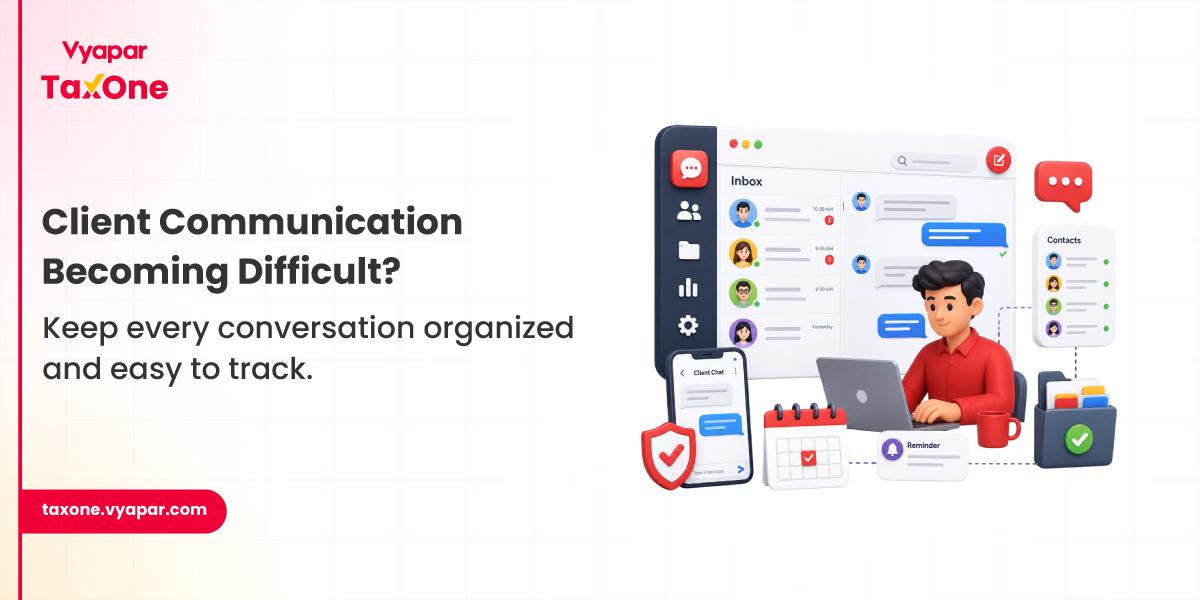
During GST filing weeks or month-end closing, communication issues in a CA firm rarely happen because clients refuse to respond. More often, they begin when updates, documents, and follow-ups are scattered across emails, WhatsApp conversations, and individual team members.
A purchase register arrives over email, a GST clarification comes through WhatsApp, and revised data reaches another team member separately. Over time, important updates get scattered across channels instead of remaining connected to the client engagement.
Individually, these situations may not seem serious. But when dozens or even hundreds of clients are active at the same time, they quickly turn into operational delays. Instead of focusing on reconciliation, return preparation, or audit work, teams spend valuable time searching for messages and confirming:
This is often the point where firms realise the challenge isn't the lack of communication tools, it's the lack of a structured communication workflow that keeps the entire team aligned.
Most firms don't experience communication issues when handling a handful of clients. The challenges become visible as client volume increases, deadlines overlap, and multiple team members begin working on the same engagement.
We often see this during monthly GST filing cycles. One person collects documents, another prepares working papers, someone else reviews reconciliations, and the partner communicates final observations. If every conversation happens on different platforms, keeping everyone aligned becomes increasingly difficult.
Some common situations include:
Clients communicate in whichever way is most convenient for them.
Some prefer email. Others send documents through WhatsApp. Certain businesses continue using shared drives, while others call directly whenever they have questions.
Over time, a single client's communication history gets distributed across multiple platforms. Unless someone manually checks every source, important information can easily be missed.
This becomes even more challenging when another team member needs to take over the engagement. Instead of continuing the work immediately, they first have to understand previous discussions and locate supporting documents.
Following up with clients is part of every compliance cycle.
The challenge is that reminders are often managed manually.
Teams maintain Excel trackers, personal notes, or separate reminder lists to keep track of pending documents. As deadlines approach, accountants spend hours sending similar messages to different clients.
The effort isn't just repetitive, it also creates inconsistency. Some clients receive multiple reminders, while others are missed altogether because there isn't a central system tracking pending requests.
We've often seen firms realise the scale of this problem only after their client base grows beyond what individual team members can comfortably manage.
As more people become involved in client work, keeping everyone on the same page becomes increasingly difficult.
One team member requests documents, another begins reconciliation, while a senior reviews the working papers. If updates remain scattered across emails, WhatsApp chats, or personal notes, no one has a complete picture of the engagement.
This becomes even more challenging when clients share revised files. An updated purchase register may arrive after reconciliation has started, but unless everyone is working from the same communication history, different team members may unknowingly continue working with an earlier version of the data.
Instead of moving work forward, teams spend time answering questions like:
These delays become most visible during review, when missing communication or outdated documents slow down the final stages of compliance work.
We've often seen these issues become visible only during partner review or the final reconciliation stage, when teams realise different people have been working with different versions of the same information.
As client volumes grow, communication becomes harder to manage through individual inboxes, WhatsApp chats, and manual trackers. Practice Management Software helps bring these activities into a structured workflow by:
Rather than changing how clients communicate, it helps firms manage those interactions more consistently, especially during busy GST filing and month-end compliance cycles.
We've often seen this during GST filing cycles in firms managing 100+ GST clients. As the return due date approaches, documents begin arriving from almost every client within a few days. Some clients submit complete data, while others share purchase registers, sales reports, and clarifications in multiple stages through emails and WhatsApp.
By mid-week, the team may have already sent over 150 follow-up reminders while coordinating communication across multiple engagements. Without a structured communication workflow, accountants spend several hours each day checking emails,
WhatsApp conversations, and Excel trackers just to answer questions like:
Instead of focusing on reconciliation and return preparation, a significant part of the team's time goes into tracking conversations and following up with clients. As filing deadlines get closer, managing client communication often becomes just as time-consuming as completing the compliance work itself.
While every CA firm has its own way of working, structured communication workflows usually follow a similar pattern:
Document requests are shared with clients.
Conversations and files remain linked to the client engagement.
Team members can view pending requests and previous discussions.
Managers track progress without asking for individual updates.
Complete communication history is available during review.
The objective isn't to change how clients communicate. It's to ensure everyone involved has access to the same information throughout the engagement.
Client communication is only one part of practice operations. As firms expand, they also need better control over tasks, documents, deadlines, and team coordination, which is where structured CA firm operations become important.
Before every compliance cycle, ask:
Small improvements in these areas often have a much larger operational impact than firms initially expect, especially as the number of active clients and compliance engagements continues to grow.
Most CA firms don't decide to adopt a Practice Management Software because communication suddenly becomes difficult. It usually happens as client volumes increase, compliance deadlines overlap, and multiple team members begin handling the same engagement.
Over time, firms realise that the challenge isn't just responding to clients, it's keeping every conversation, follow-up, document request, and update visible across the team. That's why many CA firms gradually move towards connected communication workflows instead of relying on individual inboxes and chat histories.
This is the kind of operational challenge that structured workflow platforms like Vyapar TaxOne are designed to address.
Before selecting a platform, firms should evaluate how different solutions handle practice management workflows based on their current processes.
Rather than introducing another communication channel, Vyapar TaxOne Chat helps bring client interactions into a more structured workflow.
Some of the ways it supports accounting teams include:
As communication volumes grow, structured workflows like these help teams spend less time coordinating conversations and more time completing compliance work. For firms looking to bring greater structure to client communication, Vyapar TaxOne fits naturally into that workflow.
WhatsApp works well for day-to-day conversations. The challenge begins when multiple team members need visibility into those conversations. As the number of clients grows, relying only on individual chats makes it difficult to track document requests, follow-ups, and previous discussions.
The first step is making follow-ups visible across the team instead of maintaining separate reminder lists. Once everyone knows which requests are pending, duplicate reminders and missed follow-ups become much less common.
In many firms, it's not the accounting work itself. Delays often happen because documents arrive in stages, client responses are spread across different channels, and teams spend time confirming whether the latest information has actually been received.
This becomes much easier when conversations, documents, and task updates are available as part of the client engagement rather than remaining in one person's inbox or WhatsApp history.
When conversations, follow-ups, and document requests remain connected to each client engagement, partners can quickly review the communication status without depending on individual team members for updates.
From what we've observed, it's maintaining consistency.
As more people become involved in client work, keeping everyone updated without a structured communication process becomes increasingly difficult.


Get started today and simplify your accounting process!