 Is Now Vyapar TaxOne | Same Trust, New Name!
 AI Weapon for Financial Soldiers


Anyone who has handled GST reconciliation knows that the real problem is rarely one big error. Most of the time, it is a series of small issues: one invoice missing in GSTR-2B, one supplier filing late, one GSTIN entered incorrectly, one tax amount not matching, or one ITC entry needing another review.
These small issues take time. They create extra work for accountants, follow-ups with vendors, and uncertainty for business owners before filing returns. For CA firms and tax professionals, the pressure increases further when multiple clients need reconciliations simultaneously.
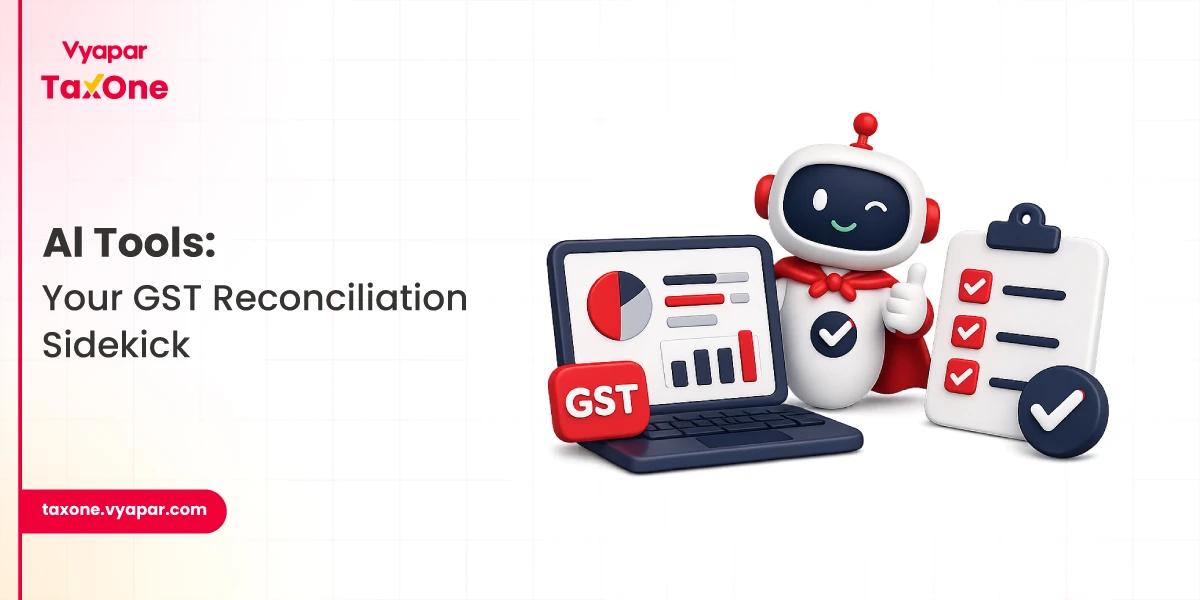
This is where a GST AI tool can make the process more manageable. The goal is not to replace tax expertise, but to reduce repetitive checking, identify mismatches faster, and make GST reconciliation easier to review.
At Vyapar TaxOne, we understand GST reconciliation from the user’s side, not just the software side. Businesses need clarity. Accountants need speed. CA firms need accuracy and organized reports.
This guide explains how AI tools for GST reconciliation work, what features actually matter, and how to choose the right tool for your business.
The best GST AI tool is the one that can match your purchase register with GSTR-2A/2B data, detect invoice-level mismatches, track eligible ITC, support vendor follow-ups, and generate clear reconciliation reports.
For small businesses, ease of use and integration with accounting software matter most. For CA firms and enterprises, bulk reconciliation, multi-GSTIN support, audit trails, and role-based access become more important.
A good GST AI tool should help with:
| Requirement | Why it matters |
|---|---|
| GSTR-2A/2B reconciliation | Helps compare supplier-reported data with books |
| ITC tracking | Reduces missed or wrongly claimed input tax credit |
| Invoice mismatch detection | Finds GSTIN, invoice number, date, value, and tax differences |
| Vendor follow-ups | Helps resolve missing or incorrect supplier filings |
| IMS readiness | Supports invoice actions such as accept, reject, or pending |
| Reports and audit trail | Useful for review, compliance, and internal control |
GST reconciliation involves matching the purchase register or books of account with supplier-reported data in GSTR-2A and GSTR-2B. Since GSTR-2B gives a period-based ITC view and GSTR-2A keeps updating with supplier filings, it is important to understand GSTR-2A vs GSTR-2B before choosing a GST AI tool for reconciliation.
But the importance doesn’t end there. Incorrect reconciliation can lead to hefty penalties or even delayed refunds. And let’s not forget the human errors lurking in manual processes.
With the Invoice Management System, businesses also need to review supplier invoices and take appropriate actions, such as accepting, rejecting, or keeping pending, based on the invoice status and ITC eligibility.
Common GST reconciliation checks include:
A GST AI tool does not replace tax judgment, but it can reduce repetitive manual work in reconciliation. Instead of checking hundreds or thousands of invoices line by line, AI-based reconciliation tools can compare books with GST portal data, identify probable matches, flag mismatches, and highlight records that need human review.
For instance, an AI tool can instantly identify mismatches between GSTR-2A and your purchase register. It can also flag errors in supplier filings, saving you from unpleasant surprises during compliance checks.
Beyond that, AI’s ability to process large volumes of data quickly ensures even the most complex reconciliations are handled efficiently.
What sets AI apart is its ability to learn and improve over time. With every transaction analyzed, these tools become smarter, making your GST reconciliation process not just faster but also increasingly reliable.
These tools can help detect:
When choosing an AI tool for GST reconciliation, certain features can make all the difference.
First, ensure the tool is compatible with your accounting software. Seamless integration can save hours of manual data entry. Real-time data processing and error detection are also essential. These features ensure discrepancies are caught before they snowball into bigger issues.
Look for cloud-based tools that offer the convenience of accessing data anytime, anywhere, with top-notch security measures.
And let’s not overlook advanced analytics, tools that not only identify mismatches but also provide actionable insights to improve compliance processes.
Along with reconciliation reports, the tool should help businesses review ledger-level issues before filing. This is why understanding how to clean up ledgers before GST filing is important for accurate GST compliance.
Before choosing any AI tool for GST reconciliation, check whether it supports the following:
| Feature | Must-have or good-to-have | Why it matters |
|---|---|---|
| GSTR-2A/2B import | Must-have | Required for ITC reconciliation |
| Purchase register matching | Must-have | Helps compare books with GST data |
| Fuzzy matching | Must-have | Useful when invoice numbers or dates differ slightly |
| Vendor-wise mismatch report | Must-have | Helps follow up with suppliers |
| IMS action support | Must-have in 2026 | Useful for accept, reject, and pending invoice workflows |
| Multi-GSTIN support | Must-have for CA firms | Helps manage multiple clients or branches |
| Tally/Excel/accounting software import | Must-have | Reduces manual data entry |
| Role-based access | Good-to-have | Improves team control and data security |
| Audit trail | Good-to-have | Helps during review and compliance checks |
| Exportable reports | Must-have | Useful for client sharing and internal review |
Best AI Tools for GST Reconciliation: Quick Comparison
The tools below are compared based on GST reconciliation relevance, ease of use, automation capability, accounting integration, reporting, and suitability for Indian businesses or tax professionals.
| Tool | Best for | Key GST reconciliation use case | Suitable users |
|---|---|---|---|
| Vyapar TaxOne | Indian businesses and tax professionals | GST reconciliation, mismatch detection, reports, automation | SMEs, accountants, CA firms |
| ClearGST | Larger businesses and enterprises | GST return filing, reconciliation, ITC tracking, ERP data handling | Enterprises, finance teams |
| Avalara | Businesses with complex tax operations | Tax automation and compliance workflows | Multi-location or global businesses |
| Zoho GST | Small businesses using Zoho ecosystem | GST filing, accounting, basic reconciliation support | Small businesses and Zoho users |
Now that you know what to look for, let’s talk about the best AI tools for GST reconciliation in 2026.
Vyapar TaxOne is designed for Indian businesses, accountants, and tax professionals who want to simplify GST reconciliation and reduce manual matching work. It helps automate GST data matching, identify mismatches, and generate reconciliation reports that are easier to review before filing.
It is useful for teams that regularly handle purchase register matching, supplier-side differences, ITC reviews, and GST compliance follow-ups. For businesses still using spreadsheets for reconciliation, Vyapar TaxOne can reduce repetitive work and structure the reconciliation process.
Best for: Businesses, accountants, and CA firms looking for an India-focused GST AI tool.
Useful for: GST reconciliation, mismatch tracking, ITC review, and report generation.
Why consider it: It focuses directly on GST automation and reconciliation workflows instead of being a general accounting tool.
Watch this video to see how to use Vyapar TaxOne’s GST Reconciliation:
A go-to tool for many businesses, ClearGST simplified reconciliation with real-time data updates and advanced error detection. Its intuitive dashboard makes it easy for professionals to manage large volumes of data.
Avalara is a robust solution known for its precision and scalability. Ideal for businesses handling complex tax structures, this tool integrates effortlessly with existing systems.
This tool is popular for its affordability and comprehensive features, making it a favorite among small businesses. From data import to ITC tracking, Zoho GST covers all the bases.
Each tool has its strengths, and the choice ultimately depends on your business’s unique needs.
GST reconciliation is no longer limited to comparing books with GSTR-2A or GSTR-2B. With the Invoice Management System, taxpayers also need to review supplier-uploaded invoices and take action where required. This makes invoice-level tracking more important.
A modern GST AI tool should help users manage:
Selecting the right AI tool doesn’t have to be overwhelming. Start by evaluating your business needs.
Are you dealing with high transaction volumes? Do you need to integrate certain accounting software programs? These considerations will help narrow down your options.
Cost is another factor. While some tools offer premium features at higher prices, others cater to smaller budgets without compromising on quality.
Always look for customer reviews and ensure the tool provides reliable support and regular updates. After all, the effectiveness of any AI tool is only as good as the team behind it.
Looking ahead, AI tools are set to become even more sophisticated. Expect features like predictive compliance, where AI anticipates discrepancies before they occur. Blockchain integration might further improve transparency and security in GST reconciliation.
With such advancements, the future of tax compliance looks promising, and businesses that adopt these tools early will undoubtedly have a competitive edge.
In 2026, the question isn’t whether you should use AI tools for GST reconciliation; it’s which one you should choose. From saving time to ensuring accuracy, these tools are invaluable for businesses and tax professionals alike.
If you’re still relying on manual processes, now’s the time to explore the AI options available. Your GST compliance doesn’t have to be a source of stress. With the right tool, it can become one of the easiest parts of your financial operations.
You can start with a 7-day free trial of Vyapar TaxOne for sure!
A GST AI tool is software that uses automation and intelligent matching to help businesses compare GST portal data with their books of accounts. It can help identify invoice mismatches, missing supplier entries, duplicate invoices, ITC gaps, and reconciliation differences.
The best AI tool for GST reconciliation depends on your business size, invoice volume, accounting software, GSTIN count, and reporting needs. Small businesses may need simple automation, while CA firms and larger companies may need bulk reconciliation, vendor reports, IMS tracking, and multi-client support.
Yes. AI tools for GST reconciliation can help compare purchase register data with GSTR-2A and GSTR-2B records, detect mismatches, and prepare reports for review before ITC claims and return filings.
Yes. CA firms can use GST AI tools to handle multiple clients, reduce manual invoice matching, track vendor-wise mismatches, and prepare reconciliation reports more efficiently.
No. AI can automate repetitive matching and highlight errors, but final review should still be done by a business owner, accountant, or tax professional.

Get started today and simplify your accounting process!