 Is Now Vyapar TaxOne | Same Trust, New Name!
 AI Weapon for Financial Soldiers


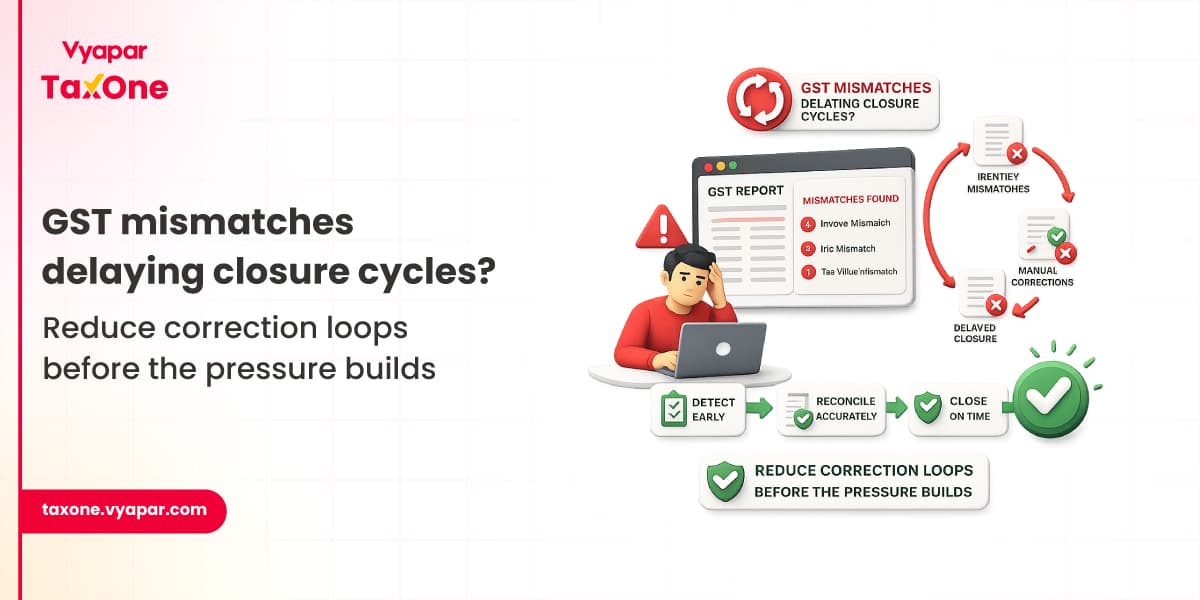
In most CA firms, GST reconciliation is no longer a single activity that starts and ends in a defined window.
It quietly builds up across the month through routine accounting work, invoice entry, vendor updates, GST portal syncing, and internal approvals.
By the time reconciliation actually begins, the mismatch is not a discovery.
There is already accumulated data that was never aligned in the first place.
So even in 2026, the issue is not GST complexity.
It is the lack of alignment between books, GST portal data, and invoice-level updates across different stages of accounting work, a pattern that often shows up in common accounting workflow issues when processes are not standardized across teams.
Most reconciliation issues don’t start during review.
They start much earlier in execution.
In CA environments, this usually looks like:
Once this happens repeatedly, reconciliation stops being a matching exercise and turns into a correction cycle, similar to what firms experience during GSTR-1 reconciliation process challenges in peak filing periods.
At this stage, reconciliation is no longer about identifying errors, it becomes about managing the delay between systems.
Tool selection in CA firms is rarely feature-driven.
It is based on where reconciliation is breaking operationally.
The evaluation usually sounds like:
The decision is usually made after repeated failure of manual tracking, not before it.
In most CA workflows, GST reconciliation tools sit in three layers:
Most firms don’t adopt Vyapar TaxOne as a first step.
It enters the workflow when Excel-based reconciliation starts showing structural limits.
This usually happens when:
At that stage, the requirement is not “automation”.
It is structured reconciliation tracking across clients.
That is where tools like Vyapar TaxOne typically get introduced into the workflow.
ClearTax is typically used in CA workflows where reconciliation is not separate from return filing.
It fits into environments where:
It works best when reconciliation is part of compliance execution, not a standalone layer.
Tally continues to act as the core accounting system in most CA setups.
In reconciliation workflows: Ledger-level entries originate from Tally
It is where reconciliation data originates.
Zoho Books is typically seen in environments where accounting is already digitized end-to-end.
Common usage patterns:
It works best where manual accounting intervention is already minimal.
Genie GST is generally used in high-volume reconciliation environments.
Where:
In real practice, firms don’t choose one tool and stick to it.
They map tools to workflow breakdown points:
Most firms end up using a combination based on client segmentation rather than a single system.
This is because GST reconciliation in practice is not a single-system problem. It is a workflow distributed across accounting, validation, and compliance teams.
When these tools are introduced into CA workflows, the change is operational, not structural.
The most visible impact is not on daily efficiency.
It is reduced pressure during month-end closure.
The decision usually depends on:
Adoption typically happens after operational pressure, not planning cycles.
In most CA firms, GST reconciliation software in 2026 is not treated as a replacement for accounting systems. It functions as a control layer between three moving parts, bookkeeping entries, GST portal data, and compliance validation cycles.
Accounting continues in systems like Tally or ERP platforms. GST returns still follow regulatory workflows. The reconciliation gap exists between these systems, not within them.
Most firms only shift toward structured tools after repeated filing cycles where Excel-based tracking starts breaking under volume or multi-client complexity.
At that point, tools like Vyapar TaxOne are introduced not to change accounting processes, but to bring visibility and structure to reconciliation tracking across GSTINs and clients.
The real improvement is not automation of accounting, but the reduction of correction loops between mismatched systems during peak filing pressure.
In most cases, mismatches don’t start at the reconciliation stage. They start much earlier, when invoices are entered at different times in books, vendor updates come late, or GSTIN tagging isn’t consistently followed. By the time reconciliation begins, those small gaps start showing up as larger mismatches.
Because the software is only working on available data. If entries are delayed, invoices are missing, or GST portal updates happen at a different time than books, mismatches will still exist. The software helps surface them faster, but it cannot fix timing gaps in the underlying data flow.
Excel usually stops being practical when reconciliation starts involving multiple clients, high invoice volumes, and repeated corrections across files. The issue is not calculation, it’s tracking. Once teams start losing visibility on what is matched, pending, or corrected, Excel becomes more of a burden than a tool.
Most firms struggle when reconciliation data is scattered across sheets or handled client-by-client manually. In practice, teams try to separate client workflows, but without a structured system, overlaps and mismatches are common during peak cycles.
This usually happens when mismatches are discovered late, often during ITC validation or final review stages. Once corrections start at that point, teams end up rerunning matching cycles, which pushes reconciliation closer to filing deadlines.
The biggest change is not speed, it’s visibility. Teams can see mismatches earlier in the cycle, track corrections more clearly, and reduce repeated back-and-forth during month-end closure. The actual accounting work stays the same, but coordination becomes less chaotic.
It typically happens after repeated filing cycles, where Excel starts slowing down reconciliation work, especially when invoice volume increases or the client base expands. The trigger is usually operational pressure, not planned migration.

Get started today and simplify your accounting process!