 Is Now Vyapar TaxOne | Same Trust, New Name!
 AI Weapon for Financial Soldiers


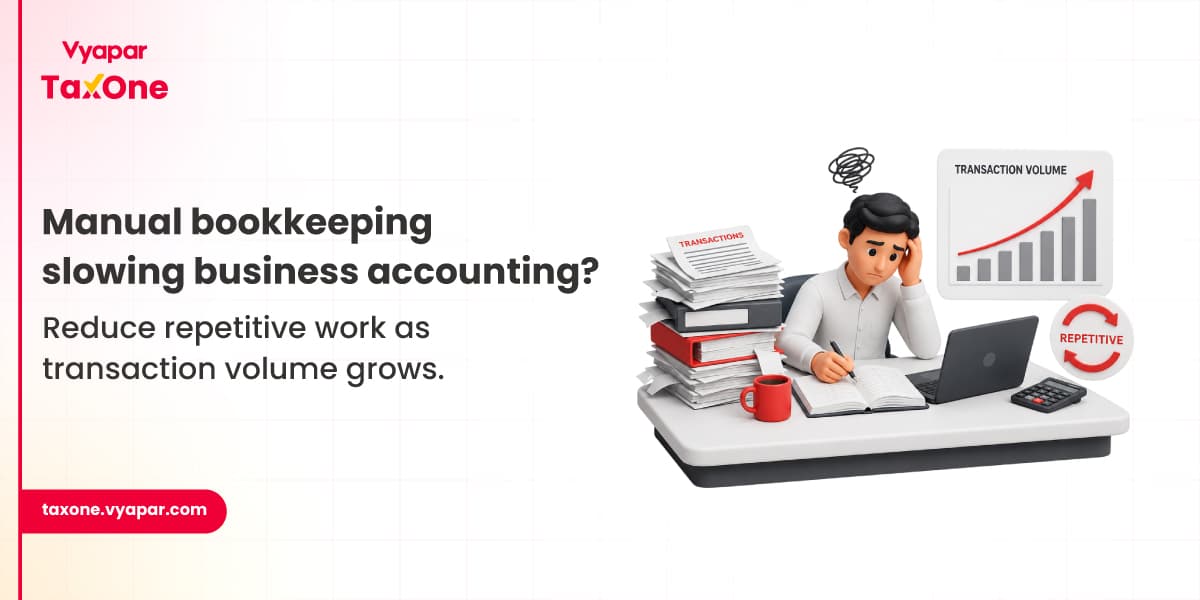
For many small businesses, bookkeeping usually starts as a manageable part of day-to-day operations.
When there are only a limited number of invoices, vendor payments, bank entries, and expenses to track, handling bookkeeping manually often works well in the early stages.
The challenge usually begins when transaction volume starts increasing.
As businesses grow, finance teams often spend more time entering transactions manually, verifying payment records, matching invoices, and fixing bookkeeping errors that can start delaying reporting timelines.
This shift is one of the main reasons automated bookkeeping is becoming increasingly common across small business accounting operations, as more businesses begin understanding the bookkeeping automation benefits that come with reducing repetitive manual work.
The move is not about replacing accounting work. It is about reducing repetitive execution work that becomes harder to manage manually over time.
In day-to-day accounting operations, automated bookkeeping simply means reducing manual dependency across repetitive bookkeeping activities.
Instead of processing every transaction entry individually, businesses begin using structured systems that support accounting workflows such as:
The purpose is not changing accounting itself.
The goal is to reduce repetitive bookkeeping effort as operational volume increases.
Small businesses often continue relying on manual bookkeeping longer than what is practically sustainable.
As business activity increases, businesses begin running into several common accounting problems small businesses face, and bookkeeping inefficiencies often become one of the earliest operational bottlenecks.
Common reasons include:
At lower transaction volume, these issues usually remain manageable.
But as daily financial activity grows, manual bookkeeping starts consuming a much larger share of accounting time.
Businesses that begin reducing manual bookkeeping dependency often notice improvements across several accounting activities.
Teams spend less time manually entering recurring financial data every day.
Reducing repetitive manual entry helps minimize common errors such as duplicate entries or incorrect categorization.
Businesses can review transaction records, expense tracking, and payment data much faster when bookkeeping workflows become more structured.
As invoice count and payment activity increase, bookkeeping processes become easier to manage consistently.
Although bookkeeping automation offers clear operational advantages, businesses often face challenges while adopting new accounting workflows.
Many businesses continue relying on spreadsheets and manual bookkeeping habits built over several years.
Shifting away from manual bookkeeping often requires process changes and internal workflow adjustments.
Small businesses sometimes work across older accounting software, billing systems, or disconnected financial records that can make workflow transition slower.
The challenge is usually not adoption itself.
It is changing long-established accounting habits.
As bookkeeping processes become less manual, daily accounting operations start becoming much easier to manage.
Businesses usually notice improvements in areas such as:
Repetitive entry work reduces significantly.
Payment records become easier to review and monitor consistently.
Matching financial records becomes faster compared to fully manual workflows.
Teams spend less time correcting bookkeeping errors before generating reports.
Businesses gain better visibility into payment cycles and outgoing expenses.
In the early stages of business growth, manual bookkeeping often feels manageable because the volume of transactions is relatively low.
But as operations start expanding, bookkeeping gradually becomes more time-consuming and harder to manage consistently.
This is usually when businesses begin noticing operational pressure building inside their accounting processes.
Here are some of the most common situations where that pressure starts becoming visible.
As a business grows, the number of invoices being created, processed, and recorded naturally begins increasing.
What used to take a small amount of time every day can quickly turn into a repetitive process that requires constant manual checking. Finance teams often spend extra time reviewing entries, verifying invoice details, and correcting small errors before reports are finalized.
As invoice volume continues growing, even minor bookkeeping mistakes can start affecting reporting accuracy and overall efficiency.
Many growing businesses no longer rely on a single payment source. Customer payments may come through UPI, bank transfers, cards, payment gateways, or other digital channels.
When these payment records are updated manually across separate systems, reconciliation often becomes slower and more difficult to manage.
Teams may need to repeatedly cross-check payment records, identify mismatches, and spend additional time ensuring all transactions are properly recorded before closing accounts.
When Teams Spend More Time Updating Records Than Reviewing Finances
One of the biggest signs of bookkeeping pressure is when accounting teams begin spending most of their time entering and updating records instead of reviewing financial performance.
As repetitive tasks start consuming more working hours, businesses often realize that manual bookkeeping is no longer supporting growth as efficiently as it once did.
Businesses typically begin by gradually reducing manual work across repetitive accounting activities, often by introducing accounting process automation into the parts of finance operations that consume the most time daily.
Common starting points include:
Reducing time spent entering recurring transaction records.
Making payment updates easier to monitor consistently.
Limiting repetitive transaction matching work during reporting cycles.
Creating more structured bookkeeping workflows as operations grow.
Automation usually begins with repetitive work reduction rather than making full accounting process changes immediately.
Before scaling, businesses should ask:
If the answer to multiple questions is yes, bookkeeping workflows may already be under operational pressure.
Manual bookkeeping often works well during the early stages of business operations when transaction volume remains manageable.
But as businesses begin processing more invoices, handling higher payment activity, and managing larger volumes of financial records, repetitive bookkeeping work starts consuming significantly more accounting time.
What initially feels manageable gradually becomes harder to sustain.
Finance teams begin spending extra time entering transactions manually, reviewing duplicate records, correcting bookkeeping mistakes, and spending more effort on reconciliation before reporting cycles are completed.
This is often the stage where businesses begin realizing that manual bookkeeping processes are no longer scaling efficiently alongside business growth.
The challenge usually is not accounting knowledge or team capability.
It is the growing operational burden created by repetitive manual execution across everyday bookkeeping activities.
As businesses begin facing these operational challenges, many gradually shift toward more structured bookkeeping workflows that help improve reporting consistency, transaction accuracy, and overall accounting efficiency.
This is where structured systems like Vyapar TaxOne often become relevant as businesses begin reducing dependency on manual bookkeeping for routine accounting processes.
The shift is rarely about replacing accounting teams.
It usually begins when manual bookkeeping stops scaling with business growth.
This usually happens when transaction volume starts increasing consistently and finance teams begin spending more time on repetitive tasks like invoice entry, payment tracking, and reconciliation review.
Invoice processing, expense categorization, bank reconciliation, recurring payment tracking, and transaction verification are often the first areas where manual bookkeeping starts creating delays.
As transaction volume grows, accounting teams handle larger amounts of repetitive data entry, increasing the chances of duplicate entries, incorrect categorization, missed transactions, and delayed reconciliation checks.
The most common challenges include adjusting long-standing manual processes, training teams on new workflows, and managing accounting data spread across multiple systems like spreadsheets, billing tools, and accounting software.
It helps reduce repetitive manual work, improves record accuracy, shortens reconciliation time, and allows finance teams to spend less time correcting bookkeeping errors during reporting cycles.
Yes. In most cases, businesses start by reducing manual dependency in repetitive tasks such as invoice entry, payment tracking, and reconciliation workflows before making larger process changes.
As business activity increases, manual bookkeeping becomes harder to scale efficiently. Higher transaction volume creates more operational pressure, pushing businesses toward structured systems that make accounting workflows easier to manage consistently.



Get started today and simplify your accounting process!