 Is Now Vyapar TaxOne | Same Trust, New Name!
 AI Weapon for Financial Soldiers



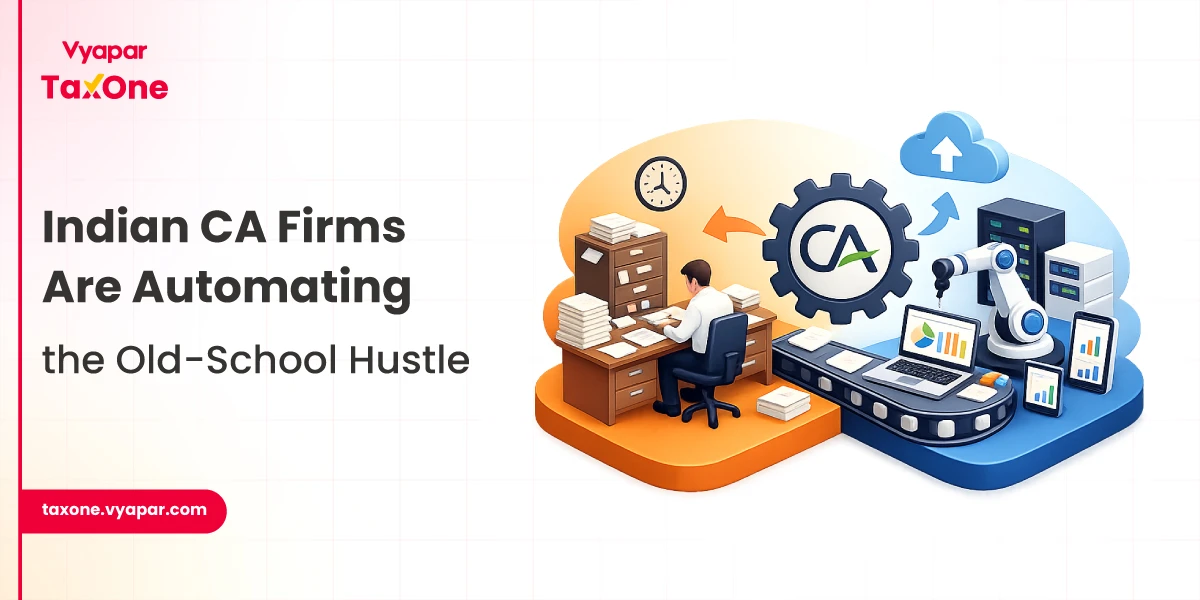
The role of a Chartered Accountant in India is no longer the same, and that's exciting. With increasing regulatory complexity, frequent tax law updates, and heightened client expectations, the compliance-driven model is no longer sufficient.
Automation now enables CAs to reduce time spent on repetitive manual tasks, such as data entry, reconciliation, and filing, and instead focus on high-value advisory services, such as tax planning, business strategy, and financial forecasting.
This shift isn't merely a trend; it's a strategic transformation.
By adopting intelligent automation tools, tax professionals can provide proactive insights, ensure greater compliance accuracy, and strengthen client trust, all while efficiently scaling their practices.
In the financial environment, clients expect their CAs to go beyond compliance checklists. Advisory roles, helping businesses optimize cash flows, manage tax exposure, and anticipate risks, offer significantly greater value.
Key benefits include:
Despite clear benefits, many Indian accounting firms struggle to pivot from compliance to advisory due to:
These challenges, however, can be systematically addressed through structured automation.
Automation enables CAs to integrate data from GST, TDS, income tax portals, ERP systems, and accounting software into a unified dashboard. Using APIs and automated data pipelines ensures accuracy, consistency, and real-time visibility.
This eliminates redundant entry work, minimizes reconciliation errors, and speeds up reporting cycles, helping CAs focus on analysis rather than administration.
Automated tax computation systems can efficiently manage GST returns, TDS processing, and income tax filings. Rule engines ensure that every update from the CBDT or GSTN is reflected without manual intervention.
Automated task reminders and audit logs improve compliance accuracy, while e-filing integrations save substantial preparation time.
A smart Document Management System (DMS) powered by Optical Character Recognition (OCR) extracts key data from invoices, bank statements, and other documents. This ensures compliance-ready storage, encrypted sharing, and effortless retrieval during audits or assessments.
Automation standardizes engagement processes from client onboarding to billing, through digital workflows that assign tasks, track milestones, and measure billable utilization. CAs gain transparency into the firm's performance while ensuring smooth collaboration.
Automated dashboards powered by analytics tools help visualize effective tax rates, cash flow impacts, and potential optimization areas. Real-time insights empower CAs to provide proactive advice rather than reactive compliance support.
Proactive Tax Planning By leveraging real-time financial data, CAs can simulate tax-saving scenarios, model investment timing, and help clients plan financial decisions that align with evolving regulations.
Risk Management and Compliance Assurance Automated systems continuously scan for anomalies, missing data, or regulatory mismatches, flagging risks early. This proactive monitoring improves governance and builds client confidence.
Business Advisory and Profitability Analysis Automation enables advanced profitability analysis and cost optimization. CAs can deliver insights into working capital management, pricing, and liquidity planning that drive business growth.
1. Assess Firm Readiness
Perform a process audit to identify bottlenecks and repetitive tasks suitable for automation.
2. Select the Right Technology Stack
Choose software integrated with India's tax systems (GST, TDS, Income Tax). Prioritize solutions offering:
3. Manage Organizational Change
Adopt a phased rollout plan. Train staff to interpret automated insights and maintain advisory quality. Establish accountability for data accuracy and client privacy.
4. Maintain Data Security and Compliance
Implement strong access controls, encryption, and data localization in accordance with Indian IT standards. Transparency and trust are essential for successful automation adoption.
These features not only save time but also improve the perceived value of advisory services.
Track metrics that demonstrate automation's impact:
Use these insights to refine strategies and continuously enhance advisory outcomes.
Automation adoption must be guided by sound governance:
Vyapar TaxOne(Formerly Suvit) is designed specifically for Indian tax professionals who want to transition from manual compliance to intelligent advisory. It automates GST return filing, TDS processing, and other computations, reducing repetitive effort while safeguarding accuracy.
With seamless integration to Vyapar's accounting ecosystem, TaxOne helps CAs:
By minimizing compliance workload, Vyapar TaxOne enables firms to focus on what truly matters: strategic growth, client relationships, and proactive financial guidance.
In essence, automation is not replacing CAs; it's amplifying their expertise. By combining professional judgment with intelligent tools like Vyapar TaxOne, Chartered Accountants in India can redefine their practice, shifting from compliance-focused operations to impactful advisory excellence.
Automation streamlines manual tasks like data entry, reconciliation, and filing, allowing CAs to focus more on high-value advisory services such as tax planning, financial optimization, and business growth strategy.
It improves accuracy, saves time, ensures faster compliance, enhances client satisfaction, and opens new opportunities for strategic advisory-based revenue.
Yes. Even small firms can benefit from affordable cloud-based automation tools that simplify compliance, centralize data, and enable smarter decision-making.
By choosing trusted software that provides encryption, access controls, and compliance with Indian data localization and privacy regulations.
Vyapar TaxOne automates accounting, GST and office workflows, reducing manual effort and freeing CAs to deliver proactive and strategic advisory services.


Get started today and simplify your accounting process!